The JUREK rifles
and one of his pistols - with associated articles.
Please be aware that some specialist imagery may take time to load.
This site is for dedicated researchers and is best viewed on desk or laptop.
THE JUREK PISTOL - on this page
Below, are images of rifle serial no.4, identified as "Unique"
by the
fine hand engraving on the top at the rear of the action body.
Drag horizontally to rotate subject - Click to zoom and drag to pan
Full screen viewing from expansion arrows (Tap to Zoom)
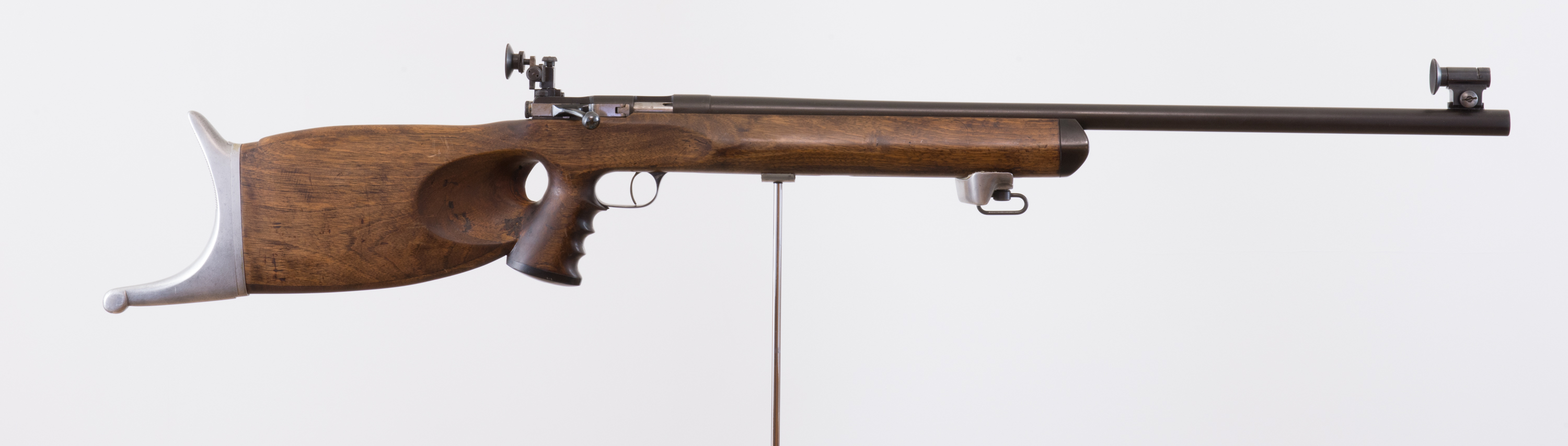

These rifles were manufactured by the late Dr. M.K.(Marian) Jurek,
more commonly known for his target pistol designs, and as co-designer of an automatic pistol in his time with Webley & Scott.
We are uncertain why the term Unique was employed on Dr. Jurek's rifles, but we are not aware that there is a connection with the rather more well-known Unique rifles.
The rifle here shown has an unusual almost straight-pull toggle-action similar to that of a Luger pistol turned on its side. The system is quite effective when operating properly.
There are believed to have been only 19 of these .22RF target rifles made. The whereabouts are known of Nos. 3,4,5, & 6, each being of the toggle-action type. We are also aware of just two of what were understood to be only four turning-bolt actioned rifles Jurek produced, the latter with the unusual facility for fitting the bolt handle to either side of the action, which is slotted to receive it on both sides; a truly ambidexterous rifle. Such a rifle is illustrated further down this page, along with the patent for the bolt-action. Jurek bored and rifled many of his barrels with his own rifling machine.
Of the four known early toggle-action examples, each has variations in the machining of the action or barrel, and of the wood furniture.
The accuracy of these barrels, when in good condition, is not in doubt. One recently shot comfortably in the high nineties on a current NSRA short range (1989) target
The rifles are both very rare and eligible for the Post-Veteran Class in the HARC Postal Leagues.

Jurek's workshop's address, at the time these rifles were produced in the early 1960s, was
St. Mary's Row, Birmingham,
and is proudly hand engraved on the top of the rifle's action
along with his "MJK" motif.
Much of this area of the Birmingham Gun Quarter has been demolished and redeveloped; however, 10, St. Mary's Row still stands, occupied by a hairdressing business, adjacent to where W.W. Greener's extensive factory once stood.
____________
Marian Jurek's first efforts at building a gun were made in 1919 at the age of just fifteen. He enjoyed shooting sports and, in 1937 as a representative of the Kraków CS Staff, he took second place in the military category at Vilnius in the twelfth National Rifle Competition.
He graduated from university and gained a doctorate fellowship with the chemistry department of the Jagiellonian University. Subsequently he commenced work at a Warsaw munitions factory.
The Second World War unsurprisingly found him soldiering in the Polish Army, but he was still undertaking his design work and, in 1942, constructed his first sub-machine gun. Work of this kind dictated his main activity during the following years, and he was also involved with the design of a light machine gun. Post War, having come to Britain, and whilst serving in the 1st. Armoured Division, in 1946 Jurek made a prototype of an improved design for his machine gun. Whilst more successful than his 1942 design it was never produced in any quantity. Jurek was demobilised in 1949 and joined the company of Webley & Scott. It was while he was with that company that Jurek designed an automatic pistol intended to compete for a British Government supply contract. It was after this Webley & Scott pistol failed to match the Browning High-power model, which of course was already in use in the British Forces, that Jurek left the company to start his own business. In all this time, his wife and family had remained in Poland.
_____________
Returning to the subject of his toggle-actioned small-bore target rifles, the difference between the earlier action body of rifle No.4 and that of the later No.5, previously illustrated, is clear to see. The initially very square finish was heavily chamfered on the later rifles, no doubt to improve both the aesthetics and handling, although a modest weight reduction would also have been effected.
We illustrate the 1954 patent for Jurek's toggle-action.
These text-searchable documents can be viewed with vertical scrolling
or as flip-pages by clicking the appropriate icon.
Depending upon the number of pages they may take a few moments to load.
Double tap tablet or click  for full page display.
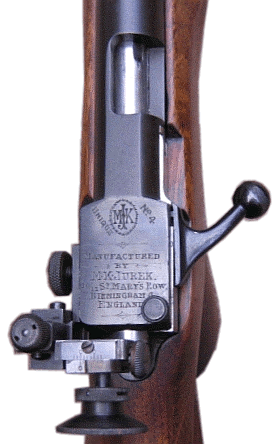
Shown below are two images of the bolt toggle arrangement, open and closed.
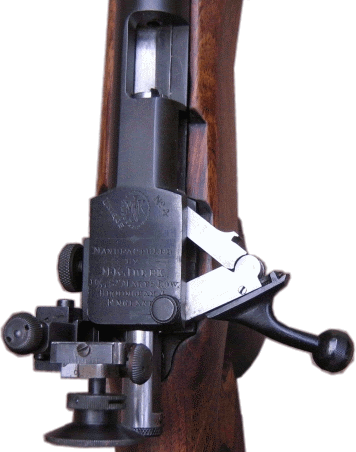 .......................
Also evident is the modified Parker-Hale rear-sight.
Below: images of Jurek .22RF target rifle serial no.5
Mad by M.K. Jurek
Model : Unique
Type : Rifle
Mechanism : Toggle-Bolt Action
Calibre : .22 Rimfire
Barrel Length : 28"
Stock Length : 13"
Serial No. : 5
Description : Single-shot heavy-barrelled target rifle with thumb-hole
pistol-grip stock with aperture sights, palm stop & accessory rail.
Long after this rifle was photographed for us,
it came up for auction at the Norfolk-based auction house Holts.

Below, the toggle-bolt action open with handle fully back.
The chamfered receiver top is clearly seen, along with the special rear-sight.

A low side elevation shows the finely worked thumb-hole and pistol grip

Two views of the closed action with the engraving that reads
" MANUFACTURED BY
Dr. M.K. JUREK
10/11 St. MARY'S ROW B'HAM
ENGLAND"
 .................
Judging by the quality of inletting, the accessory rail with its BSA International hand-stop
may well have been a retro-fitment, but the fine shaping of the fore-end nosing is original.

The Jurek-made rear-sight on this early example does not bear his oval logo stamp used later..
The light knurling on the rear of the bolt, to assist removal, is evident.

Left: a rear view of the rear-sight also shows the pivot-pin for the toggle-bolt handle.
Right: the BSA Martini International Parker-Hale PH-1 fore-sight is mounted on Jurek's base.
 ............
Dr. Jurek sent a letter to accompany the delivery of rifle serial no. 8 to its purchaser, with instructions about the sights and trigger configuration. We are able to show a facsimile of Jurek's note, including the hand-drawn sketches he included with his comprehensive explanation.
The letter is hand-written, and obviously not OCR processed or searchable.
It can be viewed as a flip-page document
or with vertical scrolling by clicking the portrait icon.
It may take a few moments to load.
Double tap tablet or click for full page display.
To complement Dr. Jurek's letter and trigger diagrams, we illustrate his 1959 patent
for his trigger mechanism used on both the bolt and toggle-action rifles.
The next rifle covered is serial numbered "9"
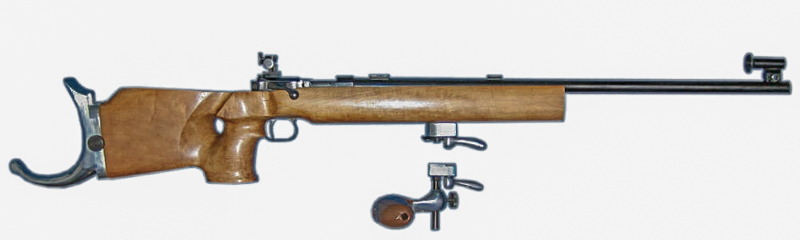
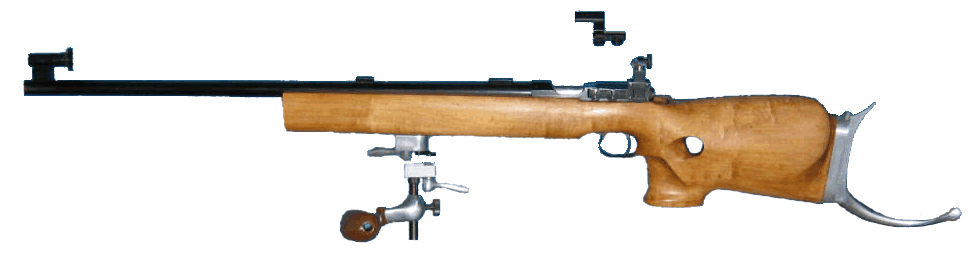
This rifle still has its original fitment palm rest for standing competition - shown underneath - and a specially made alternative mount for the rear-sight dovetail. This mount carries a rear dovetail block to which a Freeland type tube rear-sight can be fitted.
The foresight is a standard BSA Martini International sight, the barrel mount for which will also take the Freeland fore-sight tube that pairs with the tube rear-sight.
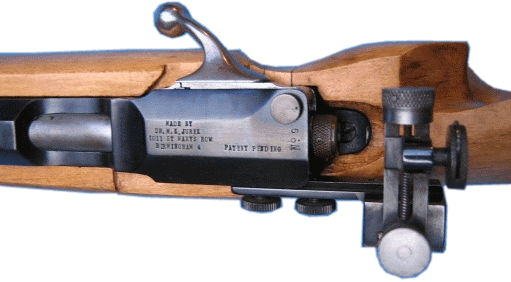
It can be seen that the receiver top has been chamfered even more heavily than rifle no. 5, and that the rifle is capable of being loaded from either side is evidenced by the symetrical cut-outs each side of the bolt body.
The knox-form has been stamped with Dr. Jurek's oval logo, below which is stamped "UNIQUE", an unusual marking for one of his rifles, some of which he described as "universal" models when interviewed in 1979 after his retirement. The interview is covered in an article at the bottom of this page.
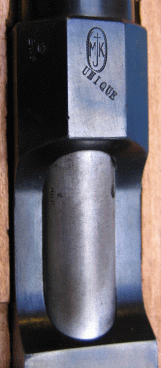
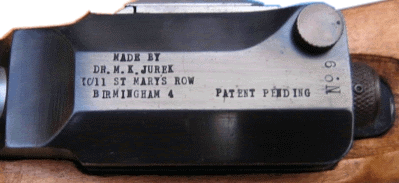
We have been made aware that toggle-actioned rifle No.10 has recently been sold out of a well-known London auction house.
This rifle appears to differ little from its immediate predecessors, and is shown below.
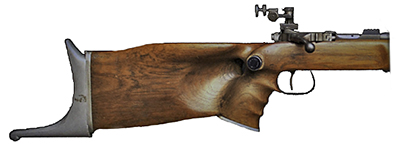
THE AMBIDEXTEROUS TURNING-BOLT ACTIONED RIFLES
The first example of the four understood to have been built by Dr. Jurek is shown next. It is set up for right-handed use, and carries serial number 18. As it is the earlier rifle with this serial number we have notated it as 18(a).
These images can be zoomed


The engraving affording the address of Jurek's earlier workshop
at St. Mary's Row is very clear, with his oval motif above.

To the left above are the original proof marks and later BNP stamp.
The date and place of proofing is indicated by the numbers and letters "sword dancing" between the very small crossed swords mark.

The "M" relates to 1962, and the "B" to the Birmingham Proof House.
The number 3 identifies the Proof House inspector.
See "Date your Rifle"
The bolt handle and rear-sight components are symetrically machined. This permits reversal of each item between hands.
The rear of the round section receiver , and the adjacent stock woodwork are slotted on either side for the bolt handle, which can be removed from the bolt body by slackening the single large slotted cheese-head machine-screw.
Occasionally, Allen hex screws will be seen on many of Dr. Jurek's guns, usually with the cap-heads recessed in counter-bores for neatness.
Below, the action is shown from both sides with the bolt-handle raised.
Obviously, the rear-sight receiver mount would need to be reversed
to adjust the rifle for shooting in the opposite hand,
and the sight itself either changed, or perhaps, at a pinch, it could be
reversed on its forward mounting arm and have the eye-piece
screwed in from the opposite side of the windage arm slide?
 .........
Next: the rear-sight from above.....

....... and from directly behind, showing the rear of the bolt,
and the bolt-handle retaining screw.

... and, finally, the fore-sight, believed to be made by Jurek,
with a wide and neatly recessed slot for what are presumably
the standard Parker- Hale elements.

_____________________
The earlier example shown next is set up for left-handed use, and also carries serial number 18. As it is the later rifle with this serial number we have notated it as 18(b) for our own benefit in the imagery files.
The bolt handle and rear-sight components are again symetrically machined. This permits reversal of each item between hands.
The rear of the round-section receiver is slotted on either side for the bolt -handle, which can be removed from the bolt-body by slackening a single hexagon allen cap-head machine-screw.
Again, such Allen screws will be seen on many of Dr. Jurek's guns, usually with the cap-heads recessed in counter-bores for neatness.
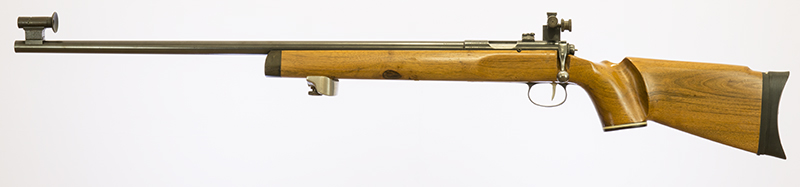
The rifle cocks on rotating closure of the bolt handle,
in the same way as does the Lee-Enfield Rifle No.8.

Here is a "Rotate & Zoom" image of Jurek Rifle No.18 (B)
Drag horizontally to rotate subject - Click to zoom and drag to pan
Full screen viewing from expansion arrows (Tap to Zoom)
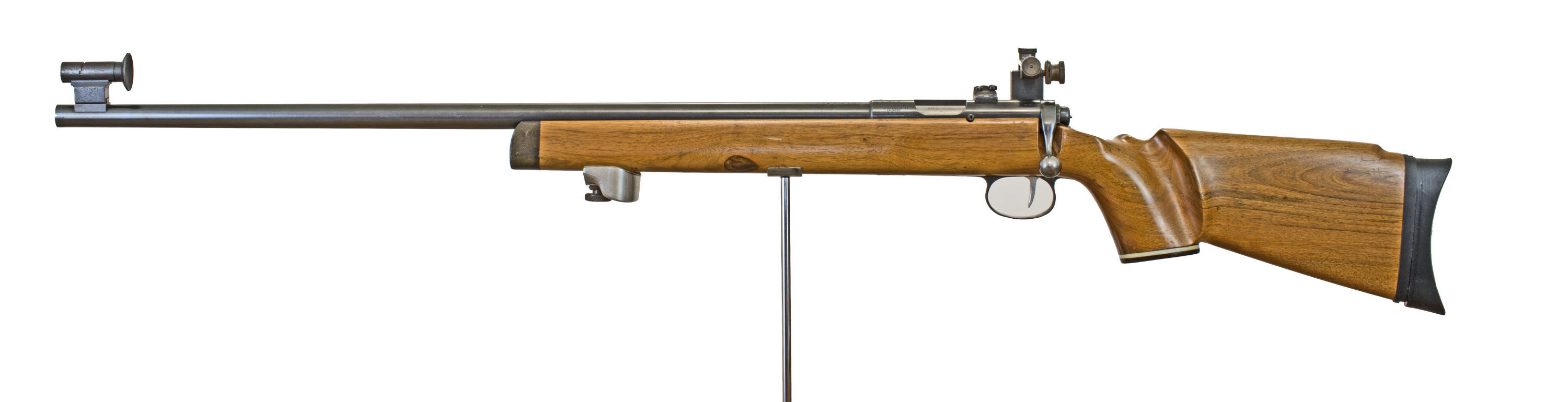
Close examination of this rifle shows that, whilst the action is ambidexterous, the stock is not. There is no cut-out in the woodwork for the bolt-handle on the right hand side, initially suggesting that perhaps the stock had been changed by an owner wishing a pure left-hand stock. However, the rifle was almost certainly ordered direct from Dr. Jurek in this configuration, in view of the facts that the ebony style fore-end cap is very similar to that used on other rifles by Dr. Jurek, and that the action of this rifle is marked specifically "FOR J.L. SCOLTOCK" beneath the address.

John Leslie Scoltock was director of the JLS & Company (1959) Ltd., West Bromwich arms dealers in the West Midlands. John Scoltock founded the Wednesbury Marksmen Club in 1982, their range being constructed that same year in the heart of the town. The building also housed the JLS company and a shop retailing both their imported and U.K acquired firearms and accessories. The premises and business were taken over in 1994.
This rifle carries the serial No.18, along with the later address for Jurek's workshops at 180, Bradford Street Birmingham, where he was based between 1965 and 1974; although, oddly, it has come to light that there is another similar ambidexterous bolt-action rifle, also Serial No.18, by Jurek, but that example is stamped with the earlier address at 10/11 St. Mary's Row. The stock of this latter rifle has cut-outs for the bolt-handle on both sides, but does not have the ebony-like fore-end cap of the rifle here illustrated.
As with Jurek serial no.18(a), 18(b) has a Birmingham Proof House date mark beside the proof marks. The "B" date letter is for 1951, which is confusing, in that the earlier rifle 18(a) built at St. Mary's Row has a date letter of "M" for 1962.

In search of an explanation for this, we could only conclude either that Jurek had a stock of barrels, and occasionally selected one that had been proofed years earlier, or that the 18(a) barrel had been re-proofed later.
____________
Not the best photographs of the top of the action, but illustrative of the layout, and indicating how the bolt-handle can be reversed.


When Dr. Jurek was interviewed by Californian Jerry Evans (see Evans' comprehensive 1981 article reproduced at the bottom of this page) in what must have been 1979 - as Jurek was born in 1904 and was 75 years of age when interviewed; four years after the Bradford Street workshop was closed - he then advised that he had built just eleven toggle-action target rifles and four ambidexterous turning-bolt models. The sequencing of his serial numbering remains something of a mystery yet to be resolved. Perhaps his records mixed numbering of rifles with those of his more significant production of pistols? We will probably now never know, unless his personal documentation has been kept safe somewhere, and is newly discovered.
Here the bolt is open showing the cut-out in the stock.

The receiver and chamber, with the rear-sight mount viewed from behind.

The receiver from in front, showing the bolt-head with its recess for the cartridge-rim, the firing-pin aperture, the extractor, and the ejector in the loading platform.
That the receiver is substantial is evidenced by the thickness of the walls.
These rifles are heavy!

The trigger and guard viewed from beneath.

And the underside of the fore-end, with an accessory rail and another hand-stop from a BSA martini International.

While Jurek sometimes made his own rear-sights for these rifles, he also modified variants of the No.25 model Parker-Hale sight as usually fitted to the BSA Martini International rifles
The foresight used was often the Parker-Hale PH-1 model also fitted to the BSA Martini Internationals.
Below are two images of Dr. Jurek's own rear-sight fitted to the bolt-action target rifle that is here under discussion.
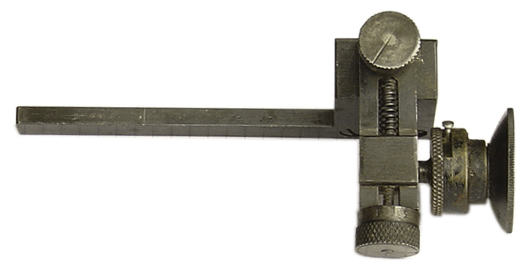
Jurek's cartouche, familiar to owners of his rifles or pistols,
is stamped above the fairly basic vernier graduated elevation scale
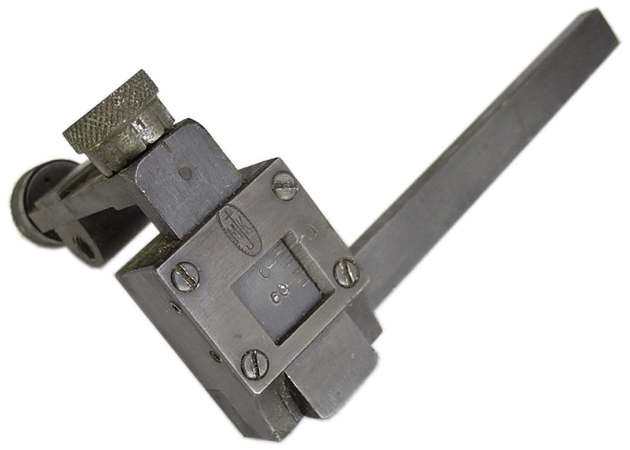
The fore-sight appears to be of Jurek manufacture, similar to the PH-1,
but without the drop-in element slot - presumably requiring the elements to be fitted by unscrewing the eye-piece bell, akin to the earlier BSA and A.G./ A.J. Parker FS No22 models..

We illustrate the 1957 patent for Jurek's bolt action.
These text-searchable documents can be viewed with vertical scrolling
or as flip-pages by clicking the appropriate icon.
Depending upon the number of pages they may take a few moments to load.
Double tap tablet or click for full page display.
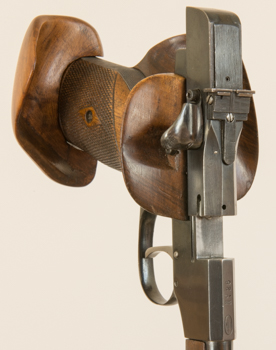
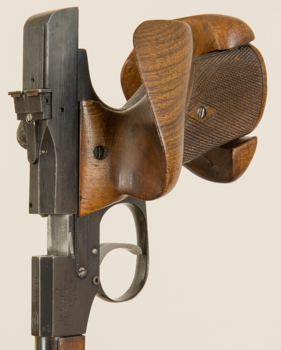
We have been afforded the opportunity to photograph one of Dr. Jurek's free pistols. We show this single-shot .22 rimfire model as a matter of interest. Jurek made in excess of three hundred pistols, mainly single-shot, but including various centre-fire calibres such as .38" also used in free-pistol competition; not to mention a few revolvers with exchangeable calibre barrels.
Below is a trial "Rotate & Zoom" image of the pistol.
When the imagery is shown as loaded, use a scroll-wheel to rotate it, or click and slide your cursor left & right across the image. Click the magnifier on the image to show a high-resolution picture of the chosen position. The arrow icon at the top right will take the image full-screen, where the same controls apply.
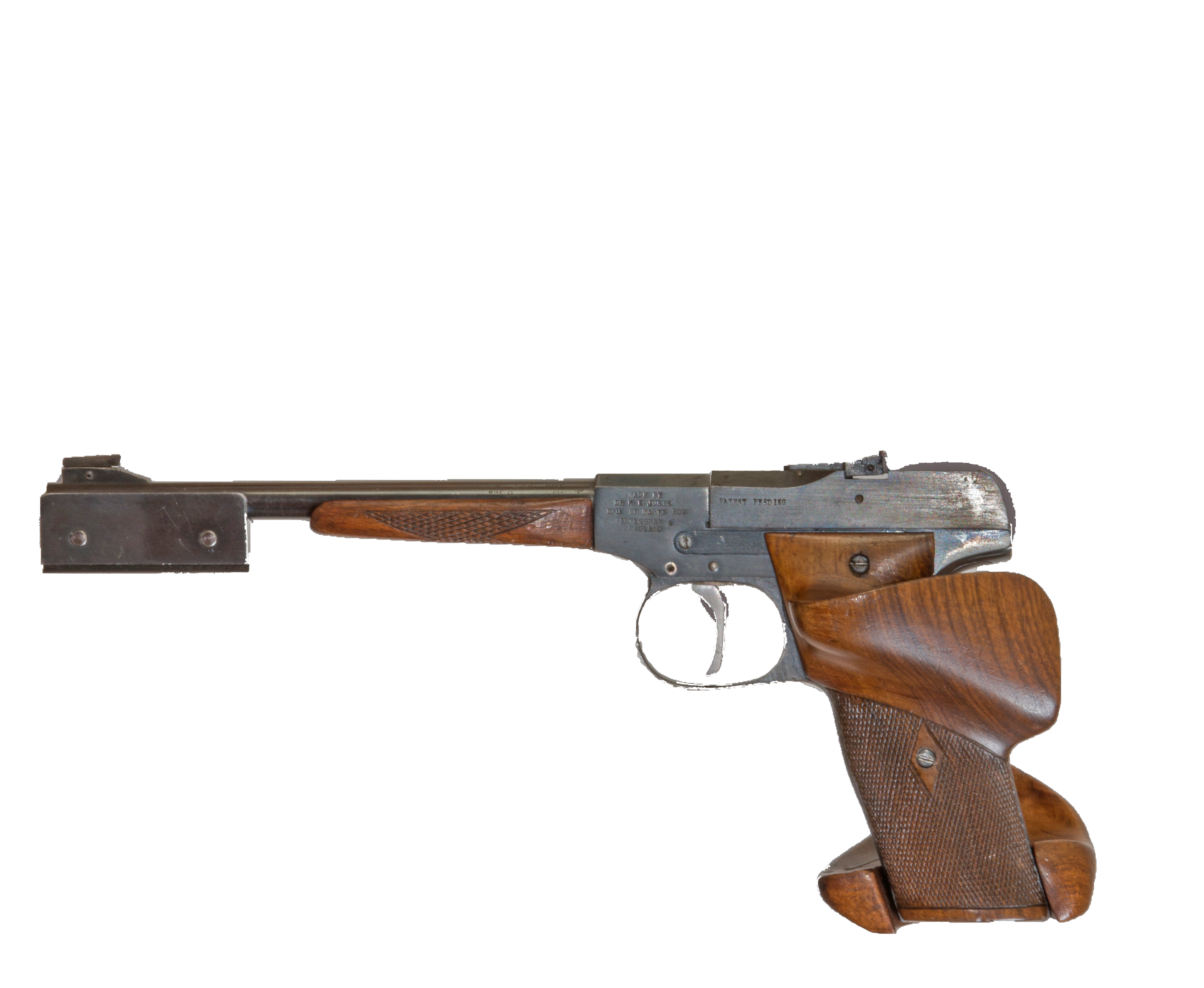
Zooming into the images showing the pistol from above, it will be seen that the Serial stamped on the receiver is "No. 25". Dr. Jurek's personal stamp is also there in the form of "MJK" within an oval cartouche. This stamp was used on almost all of his products, often including any of his specially manufactured rifle sights.
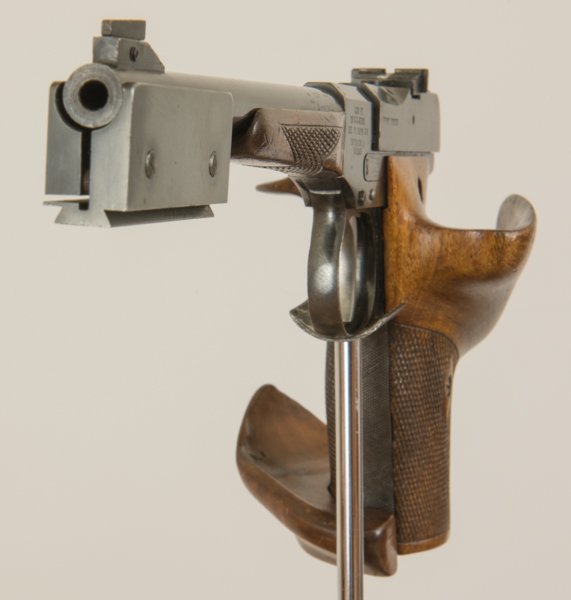
Some still images of the pistol and action are shown below.
The pistol is supported by a chrome-plated tubular stand under the trigger-guard
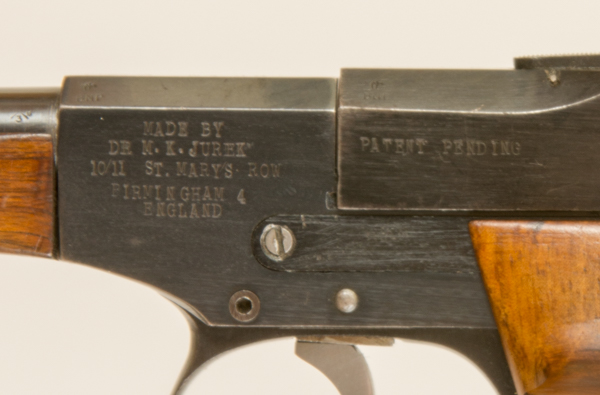
A close-up of the markings illustrates that Dr. Jurek may perhaps not himself have been an accomplished engraver, or he preferred to stamp the required information himself to save the time and/or expense that must have been expended on a few of his products; notably Rifle No.4 at the top of this page.
Below can be seen the simple slide action.
This pistol is built as a right-hander, and, without altering the grip, the left hand could be held above the action, and the left thumb used to depress the spring-loaded slide release lever (shown on the RHS of the action) before pulling the slide rearwards to extract the fired cartridge case prior to reloading. Simple but effective ......... and trouble-free.
In 1981 an article was published in Target Gun magazine
on "The Remarkable Guns of M.K. Jurek".
It was written by Jerry Evans, and is reproduced here.
Viewed as a portrait document
with vertical scrolling,
it may take a few moments to load.
Double tap tablet or click for full page display.
Five years later another article appeared, written by Anthony Morgan
Yes, each of two different articles utilised a near identical photograph,
presumably taken at the same time years earlier.
A significant mention of Dr. Jurek's pistols was included in the Small Arms Profile booklet of 1971. Long out of print, and with no apparent current copyright holder,
we have added it to this page as further documentation on the subject.
The relevant detail starts on the PDF page no.17 under "9mm Parabellum Automatics"
- or search for "Jurek".
See this website's Raison d'être