Extract from "A VANISHED WORLD"
by Oliver Hogg
Please be aware that some specialist imagery may take time to load.
This site is for dedicated researchers and is best viewed on desk or laptop.
Born in Bedford on 22nd. December 1887, Oliver Frederick Gillilan Hogg led a full life in what may now be considered to be under fairly privileged circumstances. Notwithstanding, he used that life in a truly productive and gentlemanly fashion. He joined the British Army at an early age and was commissioned as a sub-lieutenant. In 1973, as an octogenarian, he wrote a manner of an autobiography at the request of family and retired military colleagues. The document was evidently constructed using many diary notes of his varied postings and activities.
We have extracted excerpts of two sections in which he covered his last two postings at the Royal Gunpowder Factory and the Royal Small Arms Factory up to the end of the First World War. These very humanly reveal the day-to-day running of these facilities between 1916 and the Armistice, and contain a plethora of unusual details that may well interest those with a historical interest in firearms from the time of the Crimean War until the inter-war period.
Oliver Hogg attended the Royal Military Academy between 1905 an 1907, and served in Royal Artillery Home Stations until 1909 when he was posted to Gibraltar. Late in 1913 he returned home to the Ordnance College until being sent to France in 1914 as Lieutentant commanding a troop in the new and developing task of anti-aircraft gunnery, using a specially mounted 2-pounder that became known as the "pom-pom".
In 1915 he was posted back to a position at the Royal Gunpowder Factory at Waltham Abbey, and in 1916 on to the Royal Small Arms Factory at Enfield Lock, where he remained until the end of hostilities as Assistant Superintendent.
His early life, period in training, and his time in France are dealt with in his earlier chapters, but are frankly outside the remit of the Rifleman website; however, the entire document, a copy of which also lies within the archives of the Imperial War Museum in London, has been scanned with the permission of the family, for whom it was written and hand-bound in just twelve copies, and converted into a searchable PDF that is available at the bottom of this page.
__________________
Sadly, Oliver Hogg's medals were sold away from the family some years ago.
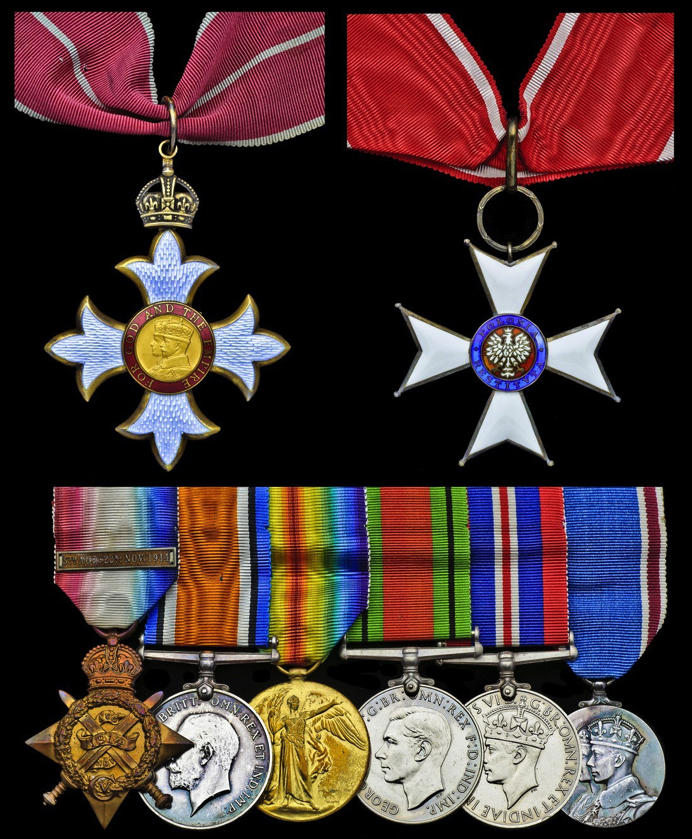
A Second War '1943' C.B.E. Group of Eight to Brigadier and Noted Artillery Historian O.F.G. Hogg, Royal Artillery
a) The Most Excellent Order of the British Empire, 2nd type, Military Division, Commander's neck Badge, silver-gilt and enamel
b) 1914 Star, with Bar (Lieut: O.F.G. Hogg. R.G.A.)
c) British War and Victory Medals (Capt. O.F.G. Hogg.)
d) Defence and War Medals
e) Coronation 1937
f) Poland, Republic, Order of Poland Restored, 1st type, Commander's neck Badge, 58mm, silver-gilt and enamel, minor blue enamel damage to motto on last, good very fine or better, the medals contained in a Spink, London, fitted case with the recipient's brother's intitals 'C.C.H.H.' embossed on the lid; the Polish award in Spink, London, case of issue (8)
C.B.E. London Gazette 2.6.1943 Colonel (temporary Brigadier) Oliver Frederick Gillilan Hogg (4083), late Royal Artillery
Poland, Order of Poland Restored, Commander London Gazette 7.12.1944 Colonel (Temporary Brigadier) Oliver Frederick Gillian Hogg, C.B.E. (4083), late Royal Artillery
'In recognition of distinguished services in the cause of the Allies.'
Brigadier Oliver Frederick Gillilan Hogg, C.B.E., (1887-1979), born Bedford; Commissioned Second Lieutenant, Royal Artillery, 23.7.1907; promoted Lieutenant, 23.7.1910; served during the Great War with No 2 Section Anti-Aircraft, Royal Garrison Artillery, on the Western Front from 26.8.1914; promoted Captain, 30.10.1914; Major, 22.5.1926; appointed Assistant Master-General of Ordnances, War Office, with the temporary rank of Brigadier, 1939; Deputy Director of Military Administration, Ministry of Supply, 1939; Director of Military Administration, 1941; retired, 1946.
A distinguished historian and writer, Brigadier Hogg devoted his retirement years to the study and history of Artillery, his greatest works being the monumental two volume history of the Royal Arsenal, Woolwich. He also wrote Artillery: Its Origin, Heyday and Decline; Clubs to Cannon: Warfare and Weapons Before the Introduction of Gunpowder; and English artillery, 1326-1716: The history of artillery in this country prior to the formation of the Royal Regiment of Artillery.
Others of Oliver Hogg's many writings covered the Development of the Royal Arsenal and the origin of The Broad Arrow.
CHAPTER VIII
THE ROYAL GUNPOWDER FACTORY, WALTHAM ABBEY 1915-1916
Waltham Abbey is a small market town 14 miles north-east of London, situated between the border of Hertfordshire and the forest of Epping. The original hamlet of Waltham is said to have been founded by one, Tovy, the king's standard-bearer, from whom it devolved on the Crown. Edward the Confessor by his charter of 1020 bestowed the settlement and its lands on Earl Harold, his brother-in-law, son of Goodwin, Earl of Kent.
Harold, who afterwards became king and was slain at the Battle of Hastings, built in 1060, six years before his death, the abbey from which the present town takes its name. This abbey served as a collegiate chapter for Secular Canons till 1177 when they were removed with the Pope's authority by Henry II and replaced by Canons Regular. The building then became part of an Augustinian foundation till it was dissolved by Henry VIII. Its' remains now form part of the parish church; an architectural attraction of the small township.
In 1915, Waltham was a typical little self-contained Essex country town, not yet joined to its neighbour, Waltham Cross. It lay in attractive surroundings, well-wooded to the east. Pine estates, such as Upshire and Woodridden Halls flourished in its environs. Suburbia had not then engulfed it in its rapacious maw.
Powder mills had existed at Waltham Abbey since the 16th. Century, and these were purchased by the Crown from Mr. Walton on 18th. October 1787 for the sum of £10,000. In the past they had had their ups and downs, their periods of calm and disaster. Thomas Puller, who was connected with the living in 1641, says:-
It is questionable Whether the making of gunpowder be more profitable or more dangerous; the mills in my parish have been five times blown up in these seven years, but blessed be to God, without the loss of any man's life.
J.P. Parmer in his History of Waltham Abbey gives a view of the factory in 1735, then the property of John Walton, showing 22 buildings among which are certain stamping and horse mills. There were, in addition, a saltpetre refinery, a charging house, a composition house, a corning and glazing machine and several drying stoves. The horse mill was probably akin to the modern incorporating mill. Although horses were used to assist the labours and exertions of man, they were not the only form of motive power; water, in addition, was employed to drive the antiquated machinery; and in 1814 this prime mover eventually superseded the horse.
When Government purchased the property it must have been in a shocking state of repair, as a further sum of £7,988.18s.8d. had to be spent in putting the buildings into a serviceable condition. This necessitated the presence of builders and workmen for 18 months and completely precluded manufacture during that period. Production commenced by february 1789. When the Board of Ordnance acquired the mills on the behalf of the Crown, the establishment of officials with their appropriate rates of pay was laid down on 16th. february 1789. The land on which the factory stood however, was not bought till 1795 as in September of that year Major (afterwards Sir William) Congreve, Comptroller, Royal Laboratory, was directed by the Duke of Richmond, Master-General of the Ordnance, to engage 14 or 15 of the best of Mr. Walton's workmen to continue working in the factory as government servants.
In World War I, however, the main output of the powder mills was cordite, and the only powder being made was that for igniters, primers, fuzes,saluting charges and common shell. Cordite involved the manufacture of nitro-glycerine and nitro-cellulose; the solvent used being acetone.
The Royal Gunpowder Factory, covering a good acreage, was in two sections divided by the main Waltham Abbey-Waltham Cross road. The old part, well-wooded, on the right side of the road proceeding towards Waltham Cross, consisted of the original mills, the saltpetre refinery and the incorporating houses in which the manufacture of gunpowder and cordite actually occurred. The factory grew its own special trees, the wood of which was calcined into charcoal. The other half of the factory contained the nitro-glycerine plant and the various stoves and drying houses for cordite and other explosive materials. Each "manufacturing house" was a "clean building" and overshoes had to be donned on entrance and doffed on exit. There were no "clean" runways or platforms in the factory; the ground area being "dirty". In this way, Waltham Abbey differed from the Royal Laboratory at Woolwich. All pipes, smoking materials, cigarettes, matches and lighters had to be surrendered on entering the main gate as nothing capable of causing fire was allowed within the premises.
The Civil Service clerks for both factories functioned at the Royal Small Arms Factory, Enfield Lock, and the Assistant Superintendent, Building Works - Mr.Watkins - had an office in each factory. There was no medical officer on the staff at Waltham Abbey, but Dr. Priest who lived in Farm Hill Road was the civil medical practitioner. He had a daughter called Dora, aged seventeen.
The military staff at Waltham Abbey in peace time was the Superintendent who also controlled the Royal Small Arms Factory, the Assistant Superintendent and the Danger Building Officer; but as the factory adopted 24-hour working on the outbreak of war, three additional Danger Building Officers were installed on a temporary basis. This allowed the senior (and permanent) Danger Building Officer to concentrate on his office work while each of the others patrolled the factory during the 8-hour shifts. The shifts were 8.00 a.m.- 4.00 p.m., 4.00 p.m.-midnight and midnight-8.00 a.m. The duties of these patrolling Danger Building Officers comprised paying a visit to every workshop and blending house as well as to a proportion of the drying stoves, drying houses and engine houses during their tours of duty; the drying stoves, etc. being inspected on a rota basis. The distance to be covered was considerable, about 25 miles, and an electric torch and a bicycle fitted with an electric headlight and rearlight lit from a small dynamo actuated by the cycle's front wheel was essential. Being a danger area no naked lights were allowed.
Owing to the possibility of air raids the whole factory was blacked out at night. There was one drawback to the cycle-lighting arrangement; the slower the cycle moved the dimmer its headlight became until on stopping the light was extinguished as the dynamo ceased to function. This occasionally led to awkward circumstances as I was afterwards to learn to my cost. Danger Building Officers changed shifts every week by a series of dog-watches. This altered the hours in sequential weeks thus permitting time for social engagements or sport. If a Danger Building Officer actually completed his itinerary before his duty period ended, he was allowed to return to his residence so long as he could be contacted by telephone. Meals, at home, too, were permitted to be eaten within duty hours.
I must emphasise that when I reached Waltham Abbey the research, design, experiment, production and inspection of all stores including armaments, normally undertaken by the Master-General of the Ordnance at the War Office, had been transferred to the Ministry of Munitions set up on 2nd July 1915 under the Munitions of War Act 5 & 6 Geo. V, cap 54; the Ordnance Factories themselves being handed over on 9th June 1915. Therefore until I left the Royal Small Arms Factory, Enfield Lock, in 1919, I served under the Minister of Munitions and not under the Army Council.
The officers at Waltham Abbey, when I arrived on that Sunday afternoon over half a century ago, were:-
S . W . E .: Colonel F.T. Fisher (6.8.1909 - 14.12.1917),
A s s i s t a n t Superintendent: Major R. Waring, R.G.A. (1.4.1911- 22.8.1915)
Danger Building Officer: Captain P.H. Evans, R.G.A. (6.1.1914-22.8.1915)
Additional Danger Building Officers:
Captain A.H. Praser, R.G.A. (5.8.1914-14.12.1917)
Captain G.C. McC. Roome, R.G.A. (5.8.1914-10.9.1916)
Captain M.D. Wall, R.A. (7.1.1915-31.12.1915)
I had known Captain Evans and Captain and Mrs. Wall well at Gibraltar.
As Major Waring was about to vacate his appointment at the Royal Gunpowder Factory, which he did on 22nd August a week after my arrival, I was appointed in the vacancy at the bottom of the queue. As a result of Major Waring's departure the following promotions took place:-
Assistant Superintendent
Major P.H. Evans (up till 14.12.1917)
D . B . 0 . Captain A.H. Eraser (up till 14.12.1917)
'Captain G.C. McC. Roome (up till additional 10.9.1916)
Captain N.D. Wall (up till 31.12.1915)
D.B.O.s .Captain O.P.G. Hogg (up till 29.10.1916)
Future movements were as follows;-
When the post of S.W.E. was abolished on 15th December, 1917, Major P.H. Evans became Superintendent, Waltham Abbey, Major A.H. Eraser becoming Assistant Superintendent in his stead. After Captain M.D. Wall vacated his appointment on 31st. December 1915 he was succeeded on 1st January 1916 by Captain F.O. Field, a solicitor by profession. Captain G.C.McC. Roome became a sick man and suffered a nervous break-down. He left Waltham on 10th September 1916. This was his last appointment and he retired from the Service on 10th December 1920. I never heard of him again till I read of his death on 18th April 1971 in his 87th year. He was replaced as a Danger Building Officer at Waltham Abbey by Captain G.C. Westhead on 11th September 1916.
When I was transferred to the Royal Small Arms Factory, Enfield Lock, on 29th October 1916 to replace Captain Leadley-Brown as 2nd Assistant Superintendent, who vacated his appoin ment owing to ill-health, I was not replaced at Waltham Abbey, so the military staff there was reduced by one.
The three permanent officers at Waltham Abbey lived in the official quarters connected with their appointments, and the three additional wartime Danger Building Officers lived, if married, in rented houses, or if single, in lodgings. Captain Roome and I were unmarried. The former had rooms in the house of Mrs. Monk, the daughter of an old-time Customs officer who, in his day, was permitted to retain the smuggled articles he had intercepted. Mrs. Monk, therefore, had many valuable effects in her residence and Captain Roome was well looked after.
I reported to Colonel Fisher on arrival. He was a bachelor who lived with his sisters in the Superintendent's quarter, a charming old house in a large well-kept garden backing on to one of the backwaters of the River Lea. With the quarter went a boat and a boat-house. He told me that the first business must be to find me accommodation which he would attend to on the morrow. Meanwhile, he regretted that he could not put me up as he had a nephew staying with him but that Mrs. Waring had promised to do so till I could find rooms. Considering that the Warings were in the midst of packing consequent to their next week's move I thought this was a very sporting offer. The two quarters were opposite one another and after the necessary introductions had been made Colonel Fisher returned home.
I found the Warings a very pleasant couple though after their departure I never saw them again. Colonel Waring, as he afterwards became, died on 16th January 1952 in his 81st year.
The following morning Colonel Fisher took me to see some lady-bountiful who appeared to run the small town. The upshot was that Mrs. Anderson, the wife of the under manager of the local Nobel factory, offered to take me in as a paying guest in her Sewardstone Road house and look after me. She was an excellent woman in every way with a strong mothering instinct. Her own son had just joined the forces so she transferred that instinct to me. None could have been kinder or more considerate. I was given a pleasant sitting room and a comfortable bedroom. For a modest sum she catered for me, cooked and served my meals; in addition she did my mending and my laundry. Life suddenly became very satisfying after France, expecially as my pay in this technical appointment was almost exactly three times the amount I drew as a regimental captain in the field.
Mr. Greenwood was the manager of Nobel's factory and he and his wife lived in the manager's quarter, Joyce House, in Farm Hill Road close to his works. I often used to dine with them and got to know them very well.
Colonel Fisher was a queer character. I met him annually in after years at the Advanced Class dinners. He could be very courteous and charming, yet there was a mean and petty streak running through his nature. He was a typical bachelor who, I imagined, had been spoiled by his sisters. He always tended to be on the defensive which probably sprang from an inferiority complex. He was apt to be suspicious and never seemed to trust any one implicitly. He never forgot an injury, either real or imaginary. I got on well with him on the whole though I did draw swords with him on one occasion over the rate of pay for the job at Enfield Lock.
One thing which infuriated him was the regulation then in force that colonels holding technical appointments had to wear blue tabs and a blue capband instead of the red. He regarded this as denoting a kind of 2nd class "citizenship". Later on this ruling was abolished and all colonels, whatever their posts, wore red gorgets and red capbands.
When I joined the gunpowder factory there were still quite a number of old hands nearing their age limit, who had spent their lives among explosives. They were an excellent body of loyal government servants. Some of their memories stretched back to the early 1870s before the passing of The Explosives Act of'1875. I was thus told quite a number of amusing yarns. I will quote two though whether they belong to the realm of fact or fiction is an open question.
One related to a certain Superintendent (possibly Colonel C.W. Younghusband or Lieut.-Colonel Young) who was said to shut down the factory one day a week and invite his friends to partake in some shooting; the employees on these occasions being given an extra shilling and a glass of beer
to act as beaters. The old part of the mills, being much wooded, has always afforded a bird sanctuary, much game taking shelter in its pleasant glades. Pheasant shooting therefore offered a good day's sport. On a Member of the House having the temerity to enquire whether this practice were true and suggesting its undesirability, he was bluntly told by a minister that the business of an explosive is to explode. Needless to say that, if this story be true, the episode must have occurred prior to the passing of the Explosives Act.
The other is about a Colonel W.H. Noble who was Superintendent between 1885 and 1892. He was expressing bewilderment at lunchtime because certain horses, for the purpose of drawing the gunpowder van, which had been definitely promised that morning, had not appeared. He was met with a chorus from his daughters "Oh, those horses. Daddy. We saw them on arrival but as they were quite unsuitable for hunting, we sent them back".
It was always said that in the earlier years of last Cenntury the Superintendent's man-servant, his gardener and boatmen were officially employed and paid as factory workers though they had never passed through the entrance gate in their lives. Autre temps; autre moeurs.
I experienced three unpleasant incidents during my time at Waltham Abbey, one at least of which could have proved fatal. Two of these took place during the hours of darkness and one was in broad daylight. I was fortunate to escape from all three without serious injury.
The first incident was, perhaps, the least serious. I was cycling along a path by the main river during a late afternoon in the winter of 1915. I was proceeding slowly through the Cimmerian darkness so, consequently, my bicycle head lamp was dim. The Building Works Department must have left a baulk of timber on the fairway. This, naturally, I failed to see and so rode right into it. The result was a header over the handle-bars into the icy waters of the Lea. I managed to scramble out by means of the rushes growing by the river's edge and retrieved my machine lying on the path. I rode to the Anderson's house straight away, a dripping figure, changed my soaking clothes and had a hot bath. It was unpleasant but I suffered no ill-effects.
The second incident was more terrifying and could have led to a serious accident.
On 8th January 1916 I was on my way at 7.30 p.m. to inspect a boiler house close to a backwater of the Lea. I had discarded my cycle as my objective had to be reached on foot. My torch battery was almost exhausted so the torch gave a feeble light. I was proceeding towards the boiler house when I suddenly found myself treading on a wooden surface. Mindful of my recent immersion, "I stopped and I stood", like the words of George Robey's song, though I did not particularly "listen". My torch was of little assistance. All I could see was blackness to my left. This I concluded was mud so I deliberately took a step to the right and promptly fell eight feet into water. Unwittingly, I had been standing on the edge of the wharf where barges for non-explosive materials were loaded. In the Stygian gloom I could not see where I was but I found myself standing in about five feet of freezing water. Wearing gumboots and not being able to
locate my position, I hesitated to launch out into the unknown. Being unable to clamber up the side of the wharf, I shouted for help. The cold, however, was so intense that after a minute or two the effect of the icy water on my chest prevented me from giving any further-tongue. After some minutes in the "deep freeze" I heard an answering shout. Luckily, two boiler house workers returning from their evening meal heard my cries for assistance. They saw the faint glimmer of my
torch on the ground which guided them to the spot. They leaned over the wharf and hauled me out nearly dislocating my shoulder in the process. No wonder! With my gumboots and my clothes full of water, my weight must have been considerably increased.
By the time I got home my clothes were frozen stiff and my discarded uniform almost stood up by itself. A change, a hot bath and a good dinner put me right but my shoulder was sore for several days.
Next day I visited the scene of the accident. I discovered that I had involuntarily chosen to fall off the wharf at the one spot where no barge was moored. I had toppled over in a constricted space about 20 feet long between a barge loaded with iron pipes and the factory's electricians' vessel which had a large glass' superstructure. A little more to the left and I should have landed on a mass of hardware; a little more to the right and I should have crashed through a glass roof. Either alternative would have been fraught with serious consequences. I was thankful I had had such a merciful escape from injury. I was becoming tired of being one of Kingsley's Water Babies.
The last incident could have, undoubtedly, proved fatal.
About midday on 2nd January 1916 I was reading the temperatures in the cordite stoves and drying houses in the modern part of the factory. As before mentioned, only a proportion of these "danger-houses" had to be visited daily. The drying houses were wooden buildings of light construction surrounded by thick -earth traverses. The thermometers were housed in a windowed embrasure at the back of each house. To read temperatures one had to pass through the narrow opening in the front of the traverse and then walk round to the rear of the building between its walls and the internal face of the traverse, a space about two feet in width. The mode of construction was designed to mitigate the effects of an explosion. Should anything go wrong, the roof and walls of the building would catch fire, and the confining strength of the traverses allowed the proceeds of the resultant explosion to ascend in the form of fire and curtail any lateral effect.
I was passing by the guncotton yarn drying stove on the other side of the river. To get to it I should have had to have crossed a bridge. I pondered whether I should visit that house and then decided against it as I had gone there two days previously. I had walked on about fifty yards when I heard a shout. On turning round I saw the guncotton yarn house in a mass of flames about forty feet in height. I calculated that if I had journeyed to that house I should have been just recording its'temperature when it blew up. Being caught at the back of the traverse I should certainly have been burned to death. Escape in time would have been impossible.
Fate evidently determined that Waltham Abbey should not be ray executioner.
I often found my tours of the factory very exhausting especially on night shift as I was unable to sleep much by day. After completing the midnight-8.00 a.m. period I seldom obtained more than four hours slumber. Towards the end of such a week I was sometimes on my feet for 24 hours. In my off-time I was either going to London, playing hockey or occupied with some other social function. For example, I might be attending a dinner immediately preceding some night duty and then just have time to return home, change into uniform and proceed to work.
The fumes of acetone in the incorporating houses during the hours of darkness under black out conditions did not help matters. They tended to produce hallucinations in the tired mind. I often suffered from what I can only describe as an extension of consciousness. The effect of L.S.D. rather than of alcohol. I occasionally suffered from visions or delusions of this nature. Sometimes I would see a framed seascape or a large pot of flowers standing on the floor of a "clean" building. Before I had time to the ask the foreman "What the hell he thought he was playing at", the manifestation would vanish.
Often I experienced great difficulty in crossing a bridge successfully. Without a tight grip on myself I would be apt to miss it and walk into the river. In one instance when I was living with the Carricks at Claramont, a house about two miles beyond Gheshunt on the Goff's Oak road, I fell asleep on my bicycle riding home. I managed to take the correct turning to Goff's Oak in my sleep and must have travelled several hundred yards before I crashed into a hedged ditch and woke up.
On the whole, however, the job had its compensations though it was a great deal more strenuous than it appeared on the surface. If I was off duty at the factory I dined out quite a lot during the first half of 1916, mainly with the Carricks and Greenwoods, On one occasion I was a member of a large dinner party given by Sir Thomas (Powell) and Lady Buxton who lived at Woodridden Hall in Epping Forest. He was, I think, the 4th Baronet. He was a rabid teetotaller who would not allow intoxicant liquor under his roof. His guests had to put up with soft drinks. For a man whose family fortunes had been founded on beer, this seemed very odd to me.
I went to the Tower of London on Wednesday 8th March 1916 and seeing Major-General Pipon, the Major and Resident Governor, managed to retrieve my despatch-box containing my "jewelry" which had been deposited there by the R.A. Mess, Woolwich, at the outbreak of the war. I was glad to get possession of it again since, as I was once more living in a civilised community where evening dress was required on occasions, I wanted my cuff-links, studs, tie-pins, etc. and
other items of personal adornment. I remained with the Carricks till 4th May 1919 when I left Hertfordshire to join the 36th Advanced Class which assembled at Woolwich on 5th May 1919.
For the first week, of the class I lived at my club in London. Then on 9th May my wife joined me at 61 Leyland Road, Lee; a furnished house we had rented. After I had taken up permanent residence I arranged with Captain P.O. Field and his wife to dine with them at their house when I was on the 4.00p.m.-midnight tour of duty in the factory.
Even during 1915 stray Zeppelins occasionally floated around the skies above us during the hours of darkness. Whether this was instrumental in Captain M.D. Wall giving up his appointment at the Royal Gunpowder Factory, I could not say, but during one alarm their old Irish nurse, who was terrified, prayed to the saints, blessed the water jug in the bedroom and poured its contents over the children sleeping peacefully in their beds; soaking them, the sheets, the blankets and the mattresses. Perhaps Mrs. Wall felt that there was little to choose between death by fire or water. However, the Walls evidently thought it was time to leave the neighbourhood.
Since obtaining my commission I had always lived in a Mess except when on leave, or in a billet on active service. To find myself a member of a large household full of children and young people where guests often came for the weekend was a pleasant and novel experience. During the three years I spent with the Carricks there was always something on the tapis. We went toparties, played hockey and tennis, boated on the River Lea, skated on the lake in the winter, danced, went to restaurants, thes dansant at the Waldorf and theatres in London; occasionally also we attended large dinners and private dances in Town.
There was an explosion in No. 1 guncotton press in the factory at 9.40 p.m. on 24th June and another in No. 2 guncotton press at 4.15 a.m. on 28th June. No one was injured in either
of these mishaps. While still living in Abbey Lodge I was granted a fort night's summer leave on 9th July by Colonel Fisher from Friday, 14th July. This was the longest stretch of leave I had had since the summer of 1913. I left for Salcombe on the appointed day and arrived from Kingsbridge in the Kenwith dastle. We stayed at the Marine Hotel. It was here that we met Captain Westhead and got to know him. He eventually became a Danger Building Officer 21 at Waltham Abbey in place of Captain G.C. MacC. Roome on 11th September after a successful interview with Colonel Fisher on 11th August.
After my return from Devon I went up to London on 2nd August to see my brother Philip in hospital who had been evacuated from France with a fractured cartilage under the knee-cap. This accident happened while he was about 30 yards behind the front line. He just collapsed and had to wait for a stretcher party to pick him up. That day I lunched with Cherry and Mrs. Petley before returning home.
On 29th August a fire broke out in the nitro-glycerine acid factory.
During the summer we often slept out at Claramont under the broad verandah. It was cooler and it gave us a better panorama of any aerial activity in the neighbourhood. On 3rd September, Lieut. Leefe Robinson, who was afterwards awarded the V.C. for this exploit, brought down Zeppelin L 21 over Cuffley about 3.30 a.m. with a Buckingham incendiary bullet. We thus had a splendid view of the crash. At once, Miss Yorke, Rosebud, Kastner, Geoffrey and I set out for the scene of the disaster, and were some of the first to arrive. The airship had fallen vertically in flames which licked up the envelope during its descent and landed in a field not far from Goff's Oak. It was an awesome sight. A ring of fire about 30 or 40 yards across Was burning fiercely and the heat was terrific. Much of the steel structure in the debris was white-hot. It was a veritable auto-da-fé. Charred bodies, their ribs glowing like gas fires, were strewn around andeverything inflammable was alight. Dante's Inferno would be a good description. I spotted a German machine gun which had been thrown clear of the fused wreckage and, with the help of the local inspector of police whom I knew well, tried to salvage it for examination at Enfield Lock. We had almost succeeded in our task when the Royal Air Force arrived on the scene. There was an argument but the police and I were worsted in the end and had to relinquish the prize. It was after all their property. When there was nothing further to be done and we were satiated with the vision of destruction we returned home and retired to bed once more. On this occasion one of the younger maids at Claramont rushed through the house shouting "My God, it isn't safe to live".
I first met Ella Hallam, my future wife, on 22nd September 1916. She was staying with the Herons in Cheshunt at the time who, being old friends of her parents from Hong Kong days, acted as her guardians while she was in England studying at St. Hilda's College, Oxford. Gerard Heron brought her over to Claramont for tea. I remember I was storing apples in the loft when they arrived.
Rosebud decided to do war work at Southampton on 5th October 1916 but before doing so it was arranged that she should go to the Arsenal at Woolwich for a preliminary course of instruction commencing on 10th October. While there her foreman instructor would insist on referring to her as "Lady Butler" so she suggested to him politely that he should call her "Lady Rosamond". He replied "Oh, I couldn't do that, miss, it would sound too familiar". June also had her difficulties in this respect. She was introduced to a Canadian officer who would always call her "Lady June Bugg". After her course of instruction in inspection duties Rosebud left for Southampton on 20th November.
Owing to the ill health of Captain Leadley-Brown, 2nd Assistant Superintendent at the Royal Small Arms at Enfield Lock, it was proposed that one of the Danger Buildings Officers at Waltham Abbey should take his place. The first choice was Captain G.C. Westhead who, being a cavalryman and non-technical, was presumably thought to be the best man for the job. He, however, did not wish to transfer so on 28th October I offered to go in his place. This was accepted by Colonel Fisher and I was ordered on 29th October to proceed temporarily to Enfield Lock. I started there next day. The work suited me as I was quite familiar with small arms. Thus on 22nd November 1916 I decided to take up the appointment permanently at the R.S.A.F. and so became 2nd Assistant Superintendent, Enfield, in place of Captain Leadley-Brown whose state of health forbade him to resume his duties.
Therefore, I left Waltham Abbey after fourteen months sojourn.
Before concluding this chapter I propose to give a list of air-raids. These bring into relief the contrasts between the two World Wars. There were a certain amount of minor air-raids in World War I, but London life was not in the least interrupted, theatres and entertainments being in full swing. No public air-raid shelters existed though nervous people did crowd the tube stations during warnings. By and large, the metropolis paid little heed to alarms and excursions though night raids by planes instead of airships did increase in number during the closing phases. Quite different to the situation in World War II.
Rationing was in force in both wars but it was far less draconian in the first. Eggs for instance were never rationed while meat, at any rate in country districts, was in plentiful supply and rationing in this respect away from large urban centres was honoured more in the breach than in the observance. In fact, the rationing of sugar, meat and fats was not completed till the summer of 1918, a few months before the Armistice was declared. The rationing of clothes and footwear never obtained.
There was no air-raid warning in force during 1915-1916. The presence of a raid was telephoned to the local police stations in the country districts. The village constable then mounted his bicycle with a notice TAKE COVER strapped to his handlebars and toured his beat ringing a handbell. The two Government factories at Waltham Abbey and Enfield received direct telephone warnings from the Ministry of Munitions. When the raiders had left the country the local constable again mounted his cycle complete with handbell, but his notice this time read ALL CLEAR.
AIR-RAIDS
31st January 1916 - Zeppelins reported over the Wash at 5.20 p.m. Waltham Abbey closed down.
19th March 1916 - Zeppelins reported. Waltham Abbey shut down for a quarter of an hour.
31st March 1916 - Zeppelins reported over .the Royal Arsenal.
2nd April 1916 - Zeppelins over Waltham Abbey. Sixty incendiary bombs dropped on Honey Lane, Waltham Abbey. No injury to persons nor damage to property.
25th April 1916 - Zeppelins over Ilford at 11.30 p.m.
24th August 1916 - Zeppelins signalled but did not appear.
3rd September 1916 - Zeppelins overhead. One caught alight and fell to the ground beyond Cuffley station. Miss Yorke, Rosebud, Kastner, Geoffrey and myself visited the spot at 4.00 a.m. Returned to bed at 5.00 a.m.
23rd September 1916 - Zeppelin raid in the Metropolitan area. Two brought down.
25th September 1916 - Zeppelins reported. Waltham Abbey closed down.
1st October 1916 - Zeppelin raid. Bombs were dropped about a mile from Claramont.
27th November 1916 - Three zeppelins brought down in the north.
28th November 1916 - A German plane dropped two bombs over Belgravia at 11.30 a.m. It was brought down at Dunkerque.
____________________
In order to provide the locks and barrels required this old mill had to be completely rebuilt and re-equipped. After this work had been completed in 1809 the new factory at
Lewisham became known as the Royal Armoury Mills and work started there in earnest. Suddenly, as the outcome of Waterloo, the engines of policy were reversed and economy became the
order of the day. In July 1815 output at Lewisham was reduced and, principally owing to transport difficulties and the deficiency of water-power at Lewisham, it was decided to transfer the barrel branch to the recently erected Royal Small Arms Factory at Enfield Lock; the locks and finishing sections soon following.
Utilization of the waters of the river Lea as a source of power was the primary object of establishing a factory at Enfield Lock and, to this end, the Board of Ordnance purchased the site in 1811 together with an additional twenty-five acres of land surrounding it. The actual building of this establishment commenced in February 1814 under the supervision of Major By, R.E., who commanded the Royal Engineers at Waltham Abbey, an officer who afterwards constructed the Rideau Canal in Canada and founded the small settlement of Bytown which later developed into Ottawa, the present capital of that Dominion.
The factory at Enfield Lock was a much more ambitious project than the Lewisham mills, being conceived on more generous lines. Further improvements took place over the years and the modern establishment at Enfield Lock may be said to have come into existence during the Crimean War.
Enfield and Waltham, therefore, adjacent factories in the Lea Valley kept their independence till the first decade of the twentieth century.
Colonel Sir F.L. Nathan, who was appointed Superintendent of the Royal Gunpowder Factory in 1900, proposed in 1908 that the Royal Gunpowder Factory and the Royal Small Arms Factory should be combined under one superintendent to be known as the Superintendent, Waltham and Enfield, or S.W.E. for short.
This suggestion was not made on technical grounds as the two factories had nothing in common scientifically, Waltham was essentially a chemical factory while Enfield was an engineering works; it was put forward because financial savings could be made. By combining the clerical staff and common services, considerable savings would accrue to the Exchequer. This proposal was adopted and so in 1909 Colonel (Major as he was then) P.T. Fisher was appointed the first (and last) Superintendent, Waltham and Enfield. This "marriage" functioned reasonably well in peace time when supplies from both factories were limited and when half a working day gave S.W.E. ample time to serve both interests. The overwhelming demands of a world war proved decisive and, after two years of World War I, the "marriage" broke down and divorce followed. The collapse of this "Siamese twinship" was effected by the composition of the Ministry of Munitions which took over armament supply in 1915.
As this new ministry developed, various Directors-General emerged as Members of Council, and the one who controlled the Director of Propellant Supplies, Sir F.L. Nathan, was different from the Director-General of Ordnance Supplies, Sir Charles Ellis, who was responsible for weapons. Waltham and Enfield, therefore, became responsible to different Members of Council and this rendered the task of a S.W.E. impossible.
The two factories thus became independent again in 1917. As Colonel Fisher had held his appointment for eight years it was decided to make a break with the past and inject new blood. Lieut.-Colonel P.M. Evans, the Assistant Superintendent R.G.P.F, new Superintendent at Waltham Abbey, and Lieut.-Colonel C.J. Newton (who was made a brevet Colonel) was given the appointment of Superintendent R.S.A.F. Colonel Fisher vacated his post, as a result of these changes. He retired in 1920 and died on 15th May 1938 in his 76th year.
Major S.C. Halse, Assistant Superintendent at Enfield Lock from 1914-1916, became a Director at the Ministry of Munitions and Deputy Superintendent, Enfield, from 1916 to 1917. He severed his direct connection with the R.S.A.F. in the latter year when he was made Controller, Small Arms and Machine Guns, at the H.Q. of the Ministry between 1917 and 1920. He retired on 14th September 1920 and died on 10th March 1961 in his 90th year.
Colonel Fisher blamed Colonel Halse over his supersession at Enfield and never spoke to him again. The former believed to his dying day that the latter had deliberately manoeuvred him out of his post. Colonel Halse maintained that this was untrue. His Director-General wanted Colonel Newton and so secured his appointment; the supposition supposedly being that Colonel Fisher would become Superintendent, Waltham. Apparently, the Director-General responsible for Waltham had other ideas and put Lieut-Colonel Evans in charge.
I was Secretary of the Advanced Class Dinner Club for twenty years until 1939, and both Colonels Fisher and Halse used to fight their annual battle in my presence at the dinner. They would appeal to me as umpire. I always found this distasteful as I had no wish to be made the arbiter. It also seemed a little sad that two elderly men both retired could not let bygones be bygones. I fancy that both men, apart from this particular bone of contention, were not very compatible. Two more different types could hardly be imagined.
The end of 1916 appeared to form a watershed in the war as far as I personally was concerned. A change of emphasis occurred in my environment. This was due to two causes.
First, local people began to discard their normal way of life and take up voluntary war work and, secondly, the family at Claramont was growing up. The girls sought employment and the boys went off to school. Although many visitors still came at weekends they differed in age and type. The young men of 1915 and 1916 were undergoing military training and their appearances grew less frequent. These were replaced by those of an older generation who sought momentary escape from their weekly toil, by dominion officers serving in this country and by casualties from the battle zone. Our relaxations were boating on the Lea, bathing, walks and picnics in the Broxbourne woods. Air raids grew more frequent though their effects were limited in comparison to those of World War II.
In reality, the war was beginning to bite deeper into the conscience of the nation and existence became more purposeful and less traditional than it had been hitherto.
When I reported at Enfield Lock some of the civil staff were:-
Mr. E.W. Phillips, Principal Glerk; Mr. George Glamp; Mr. E. Bloor; Mr. P. Garnegie, Manager; Mr. Svenson, Day Assistant Manager; Mr. Powell,Night Assistant Manager; Mr. Reade, Glerk of Works; the Reverend P. Milne, Ghaplain; MissWhittaker, the Lady Superintendent; Mr. Thomas, the Head Messenger; and Inspector James of the Dockyard Division of the Metropolitan Police who had his office at Waltham Abbey. I cannot remember the name of the Head Viewer.
Besides the H.S.A.P. at Enfield Lock, there was the Small Arms Inspection Depsurtment normally under a Chief Inspector of Small Arms. This body was quite independent of the factory itself. The last Chief Inspector during World War I was Lieut.-Golonel G.H.S. Browne whose post went into abeyance in 1916. Afterwards the Inspection Branch functioned directly under the Director of Inspection of Small Arms at the Ministry of Munitions, Lieut.-Golonel W.H.W. Hope between 1916 and 1919 who died in office. Three of these Inspection Officers during my stay at Enfield were Gaptain Gopinger-Mahoney, Gaptain Tudor Owen and Gaptain J.S. Knill. There were of course others.
My duties in the Royal Small Arms Factory were numerous and diversified. They included responsibilities for:-
Fire fighting services and equipment under Fireman Carter, an ex-member of the London Fire Brigade.
First aid; training and appliances.
Air raid precautions including shelters.
Attending the Industrial Tribunal at Caxton House when any factory workers were concerned.
Security.
The A.O.C. Armourer Lads under Staff Sergeant Scully.
Escorting visiting officers round the factory.
The interests of discharged soldiers working in the factory.
The Factory View under the Head Viewer.
In addition I was a member of the Y.M.C.A. finanoe committee; the Labour Advisory Committee, Ponder's End; the Middlesex Educational Committee. Finally I was a Governor of the Enfield County School and the Officer commanding troops, Enfield Lock. My correspondence dealt with all such matters in every aspect and with any subject which had a military bearing.
I had no responsibility for production. That was the province of Mr. F. Carnegie, the Manager. By virtue of my viewing functions, however, I was responsible to S.W.E. that everything made in the factory was up to prescribed standards. Thus I had the power of rejection over any run of work.
While the Carricks still lived at Claramont I either took the train from Cheshunt to Enfield Lock station or cycled in to work. After they had moved to Hoddesdon, I went by train from Broxbourne to Enfield Lock except when I left by car for some particular purpose.
My hours of work at Enfield were normally from 10.00 a.m. to 5.30 p.m. unless a committee meeting kept me longer at work.
Once a week I did a late shift in the factory staying on till about midnight. On these occasions I dined with the Halse's at their quarter in Ordnance Road till they left Enfield and settled in London. Thereafter, I was thrown on the tender mercies of a canteen meal which was brought to my office. I returned to the factory as soon as an air raid warning was signalled. In such circumstances the factory car came to fetch me and brought me home after the "All Clear" had been received. The factory closed at midday on Saturdays and remained shut on Sundays. On the whole my day was fully occupied, though on occasions one had a day off in London for special reasons. Broadly speaking, however, one's only free time was on Saturday afternoons and Sundays.
When Colonel Newton succeeded Colonel Fisher as Superintendent life assumed a warmer tone. Colonel Fisher was a kind of "sea green incorruptible"; human up to a point. He never entertained and outside working hours one never set eyes on him. The only time I entered his house was the day I reported my arrival at Waltham Abbey.lin 1915. Colonel Newton, on the other hand, was exactly the opposite. He was known in the Service as "Hell fire Jack" because of his irascible nature; in fact he was in character like Johnnie MacMsdion at Gibraltar, but he was warm and very human. He did not live the life of a recluse. On the contrary, he was always entertaining his staff, attending parties, going to theatres and generally conforming to the pattern of the normal sociable man; he used to come to the Carricks for an occasional weekend. He and I went about a lot officially together and he became my best man at my wedding. I grew very fond of Cecil Newton and our two feunilies continued to keep in touch. He died on 7th September 1947 in his 76th year. He had married shortly after I did and his wife Ruth is still alive. She was his secretary during World War I.
Having strayed somewhat into the future I must now return to a more chronological order of events. As stated in Chapter VIII I became 2nd Assistant Superintendent, Enfield on 22nd November 1916 and shared an office with Major S.C. Halse, the normal Assistant Superintendent. As, however, he had been made Deputy Superintendent and a Director at the Ministry by this date he was seldom at the factory. I thus practically had the office to myself.
How office "literature" has been curtailed over the last half century. When at Enfield, my desk was always furnished with a current monthly Army List, a current monthly Navy List, a current A.B.C. and a current Bradshaw; and old Mr. Thomas, the head messenger, used to bemoan the fact that in the good old days officers used to be supplied with free boxes of matches as well.
A week after I had taken up my appointment a tragedy occurred at Enfield Lock. On 28th November a single German raider dropped a couple of bombs over Belgravia at 11.30 a.m. Mrs. Halse and her sister were on the front steps of their house watching our A.A. guns firing at the intruder. In order to obtain a clearer view Mrs. Halse said to her sister "You wait here while I run in and get a pair of binoculars". As the latter was doing so one of our A.A. shells which was a blind fell at the porch and killed her sister instantly. On returning to the front door she realised that the worst had happened.
One of the first jobs given me by Major Halse was to design a new charger for the Lee- Enfield Short rifle. The existing clip had given trouble in the field. Infantrymen complained that it held the cartridges too tightly to work efficiently. A revised pattern with a lengthened spring had allowed the rounds to fall out. Obviously, there must be a definite length of spring between these extremes which would allow the charger to function correctly. Efforts to pin-point this exact measurement had so far failed. It was a daunting task though I realised that it was solvable by integral calculus. I wrestled with the problem but had to admit defeat. Then I sat and concentrated and, believe it or not, a figure to four places of decimals swam clearly before my inner vision. I realised that this measurement was a possibility as it lay between the two lengths of spring previously tried. I orderd 50 chargers to be made to this dimension. These were produced and handed over to the School of Infantry for trial. They worked perfectly and thus Charger, 0.3O3 inch, Rifle,Lee-Enfield, Short Mark IV became standard equipment. Was it intuition or luck? I leave my readers to judge.
On 8th December 1916 Mr. Carnegie was made Assistant Superintendent and the two Assistant Managers were promoted to Day and Night Managers. This at once raised a fundamental issue. The factories had been and still were under military control, and all correspondence had to be signed by officers of the Superintending staff. The promotion of Mr. Carnegie did not alter his functions and he was still responsible as before to the S.W.E. for manufacture and production. It did, however, give him the right to sign his own correspondence and increased his salary. This appointment was possible as the elevation of Major Halse to Deputy Superintendent had left the post of Assistant Superintendent vacant. It was quite obvious that I could not be made subordinate to Mr. Carnegie
so I raised the point with Colonel Fisher on 9th December and spoke to him about the nomenclature of my post on 11th December. On 13th December he decided that I should become A.S.E. (a)
and Mr. Carnegie A.S.E. (b).Whether Mr. Carnegie raised any objection to this decision I do not know but two days later Colonel Fisher changed his mind and finally decided that Mr. Carnegie should become Assistant Superintendent, Enfield, and that I should be known as Military Assistant Superintendent, Enfield, and there the matter rested for the time being.
I spent Christmas 1916 at Claramont.
I attended Y.M.C.A. finance committee meetings at regular intervals throughout the war. Periodic meetings of the
Labour Advisory Committee, Bonder's End also took place, and
at the one held on 25th May 1918 I was elected Chairman of the Sub-committee of the main Committee dealing with general purposes and substitution. At one of the latter meetings which were usually held at 6.30 p.m. I had a long discussion with a member who was obviously a communist and a pacifist. He solemnly informed me that he would rather see the Germans occupy this country and rape his daughter than continue the war against them. I had to respect his view as it was obviously held so sincerely, but his sentiments seemed incomprehensible to me. He was, however, surprised to learn that an officer's training was far more strict than that of other ranks. He told me that he was amazed to hear that the officer had been trained to do all the "menial tasks" performed by soldiers. He was under the impression that officers drew their pay and exercised authority under a system of patronage and snobbery. It takes all sorts to make a world.
The Middlesex Educational Committee met occasionally at Enfield Court House and the Governors of the Enfield County School met more frequently in the same building. I must confess that I did not realise till my first meeting that Enfield County School was for girls only. I remember one meeting of the governors in particular. A girl had been expelled for theft though she denied it. I elicited, on interviewing the headmistress, that she had no proof against the child but as she came from a bad home she was considered to be the most likely culprit. I asked the headmistress what she meant by a "bad home". She replied that the child's father kept a public house. At this I let the unfortunate woman have the rough side of my tongue. I saw red at the injustice of her action. I doubt whether she had ever before been spoken to in that fashion. The end, however, justified the means. The child was reinstated.
I had to attend the Industrial Tribunal at Caxton Hall whenever an employee brought a case against the R.S.A.F. or the factory sued an employee. Sometimes the worker lost and was fined for loitering or shirking his work; on other occasions he would win. Usually, however, the government won its case on the dictum, then in force, that The Crown can do no wrong.
My job as the factory viewing officer took me to every part of the factory to watch the run of work. On my tours around with the Head Viewer I would select any component at random, stamp it with my mark and have it examined by the viewing staff. It it were correct; well and good, but if it failed at test I would arrange for that particular batch of work to be rejected. I once had an unpleasant experience when visiting the browning shop where sperm oil is one of the ingredients used in the browning process. I was watching an operation when a worker, carrying a large pan of sperm oil turned and bumped into me, hitting me on the chest with the pan. Poor man, he was most apologetic, but the effect was disastrous. I was drenched almost from head to foot with the foul-smelling liquid which seeped through my uniform down to my skin. I literally stank like a pole-cat, and had to hurry home as quickly as possible. There I had to have a bath, change all my clothes and send my uniform to the cleaners.
An important part of viewing is barrel setting. This is an art which can only be done by hand and eye. It plays a very important part in the rifle's make-up, for unless a rifle barrel is absolutely straight erratic shooting will result. The barrel is placed in a cradle in which it can be revolved by hand. A mirror reflecting light is placed at the far end of the barrel. This forms a cone of light in the barrel when viewed from the other end which, if the barrel be straight, remains stationary with its point in the axis of the barrel when the latter is revolved in its cradle. Should the barrel be out of the true, however, the point of the cone will describe a circle when the barrel is turned. The more a barrel is bent the greater will be the radius of the circle. A faulty barrel is straightened by taps from a hammer. The whole is a very delicate operation requiring exceptionally strong and penetrating eye-sight. I selected the barrel setters who were paid piece work. One pecularity about barrel setting is the colour of the eyes. Barrel-setters must have blue eyes; these are keener and stronger than brown or hazel eyes. Men without blue eyes will never become efficient barrel setters. The first thing to note when interviewing an applicant for the job is the colour of his eyes. If they be not blue, dismiss him; a test would be a waste of time.
Among my team were two Austrialian soliders in uniform seconded from the Australian Imperial Forces. These men were wizards at their job. They earned the equivalent of £60 a week in modern currency. This caused apprehension among their mates who became afraid that the piecework rate might be cut. The Australians, however, who belonged to no union, were quite unrepentant. They told me they were out to secure two aims. First, to make as much money as they could and, secondly, to do their best for the Old Country.
Going round the factory at night I often mused on how the men could stand the monotonous work, night after night, month after month, and year after year. Most jobs, unskilled or semi-skilled, were mainly automatic. As long as the skilled men had set their machines correctly, they could not go wrong. I remember one man in particular. He cut out the rough stocks from the shaped blocks. A basket stood on each side of his forming machine. One contained the blocks on which he had to work; the other the rough stocks he had cut.
Presumably, he was on piece work. He looked like a robot with an expressionless face. He spent all night carrying out the following sequential actions which took about one minute to complete. Taking the block from one basket, placing it in the machine, tightening it up and pulling the starting handle. The revolving tool guided by a counterpart in a steel template did the work in about 30 seconds. Loosening up the rough stock, taking it out of the machine and placing it in the other basket completed the circle; and the operation was repeated ad infinitum. His nightly output was around 600 roughed stocks for which he probably received 25s. To me the whole process seemed soul destroying; no thought necessary, no intelligence 'required. There was something degrading to human dignity about it. Now over fifty years later a committee to study happiness at work is being set up under Dr. Norman Wilson, an occupational psychologist. About time too. I wonder what Dr. Wilson would have thought about my particular robot had he been alive at the time.
The tooL room was quite different. Here, a small number of highly skilled men did ndividual tasks; generally in the making of gauges. Each was a specialist, each used his brains and intelligence to the utmost. The master gauges for the manufacture of all kinds of small arms were kept at Enfield together with the master matrices from which ordinary gauges were produced. As more and more civil firms undertook small arm manufacture, demands for complete sets of gauges grew. Thus the tool room was always busy. Even at that time the price of a complicated gauge could be £40 of which only 6d represented the cost of the material. These men were craftsmen and could not but have taken a pride in their workmanship in contrast to our poor robot with dull eyes and lack of human emotion.
The Ministry of Munitions was a vast organization and many stories have been told about it. Two must suffice. There was said to be an empty room in the Victoria Hotel in Northumberland Avenue in which officials, who had received files which baffled them, dumped them. When the war was over the pile of papers reached the ceiling, and nearly buried the man who first opened the door. A man who had newly joined the Ministry was asked by a friend how he had got on. He replied "Splendidly, no trouble at all. I have had three stamps cut:
Noted, thank you; Passed to you please and Error regretted.
I find that these stamps answer every paper passed to me"
The Ministry of Supply in World War II was even more gigantic. It was said to have been the only mental institution in Great Britain run by its own inmates. I had the honour, or mis fortune, to serve in both.
To illustrate the proverb "Little fleas have lesser fleas upon their backs to bite them", I arranged with the Stores Branch to place a contract for fire baskets to keep air raid shelters warm in winter. This was duly done but the baskets failed to appear on time. On a reminder from me the Stores Branch telephoned the contractors to ascertain the cause of the delay. They were told that the contract had been sub-contracted to a firm called Messrs. Dipples in the Walworth Road. I therefore went to visit the latter on 11th March 1918. There I learned to my horror that there had been a further sub-contract. I finally ran the fire baskets to earth. They were being made by two or three men in a back kitchen in a slum in the East End. I wonder what the difference in price was between that being paid by the Crown for the baskets and that paid to the actual makers in their "thieves kitchen".
During my time at Enfield I evinced an urge to scribble verse. I would not dare to claim it as poetry. Therefore, before I continue with my narrative of events I propose to interpolate three items which seem to bear on my subject. These are (a) A poetic description of air raid action at a factory, (b) A resume of a file which kept passing through my office every six months which shows how matters concerning an outpost of empire were treated in World War I, and (c) A list of air raid warnings during 1917 and 1918.
(a) Air raid action at a factory.
The lights are dimmed, the hooter sounds; To some it is a dreaded threat to hear.
They rush from work impelled by sinking fear
Of what they know not, save that death is near.
Or if not near, at least within the bounds Of possibility.
The lights are then relit, and for a space Of several minutes there is time to find
Those things that men don't wish to leave behind. Their hats and coats with which the face the wind Of icy winter nights that cuts the face
And chills the frame.
The lights are then put out and darkness reigns. While workers hurry breathless to the gates
Thinking of wife and child, and if the Pates Will be in gentle mo_qc^ and thajb__their mates
Who stayed behind will have the added gains Of rest and shelter.
A raid affects the men in different ways,
A common impulse does not move them all.
While some there are whom shock doth most appal
Others there be who wish to reach the hall
Of their own homes to reassure their wives
With their protection.
Some go to air raid shelters and play cards
And others stroll about and smoke and talk.
Quite pleased to get a break and have a walk While output suffers; and the scratching chalk.
Recorder of the numbers up-to-date.
Lies white and still.
The fire brigade stands by and first-aid men Assemble at their posts to try and aid
The injured ones, if casualties be made
By Fortune proving but a fickle jade.
All stand about and listen, wondering when
The barrage will begin.
When all at once the silence of the night Is broken by the roll of distant guns.
Through which the sound of Gothas sometimes runs. Which telle of the approach of flying Huns
Towards the Capital; whilst sky's alight With bursting shrapnel.
The flight is broken up by accurate fire For hark.' A plane has surely lost its way. It buzzes nearer while the guns let play And shrapnel splinters thud into the clay And on the roofs of buildings close around; Y/hile all take cover.
At last the gun-fire stops and all is still.
The danger passes and the hummings cease
And night once more regains her ancient peace
Yet all must wait in patience till release Is brought by sounding loudly with a will
The "All clear" call.
Then lights go on and men^stream back to work^. The furnaces resume their flaming roar,
And engines start their steady throb once more, V/hile visible through every open door
Is energy personified; the will to forge Weapons of Victory.
(b) The spares which never materialised
This file is like a tale told by an idiot, full of sound and fury signifying nothing. It is a story of wasted opportunity, pints of ink, reams of paper, vast concentration of thought and of ever-growing expansion. Yet in the end it produced precisely nought. He would be a rash man who would presume to predict where the file in question is now. In the War Office archives? At the Public Record Office? Among the Ministry of Munitions papers? Or has it been destroyed under some Civil Service edict? Who knows? Much water has flowed under government bridges since then, quantities of dust have settled on the official documents of yeateryear and new departmentsof State have come and gone.
The action began in the early part of 1913 and originated in the unfederated Malay State of Kelantan. It must be remembered that in those days "the normal channel of communication" between an unfederated Malay State and the Home government was somewhat tortuous and the time taken for a letter between the two averaged about two to three months.
Although the incidents to be described are true, I cannot vouch for the accuracy of every detail since I am relying on memory which after a lapse of more than half a century is apt to play one false. This file, growing bulkier at every appearance, passed through my office at intervals of about six to eight months. I saw it last in 1918.
The Kelantan Rifles, a native corps armed with the Snider rifle, was indeed on the boundaries of empire. The Snider rifle adopted by the British Army in 1867 was super seded in 1874 by the Martini-Henry rifle, after which the sole use of the former in England was confined to the Prison Service, the warders of which were issued with it together with a special buckshot cartridge.
The O.C. Kelantan Rifles in the early spring of 1913 was becoming worried about the condition of his battalion's weapons and, after consultation with his adjutant and quarter-master, came reluctantly to the conclusion that his rifles were rapidly deteriorating in certain respects due to age and would require new firing mechanisms to bring them back into a state of efficiency. For him the situation was becoming serious. He therefore put the wheels in motion to obtain spare parts. After some months a request from the Office of the Crown Colonies for these spares was received by the War Office and passed to the Assistant Director of Artillery (a 3) who dealt with small arms matters. In accordance with practice a file was then opened and minuted to the C.0.0. Weedon, who under the Q.M.G., was responsible for small arm supplies, to ascertain whether he could help in this somewhat strange request. The C.O.O. concerned had no doubts at all on the matter and informed the War Office that he held no spares of the store required. The War Office, always helpful, sent a reply back through the usual channels to the O.C. Kelantan Rifles informing him that as the Snider rifle was obsolete no spares of the kind demanded were available, but that if they were really considered to be necessary, enquiries could be made at the Royal Small Arms Factory, Enfield Lock, to ascertain whether they could be made if a special extract were placed and, if so, what would be the cost involved and the probable date of delivery. The War Office would await his reply.
It was almost three months before the O.C. Kelantan Rifles received this communication. He replied somewhat sourly that of course the spares he asked for were essential and pointed out that, if that had not been the case, he would not have put in his demand in the first instance. He would appreciate an estimate from the small arms factory for these spares, both as regards cost and time of delivery, and he trusted that he might be favoured with a reply as soon as possible.
Since estimating costs and the effect of such an extract on the interruption of factory throughput of work had to be carefully calculated, another six months elapsed before the O.C. Kelantan Rifles was put in possession of the facts he wanted. He learned that each spare part could be supplied for X shillings and that the order would be completed in Y months after a firm extract had been placed. With a sigh of relief the O.C. Kelantan Rifles asked for a demand to be placed for Z firing mechanisms and awaited the outcome with hopeful anticipation.
By the spring of 1914, he received a further letter from the home government saying that the cost in the meantime had unfortunately risen and that the War Office before placing an extract for the spares would like the State of Kelantan to confirm that it would be prepared to accept the additional charge, i.e. 2X shilling per spare. On the receipt of this further communication the O.C. Kelantan Rifles almost suffered from heat-stroke. His weapons by now were becoming almost unserviceable and he realised that if something were not done quickly, his command as a fighting unit would become a liability rather than an asset. He therefore urged his superiors to accept the enhanced price, damn the consequences and insist that topmost priority be given to his requisition.
Before this S.O.S. reached the War Office, World War I had broken out. This put a completely different complexion on the whole aspect. What had been an exercise in the art of the possible now became a matter of life and death, and all the factories in the country were working at full pressure on what were considered to be essentials for victory. The War Office therefore wrote back to the O.C. Kelantan Rifles pointing out that the country was now at war and that Kelantan's request placed them in a position of considerable difficulty as owing to the situation at home, work at Enfield Lock had been fully geared to modern output and that any interruption to its programme would present the gravest threat to the war effort. Could not Kelantan make do with the rifles it had? The War Office hoped that the Malay State would reconsider its attitude and withdraw its demand, and it would value its understanding comments. To say that the O.C. Kelantan Rifles became hopping mad at this latest War Office letter would be to put it mildly. He replied testily that he was quite aware that a world wide war was in progress and this was all the more reason why his men must be armed with rifles on which he could rely. He refused categorically to cancel his order and stressed strongly the importance of its being carried out at maximum speed.
Time has a habit of waiting for no man and before Kelantan's latest literary effusion reached England - it taken longer than usual owing to war conditions - the Ministry of Munitions had been set up and all questions relating to supply and manufacture had passed into its keeping. The War Office on receiving the frantic appeal from the O.C. Kelantan Rifles, perhaps happily, perhaps a little guiltily, but certainly not reluctantly, passed, after washing its hands in the manner of Pilate, the file to the Ministry of Munitions which had now become responsible for this Asiatic pantomime. The new Ministry, conscious of its responsibilities, took time to digest the contents of the file which was growing larger and more tattered with the passage of time. It eventually filtered down through the ministerial corridors to the Royal Small Arms Factory at Enfield Lock. Being quite familiar with the story, the factory was not slow to react. It replied that the Ministry well knew that it had a crash programme to produce Q thousand Lee-Enfield 0.303 inch rifles in the minimum of time to equip the new troops coming forward and this work had been ordered by the War Office, but there were as clay in their master's hands; and if both the War Office and the Ministry were prepared to face the loss of M thousand Lee-Enfield rifles for N months, Enfield could undertake to execute the Kelantan order for Snider spares in the N months but pointed out that owing to the general rise in wages and in prices of materials during the war, the cost of the Snider firing mechanism would now be 3X shillings each. Faced with this reply the Ministry of Munitions asked the War Office if they were prepared to sacrifice the M times X thousand rifles referred to.
This placed the War Office in a quandary. They did not wish to turn down Kelantan's demand seeing how persistent the O.C. Kelantan Rifles had been, so they compromised and wrote to G.H.Q. B.E.F. France explaining the position and asking whether this suggested loss of new rifles at this juncture would embarrass the Biritish Army in France. The answer was emphatic. The G.O.C. in C. could not contemplate such a curtailment of supplies at the moment, but added that possibly in six months' time the proposition could be more favourably considered provided nothing untoward happened in the meantime to decelerate the rate of supply. The War Office replied in this vein to Kelantan and promised a definite decision as soon as possible. To this the Malay State made no reply. Perhaps its vocabulary had been exhausted; perhaps it had become resigned. In any case, like "Brer Fox" it lay low.
All this had taken time and it was now 1917. Towards the end of that year the War Office Informed the Ministry of Munitions that the rifle situation in this country was at last clear, and that so far as the Army Council was concerned the Minister of Munitions was at liberty, if he so wished, to execute the Snider order without prejudicing the war effort. The Ministry consulted Enfield Lock and the factory made it quite clear that on receipt of the necessary extract they would carry out the order for Kelantan at once and made a firm promise to supply Z Snider firing mechanisms in N months, but at a new price of 4X shillings apiece.
It was now 1918, and the War Office, feeling that at last the task of Sisyphus bad been lifted from its shoulders, broke the happy news to the O.C. Kelantan Rifles asking whether the long-delayed order should be placed forthwith. This file had now reached Brobdingnagian proportions over the years which the locusts had eaten, as tossing it back and forth from court to court had caused more and more enclosures to become entangled in its intestines.
The final act in this sorry drama was a communication from the O.C. Kelantan Rifles thanking the War Office for its co-operation and offer, but pointing out that the spares were no longer required as the Kelantan Rifles had been re-armed with the Rifle, short, magazine, Lee-Enfield twelve months earlier. Thus is history made. Shakespeare would have been amused by it all.
(c) A list of air-raid warnings during 1917 and 1918
16th February 1917 - Field-Marshal's warning at 2.55 a.m. I did not wake up.
16th March 1917 - Zeppelins over Kent. No warning received.
23rd May 1917 - Field-Marshal's warning at 12.40 a.m. Dressed and went to the factory. Lights out at 1.35 a.m. Returned home at 4.20 a.m.
25th May 1917 - Field-Marshal's warning at 7.00 p.m. All clear at 7.45 p.m.
5th June 1917 - Air-raid action at 6.20 p.m. All clear at 7.40 p.m.
13th June 1917 - Air-raid on London at 11.30 a.m. Liverpool Street hit.
17th June 1917 - A Zeppelin brought down about 4.00 a.m.
4th July 1917 - Air-raid over Harwich, Frinton and Walton-in-Naze at 7.30 a.m.
12th August 1917 - Air-raid warning at 5.20 p.m. Went to the factory. All clear five minutes later. Southend was bombed.
22nd August 1917 - Air-raid warning at 10.25 a.m. All clear at 11.45 a.m.
2nd September 1917 - Moonlight air-raid over Dover.
3rd September 1917 - Air-raid warning at 11.16 p.m. Arrived at the factory at 12.25. All clear had by then sounded. Raid on S.E. coast. I did a.late night at the factory and returned home at 2.00 a.m.
4th September 1917 - Air-raid warning 11.16 p.m. Arrived at the factory at 12.30a.m. It was a raid on London lasting two hours. Little damage done.
9th September 1917 - Air-raid warning at 3.10 p.m. All clear at 4.00 p.m.
24th September 1917 - Air-raid 8.00 p.m. to 10.00 p.m. Went. to the factory by the 8.26 p.m. train and returned by car. Bombs dropped near Russell Square and N.W. London.
25th September 1917 - Air-raid 7.30 p.m. to 9.30 p.m. Went to the factory by the 8.10 p.m. train and returned by car. Only S.E. London was reached.
28th September 1917 - Air-raid 8.15 p.m. to 9.30 p.m. Failed to reach London.
29th September 1917 - Air-raid warning at 6.15 p.m. False alarm. Air-raid at 8.20 p.m. Went to the factory by car. Two or three raiders reached London. Woolwich hit. The factory closed for the night at 10.30 p.m. The All clear sounded at midnight.
30th September 1917 - Air-raid warning at 7.20 p.m. Five planes reached London. Being Sunday I did not go to the factory. Highbury and Edmonton bombed.
1st October 1917 - Air-raid 7.10 p.m. to 11.00 p.m. I tried to get to the factory by the 8.10 p.m. train but found no trains running. The car fetched me from Broxbourne about 9.20 p.m.
19th October 1917 - Air-raid warning at 8.21 p.m. Visited all the first-aid stations. Returned home in an ambulance. Twelve Zeppelins formed the raiding peirty. Six were brought down over France and most of the others were destroyed. Bombs were dropped at Hertford.
31st October 1917 - Field-Marshal's warning at 11.30 p.m. (l had been in bed for about 15 minutes). Air- raid at 11.20 p.m. All clear at 2.44 a.m. The factory car came for me. Thirty planes in seven groups came over but only three reached the S.E. districts of London. Little damage occurred. I got back to bed at 3.45 a.m. A solitary German plane was driven off the S.E. coast at 4.35 a.m.
6th December 1917 - Two air-raids; first at 2.30 a.m. and the second between 3.45 a.m. and 6.30 a.m. Returned homed in time for breakfast.
18th December 1917 - Air-raid 6.30 p.m. to 9-30 p.m.
19th December 1917 - Field-Marshal's warning 6.15 p.m. All clear at 7.00 p.m. Two cordite
stoves were burnt out at Waltham Abbey about 6.45 p.m.3rd January 1918 - Field-Marshal's warning at 6.15 p.m. All clear at 6.55 p.m.
25th January 1918 - Field-Marshal's warning for 30 minutes around midnight.
28th January 1918 - Air-raid at 8.03 p.m. All clear at 1.10 a.m. Two aerial torpedo bombs fell unexploded in the recreation ground near the factory. One German machine brought down.
29th January 1918 - Air-raid action at 9.00 p.m. All clear 1.40 a.m. A piece of shell went through the roof of the Y.M.C.A. hut. I could not get to the factory as the fog was too thick.
30th January 1918 - Air-raid on Paris.
10th February 1918 - Air-raid 10.08 p.m. to midnight. Bombs dropped on Woolwich and Chelsea.
17th February 1918 - Air-raid 10.08 p.m. to 12.35 a.m.
18th February 1918 - Air-raid 9.00 p.m. to 11.22 p.m. No bombs fell anywhere. I got to the factory as the lights went out.
7th March 1918 - Air-raid 11.25 p.m. to 1.38 a.m.
12th March 1918 - Police warning at 8.30 p.m. I went to the factory but no raid followed. I returned home at 11.00 p.m.
21st March 1918 - Air-raid warning at 8.30 p.m. I went to the factory. All clear at 9.14 p.m.
12th April 1918 - Field-Marshal'3 warning. Zeppelins over the Midlands.
26th April 1918 - Air-raid warning at 11,44 p.m. All clear at 12.30 a.m. Nothing occurred.
20th July 1918 - Field-Marshal's warning at 9.32 a.m. All clear 9.52 a.m.
21st August 1918 - Field-Marshal's warning at 10.17 p.m. I return to the factory.
____________
To continue my narrative. On 7th January 1917 I went to see H.W. Roberts in hospital at 34 Grosvenor Street, W., as he had been invalided home with a bad wound.
On 19th January 1917 there was a terrific explosion at Silvertown about 7 o'clock in the evening. It occurred at Brunner and Mond's alkali works. I was at Enfield Lock Station at the time. The sound could be very clearly heard.
The 30th January was a busy day. Four Japanese officers visited the factory between 11.00 a.m. and 2.45 p.m. Colonel Fisher, Mr. Carnegie and I, after having shown them around, entertained them to lunch in the Colonel's office. The office messenger at this time, and until the end of the war, was Shaddock, Lord Ranfurly's butler and valet. Such functions at the factory were therefore carried out with all the panache due to a nobleman's household.While I was at Enfield Shaddock taught me how to strop a razor properly and I have always been grateful to him ever since.
On the evening of 30th January I attended the social at Enfield Lock for the opening of the Women's Recreation Room in the Royal Small Arms Factory. A good deal of snow fell during that winter giving rise to considerable flooding in the Lea Valley. The Royal Small Arms Pactory closed for four days at
Easter so on 5th March I decided to go to Folkestone. We stayed at the Metropole and hotel. We spent the four days walking, attending concerts, listening to the Canadian band playing on the Leas and dancing in the evenings. Several Canadian officers came to dine, with us during our stay, and the short break did us all good. Summer time came into force on 6th March and we left on the following day.
On 30th March the Master-General of the Ordnance and his staff visited the factory. Although no longer responsible for the production of armaments, he was directly concerned with the requirements of warlike stores for the Army.
On 3rd May by brother Conrad was awarded the Croix de Chevalier, Legion of Honour. The same day I took Major Sutherland of the Canadian Ordnance Corps round the factory.
Industrial trouble broke out at the Royal Small Arms Factory on 14th May when 400-500 members of the Amalgamated Society of Engineers went on strike. I always remember a gunner in the factory who, on completing twelve years with the colours, had become apprenticed and, on finishing his training, joined the A.S.E. He, of course, came out on strike on this occasion. Mrs. Halse, helping in the canteen, spotted him there and berated him. She told him that he ought to be ashamed of himself for going on strike and that she hated to think that he and her husband had ever served in the same regiment. She considered it disgraceful that an old soldier like him should behave in this fashion in war-time. She was always a forthright woman. The ex-gunner always had the same story "You got me wrong. I aint on strike Mrs. 'Alse, no not me. I just don't feel quite well so I've taken a couple of days off for a rest". The strike did not last long. Labour was not so well organized in those days.
During the month of June heavy firing could be heard from overseas; probably from the Ypres sector.
On 10th June Charles, Bridget and Queenie Montanaro came to lunch at Claramont, Afterwards in the lounge Charles looking around suddenly remarked k propos of nothing in
particular, "That's a remarkable wart, Hogg". He was always a little pedantic in speech, and his statement was received in astonished silence till it dawned on us that it referred to a fine stuffed head over the mantlepiece, where a warthog reigned supreme.
To indicate how behind the times the War Office was in regard to the appointment of officers serving under the Ministry of Munitions, I received a telegram from the Adjutant-General on 16th June appointing me to the Royal Small Arms Factory, six months after the event. I replied in a suitable manner.
Colonel Halse finally severed his direct connection with the Small Arms Factory and vacated his post as Deputy Superintendent on 2nd July. By the end of the year he gave up the Assistant Superintendent's quarter which then reverted to me. When Colonel Halse departed Mr. Carnegie took over his office.
On 6th July, went to Salcombe for my fortnight's annual leave. On my return I found I could not work properly in the small room which had been allotted to me so I arranged to take over the manager's office which had been vacated by Mr. Carnegie. This was much larger and more convenient. It was altered to suit me and redecorated, refurnished and re-carpeted. It was on the ground floor and looked out over the river. Here during my sandwich lunch hour I read the Secret Doctrine which had the effect of giving me an hour's daily freedom from the world and its cares besides enabling me to absorb an enormous amount of knowledge which I have never forgotten.
After Colonel Halse had left I took up the question of being granted the proper rate of pay laid down in the Royal Warrant for Pay for the post of Assistant Superintendent, i.e. an increase of £150 p.a. Colonel Fisher refused to entertain the idea. After his departure I again raised the matter with Colonel Newton. He called for the Pay Warrant and being satisfied that my request was not only reasonable but just at once took up the cudgels on my behalf. As so much time had elapsed since my appointment as Military Assistant Superintendent, Enfield, he had a long struggle with the finance branch concerned at the Ministry, but at last on 31st May 1918 the increase was sanctioned though not back-dated. I was quite prepared to accept this as further argument would have delayed matters still more and I had won my point in principle. Sometimes in such cases a bird in the hand is worth two in the bush. Aesop's fables here teaches one a lesson.
A great occasion occured on 12th October 1917 when H.R.H. The Duke of Connaught and Captain Ashworth visited the Royal Small Arms Factory. The Duke arrived at 10.45 a.m., and at 11.40 a.m. opened the Royal Small Arms Tavern. Colonel Fisher Returned from leave for this visit. I, among others, was presented to His Royal Highness. At the age of 67 he was an extremely handsome man and a fine soldier.
On other occasions, distinguished officers of our own and allied forces would visit the factory to be shown round. Luncheons on these events were always provided in the Superintendent's room. They always passed off without a hitch, thanks to Shaddock.
There were two slight fires in the factory during the latter half of 1917 and one bad one on 1st August 1917 when the Women's Shifting Room was gutted.
On 15th December 1917 the post of Superintendent, Waltham and Enfield, was abolished. Colonel Fisher departed and Colonel C.J. Newton arrived on 17th December as Superintendent Royal Small Arms Factory. I was not sorry to see the new "change of management". In the New Years Honours List, Colonel Halse was awarded the C.M.G.
On 2nd February 1918 I was invited to become the Vice- President of the Royal Small Arms Factory Institute. On 21st March I lunched with my brother Conrad and Uncle Dudley at the U.S. Club and then went on with Colonel Newton to Monkhams to arrange a flight over the Royal Small Arms Factory to test the blackout precautions of the factory. This was agreed but a good deal of delay occurred over this operation mainly due to unsuitable weather. However the flight did eventually take place on 12th June with Colonel Newton as the observing officer.
Bad floods affected the R.G.P.F. and R.S.A.F. in April and the latter had to be closed for twenty-four hours.
I let my quarter in the Ordnance Road to the Y.M.C.A. from 1st June for £48 p.a. exclusive of the garden. I loaned the use of the latter to the Metropolitan Police with the proviso that they were to provide me free with any produce from it that I might require.
On 4th June the A.O.C. Armourer Lads at The Royal Small Arms Factory were transferred to my command.
During my last year at Enfield, Fireman Carter and I did a lot of work improving the fire-fighting services of the factory. We visited other Service and civilian establishments to study their systems and went to Merryweather to purchase new equipment. One of the new installations we acquired was a booster pump to increase the force of water delivery in case of fire. This was bought from Worthington-Simpson, pump manufacturers, of Newark and necessitated a visit to that city. Mr. Robinson, an engineer from Enfield, and myself, travelled up there on 11th September and spent the night at the Saracen's Head. On the following day we spent three hours watching the pump go through its paces on a test bed. This proved satisfactory and the pump was accepted.
Fireman Carter and I devoted special attention to the maltings at Ware where the rough rifle stocks were stored. A fire there would not only have been serious for the town itself; it would have been disastrous for Enfield's output. For the same reason we kept watch on Carres Mill at Waltham Abbey. By the time the armistice was declared the fire-fighting system at Enfield Lock had been thoroughly overhauled. Luckily, no damage by hostile aircraft ever occurred at the Royal Small Arms Factory or to its dependencies.
Colonel Newton, Mr. Watkins and myself gave Mr. Phillips lunch at the Piccadilly Grill Room on 29th June and afterwards took him to the Hippodrome to see A Box of Tricks. This was followed by Colonel Newton's party on 13th July to the same individuals. We lunched at Bellini's and then went on to The Soldier Boy at the Apollo and had tea at the Dug-out.
There had lately been a good deal of suspicion that men in the Polishing Shop were gambling and passing betting slips so the Metropolitan Police, Mr. Carnegie and I planned a night raid on the factory. I presented myself there about 11.00 p.m. in a shabby old suit and a dirty face, joined Mr. Carnegie and a couple of police officers in plain clothes and mixed with the workers in the shop concerned. However, we drew a blank and saw nothing. We never discovered whether that suspicion was well-founded or not.
On 2nd August we went again to Salcombe for a summer holiday.
On 28th August Colonel Newton arranged a trip to Ware in the factory motor-launch to inspect the meltings which had been rented as store houses by the Crown. He supplied the luncheon; game pie and other delicacies from Fortnum & Mason. Colonel Newton, Mr. Phillips, Mr. Watkins and I left the factory by river at 11.00 a.m. We stopped at Broxbourne to pick up Somerset. We lunched on board and arrived at Ware at 3 0'clock. On the way back we stopped and looked over Bye House which had been the home of Rumbold, a Cromwellian, where the plot was hatched in 1683 to murder Charles II and his brother James on their return from Newmarket. The conspiracy was the work of Whig extremists and former Cromwellians but it miscarried because the royal party left sooner than was expected. Lord Rassell and Algernon Sidney, although not active participants,' were executed for complicity. We all had tea at Belmont on our return.
Captain J.S. Knill (afterwards Sir John Stuart Knill, 3rd Baronet), a disabled officer who lived at Hoddesdon, had recently Joined the Small Arms Inspection Staff at Enfield Lock. Because of his condition, it was arranged that the factory car should transport him daily between his house and his office. As we lived near one another this courtesy was extended to me. Therefore from 7th October I travelled to and from the factory by official car.
_______________
On 11th. November 1918, a cessation of hostilities was signed at 5.00 a.m. All firing was to cease at 11.00 a.m. This became known as Armistice Day. The Royal Small Arms Factory closed down at 11.30 a.m. I did not join the cheering throngs in London but returned home.
On 12th November Mr. Phillips attended an investiture to receive his O.B.E. As a result of the Armistice a three-day holiday for munition workers was declared. The first day of this I spent in London lunching at the Piccadilly Hotel with Colonel Newton and Mr. Bloor. Mr. Watkins should have joined the party but illness prevented him from being present.
On 22nd November Ella Hallam and June went as nurses to Lady Maitland's hospital at Thirlstane Castle, Co. Berwick across the Border. I gave them dinner at St. Pancras Hotel and saw them off to Scotland by the 8.45 p.m. train. At the beginning of December Mr. Svenson, the day manager, died and a memorial service for him was held at the R.S.A.F. chapel at 12.30 p.m. on 4th December.
Two photographs of factory staff, which I still possess, were taken at noon and 12.30 p.m. respectively on 7th December 1918.
Two things happened on 20th December; the engagement of Lionel Gallwey Robertson to Rosebud appeared in THE TIMES and Ella Hallam returned from Scotland. The latter was of more importance to me. After Christmas Ella Hallam went for the weekend to the Herons at Roundcroft. I drove her over in the pony chaise. On the following Monday, 30th December 1918 I met Ella at Cheshunt with the factory car, Captain Knill was sitting in front separated from us by a glass screen. On the drive to Belmont I proposed to Ella. My proposal was accepted.
On 4th_Januarjr 1919, I was invited as a guest of Mr. Phillips at the Royal Small Arms Factory Clerical Staff dinner at the Cannon Street Hotel which was held at 6.30 p.m. Mr. Phillips took the Chair. After an excellent dinner with accompanying songs and music two toasts were drunk. First, the King proposed by the Chairman and, secondly, the Allies proposed by Mr. Archer, the Vice-Chairman, and replied to by me.
On 10th January I began to feel out of sorts and retired to bed. Dr. Love, our local physician at Hoddesdon, came to see me and diagnosed gastric 'flu.- However, I got up to attend the Victory Ball at the Royal Small Arms Factory that evening and had dinner at 7 o'clock. Not feeling in the brightest of moods I accompanied Ella to Enfield Lock for this special occasion. The Victory Ball (in plain and fancy dress) was held in the Ladies' Rest Room, Royal Small Arms Factory.
It was organised by Mrs. E. Higgins and Mr. J. Cannon; Mr. R. Alexander being the Master of Ceremonies. Some 200 fancy dresses were Judged by Miss Hallam, Miss Edge and the Reverend P. Milne. There was also a waltzing competition, the Judges of which were Messrs. J. Kane, A. Lorton and E. Sharpe. According to the local paper the dance was a great success and it ended its description with the following words:-
Following the presentation of prizes by Miss Whittaker and Captain Hogg, they addressed the company, testifying to the good work and becoming behaviour of the women workers of the R.S.A.F. during the time they had been working there. Miss Whittaker mentioned that during the war the girls had subscribed upwards of £400 to War Charities.
Captain Hogg called for three cheers for Mr. Cannon and Mrs. Higgins, and also for Mr. R. Alexander. A hearty response was given and Mr. Cannon replied on behalf of Mrs. Higgins and himself. 'The King' brought an enjoyable evening to a close.
I still felt poorly for the next few days, so it was decided that I should go away for a short change of air. Thus on 14th January Ella and I went up to Ripon for a week to stay with Mrs. Fawcett. On the way to Kings Cross we bought Ella's engagement ring at the Goldsmiths & Silversmiths Co. On 16th January Ella received a cablegram from Shanghai saying that her parents agreed to our engagement and subsequent wedding. Three days later our banns were read out for the first time at St. Paul's Church, Hoddesdon. After our return from Ripon Ella and I went up to London on 25th January to choose my wedding present to her, a silver and ivory fitted dressing-case, and to arrange about the wedding invitations. We spent that weekend with the Montanaro's at Blackheath. On 28th January I saw my brother Conrad off to Liverpool on his return to India. After that things really got busy. Time was running out. Invitations had to be sent out, photographs had to be taken in London and presents had to be acknowledged. One day I took Ella up to the Ladies United Service Club to meet family. A few days before our marriage the Reverend P. Milne, who was to perform the ceremony, came over to Belmont to discuss the final wedding arrangements.
CHAPTER X MARRIAGE - 1919
I was married to Ella on Tuesday 11th February 1919.
The Armourer Lads of the Army Ordnance Corps, Royal Small Arms Factory, lined up and formed a guard of honour with crossed bayonets. The service was fully choral. Shaddock acted as master of ceremonies at the reception.
After leaving the reception we proceeded to London by hired car and spent the night at the Paddington Hotel. We had hoped to spend our honeymoon in the Scilly Isles but on arriving at Penzance found that they were still under Admiralty control and out of bounds for visitors, thus upsetting our plans. We therefore took it at Penzance, Lands End, Salcombe and Torquay.
 for full page display.