involving the modification of prone small-bore rifles for benchrest competition,
and the amateur building of one-off rifles.
Please be aware that some specialist imagery may take time to load.
This site is designed for dedicated researchers, and is best viewed on desk or laptop.
THE SEASONS' PROGRESSION ......The LATEST NEWS.........NSRA BR REGS
Modify your Caldwell rest for remote elevation adjustment
On the main site: ENFIELD TRAINING RIFLES ...... - ......SMALL-BORE TARGET RIFLES
and the:..BSA Martini International Mks. I & II ...... - ......BSA Martini International Mk.III
The Colchester R.C. annual championships included a Benchrest event,
added to the various disciplines for the first time in 2023.
The competition was run, as were they all,
under the relevant rules of the National Small-bore Rifle Association.
N.B. Two of the CRC benchrest team also shoot Eastern Region competitions for the RBLMIRC,
The Royal British Legion Mersea Island Rifle Club
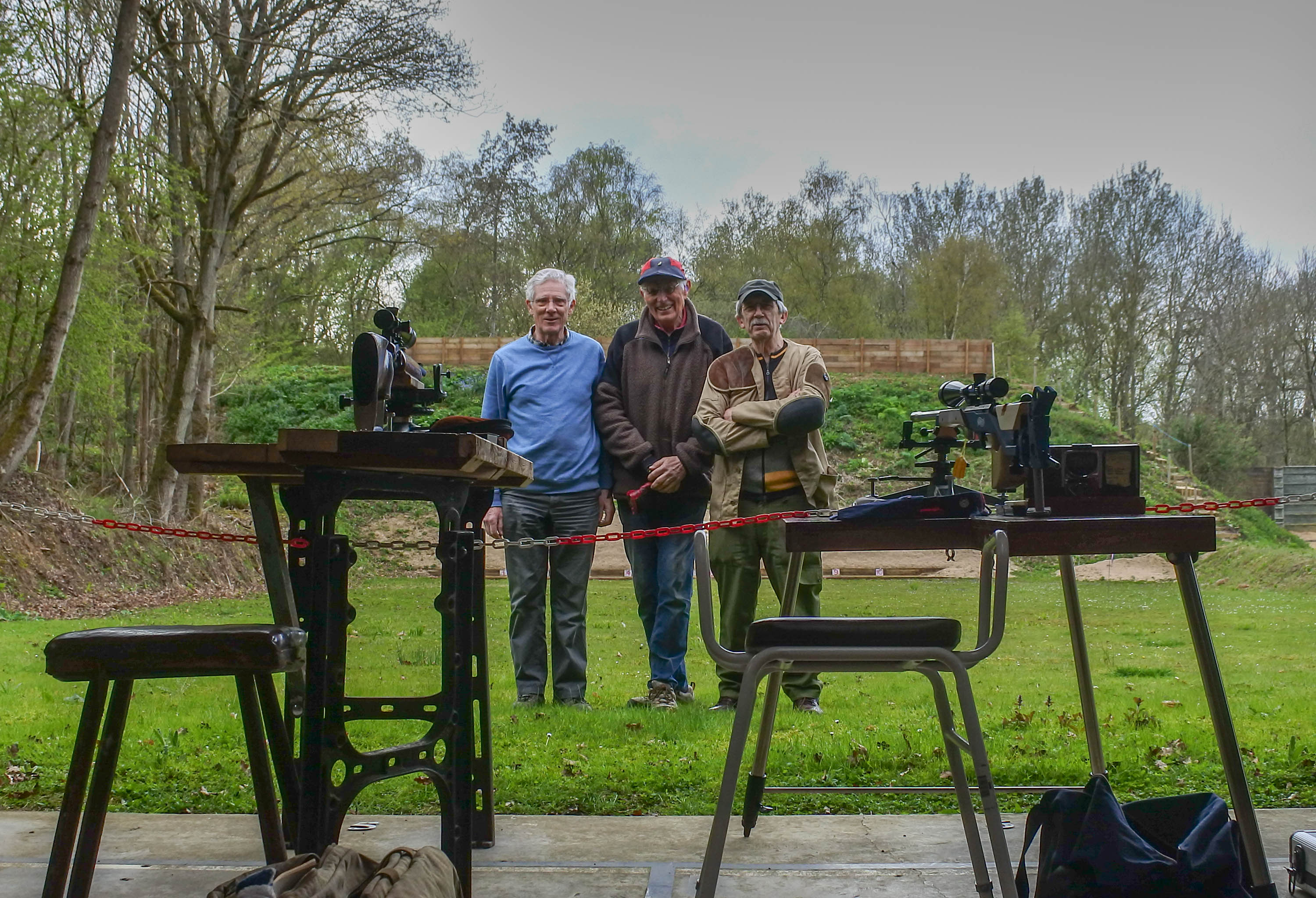
Three amateur BR exponents at first practice for the 50mtr Leagues - early Summer 2023
An early season session
with a modified BSA International MK.III
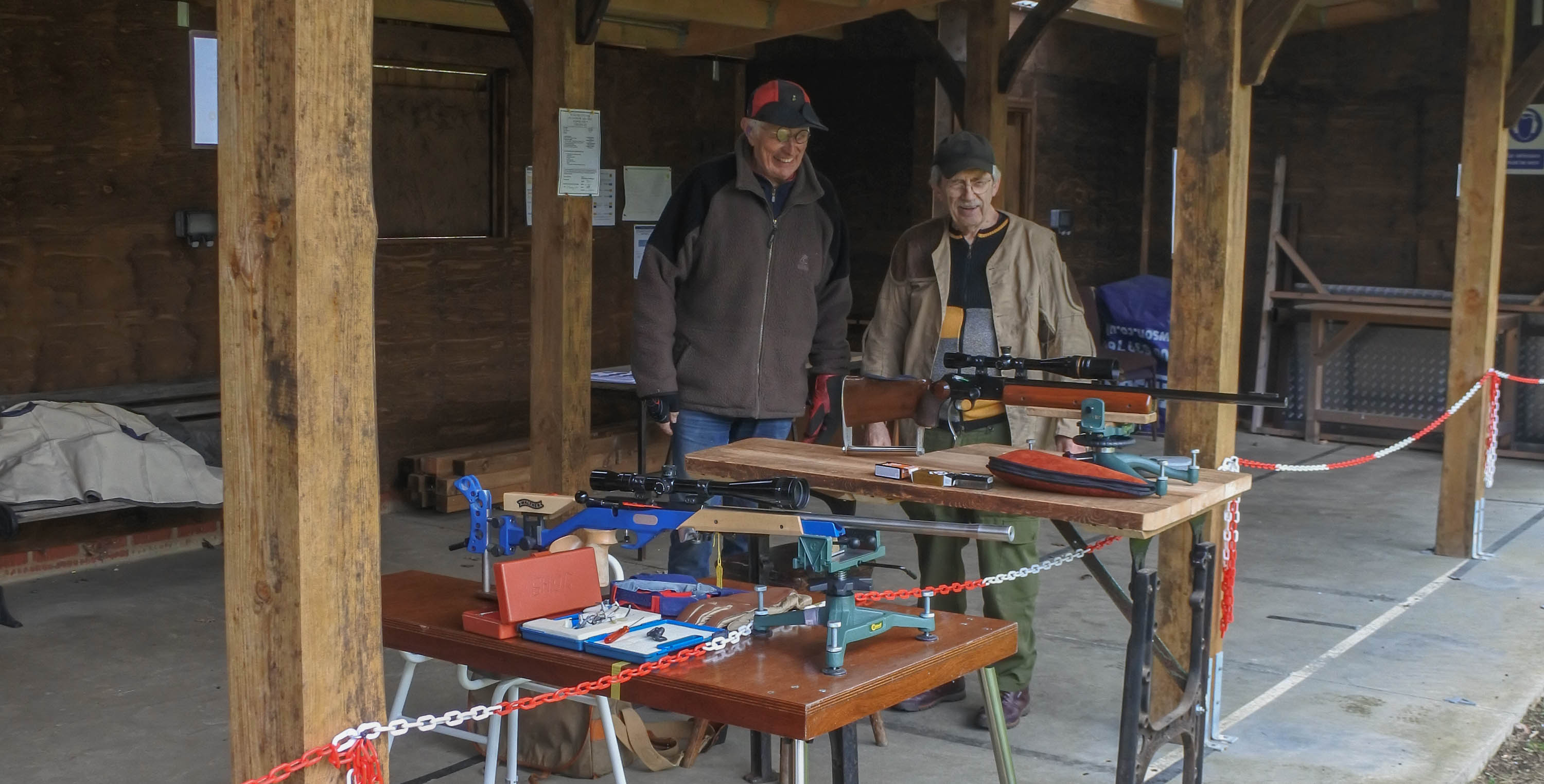
Already pictured in the championship photographs,
we make no apology for again showing the senior team member,
and instigator of benchrest shooting within the CRC,
with his excellent personally acquired purpose made bench.
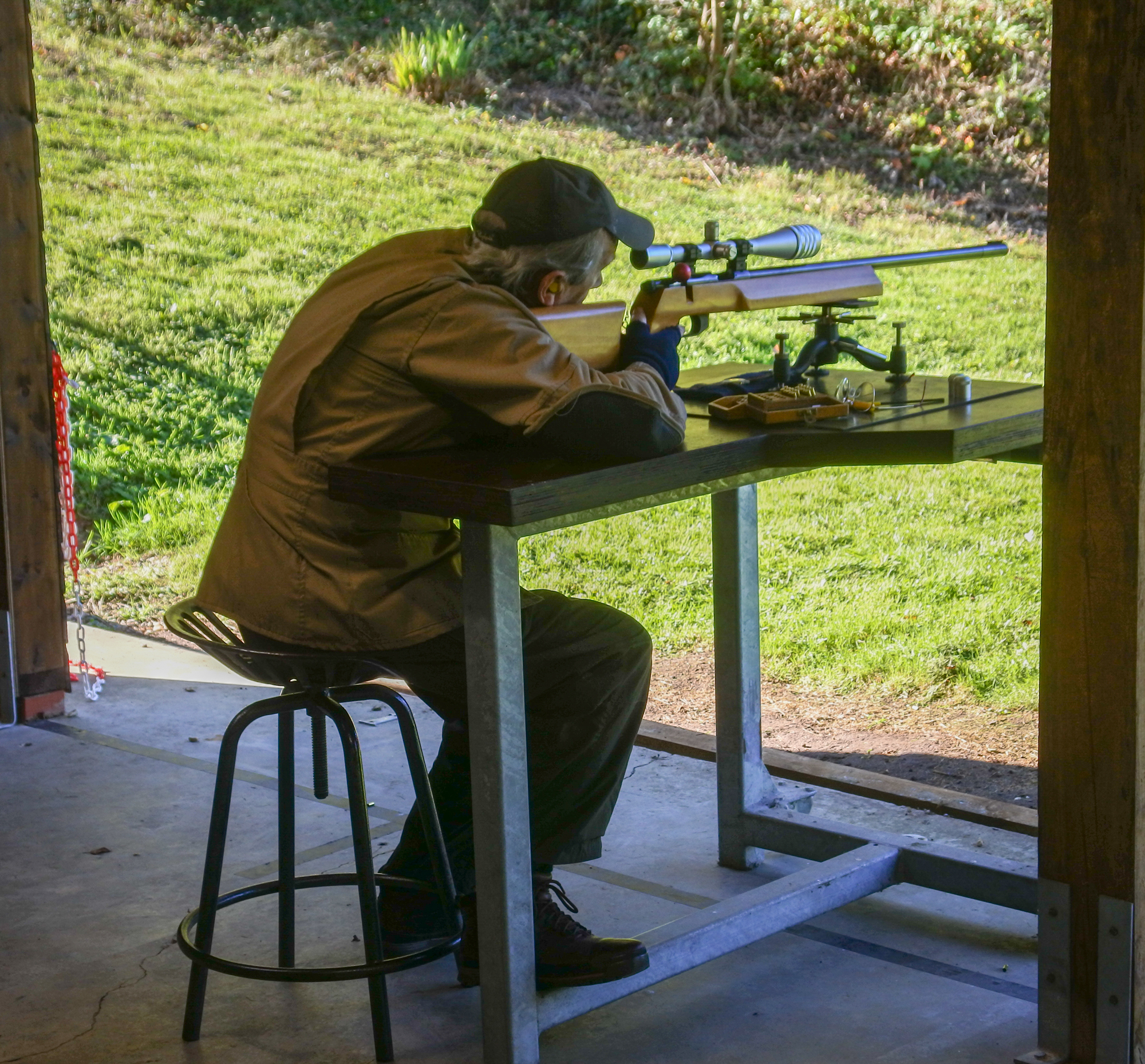
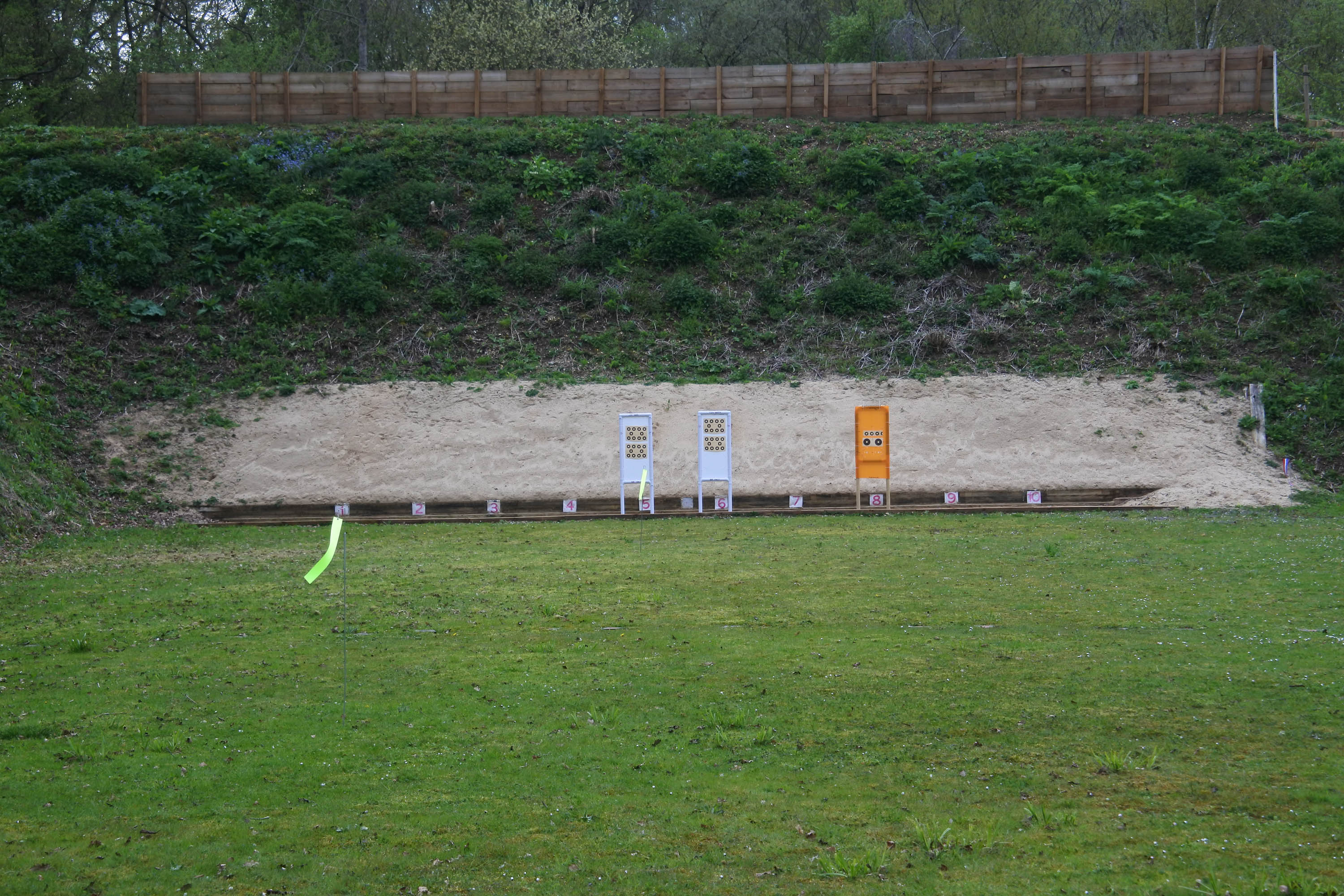
The 50 mtr. upper range used by the team.
THE EARLY DAYS
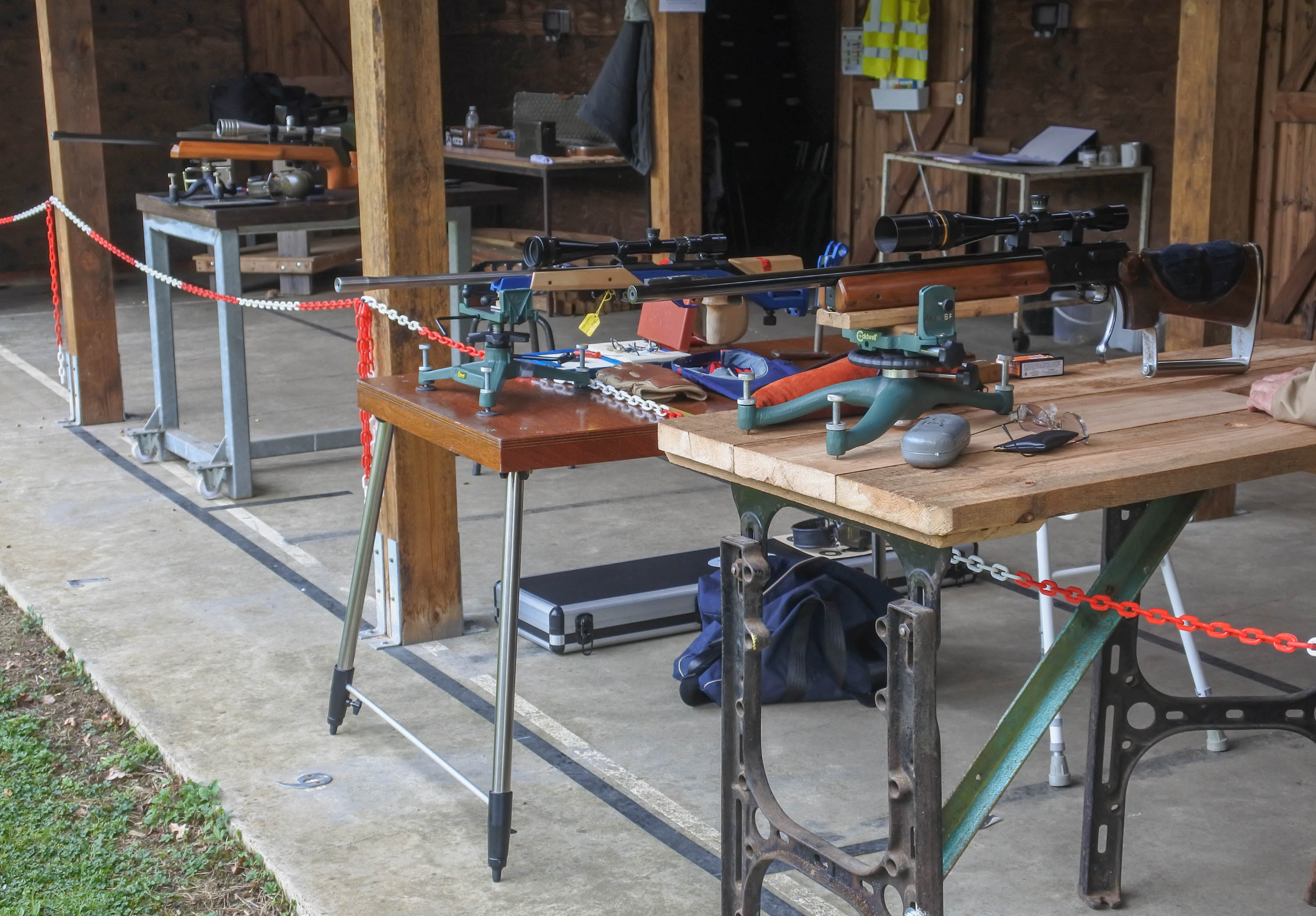
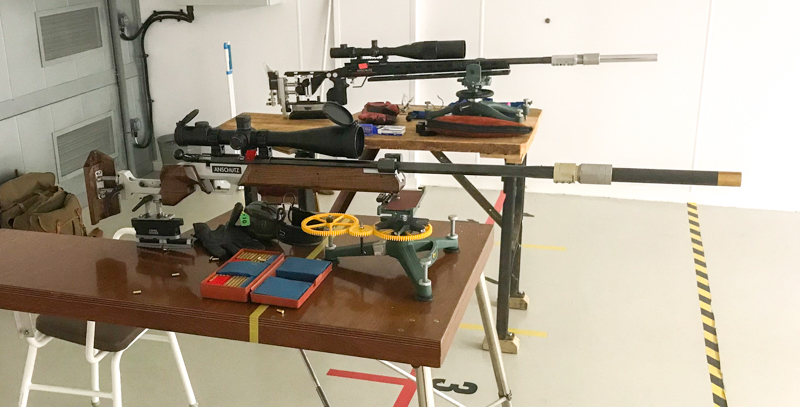
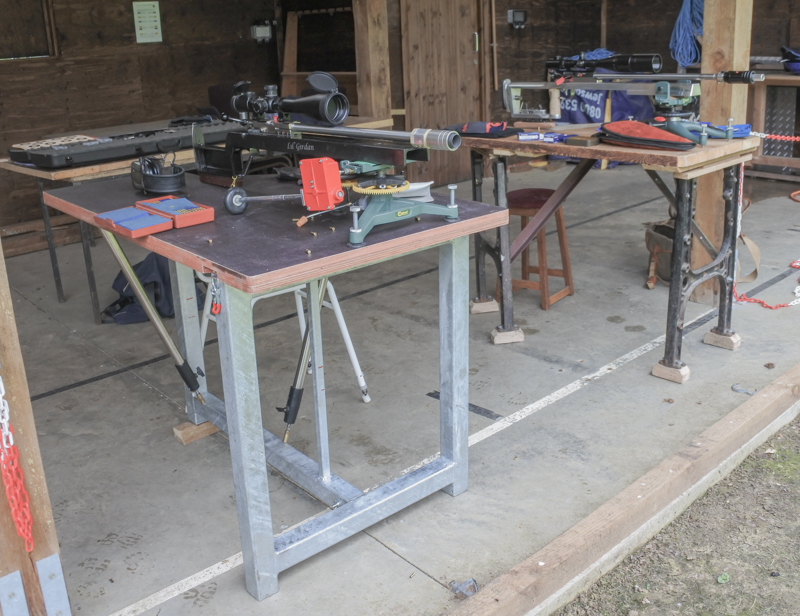
Foreground: Mk.III BSA International; custom-made dismountable bench.
Centre: Modified Walther KK200 ; custom-made folding bench.
Background: Anschutz with purpose-made proprietary benchrest stock and bench.
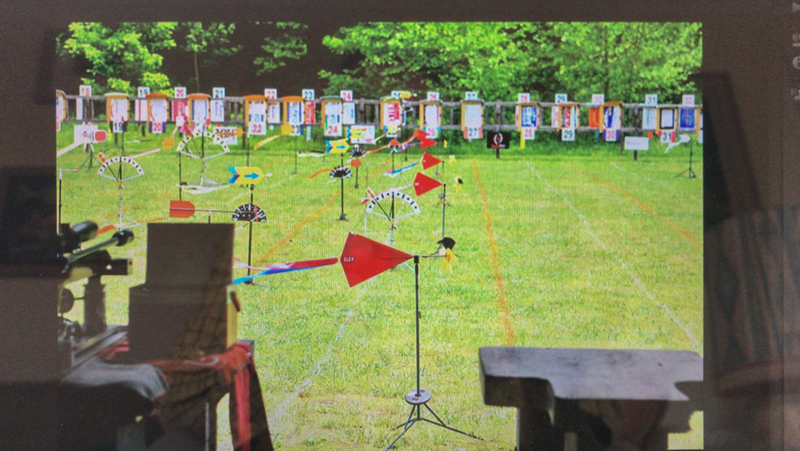
With the upper 50mtr range occasionally presenting particularly trying weather patterns,
a discussion was had on the possibility of an improved wind flag layout,
but perhaps not such as that below - seen elsewhere.
INDIVIDUAL EQUIPMENT
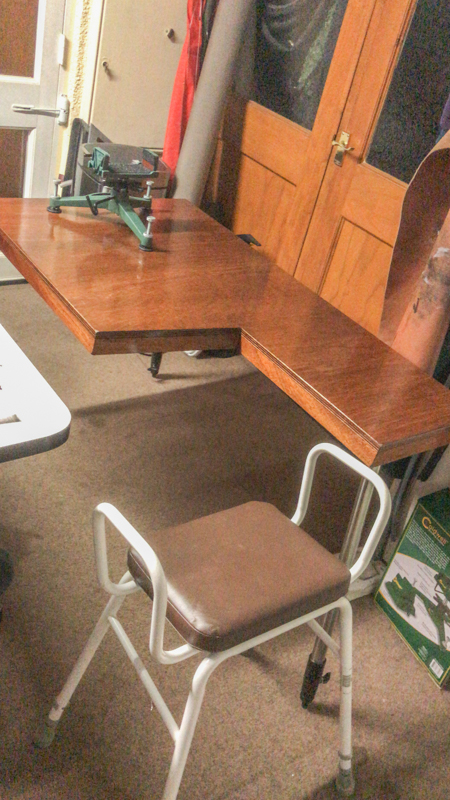
A bench is obviously needed, and can be home constructed.
And a not too expensive rest is required.
Not to mention a stool.
No, this is not the same one as in the clubroom,
but an identical one bought from a charity shop for £5.
The feet were later made finely adjustable with the insertion of four bolts
to accommodate uneven ground,
as the stool next became an integral part of the stability of the table.
More sensible and better balanced shooters use a three-legged model.
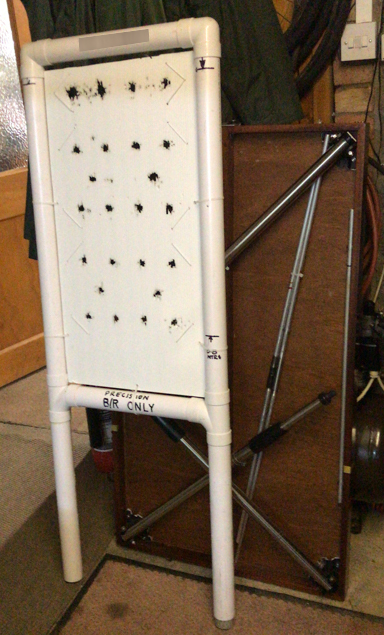
A target frame can also be knocked up from plumbing parts,
along the lines of some existing club equipment.
The above light-weight collapsible bench can be seen behind.
(The description of the latter has been carefully chosen.)
Another team member produced a really substantial version, and a milking stool,
later swapped for a new circular height-adjustable three-legged model.

An early rifle candidate was a BSA Martini International Mk.III
shown here in the club's test bench.


Various inventive butt configurations have been tried over the Summer months,
here being a design for a long under-butt hand support for a BSA Martini International Mk.II..

Susequently changed to a MK.III International, the butt was further modified
using an Anschutz Supermatch adjustable cheek-piece, and an improved hand support.
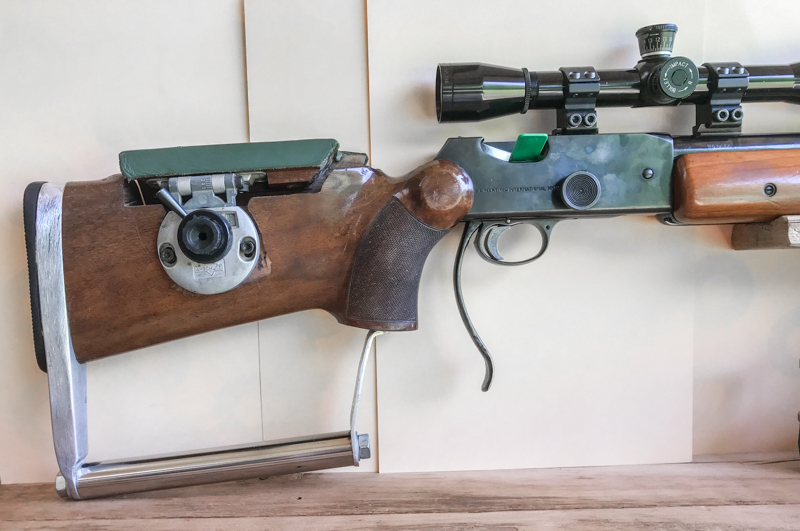
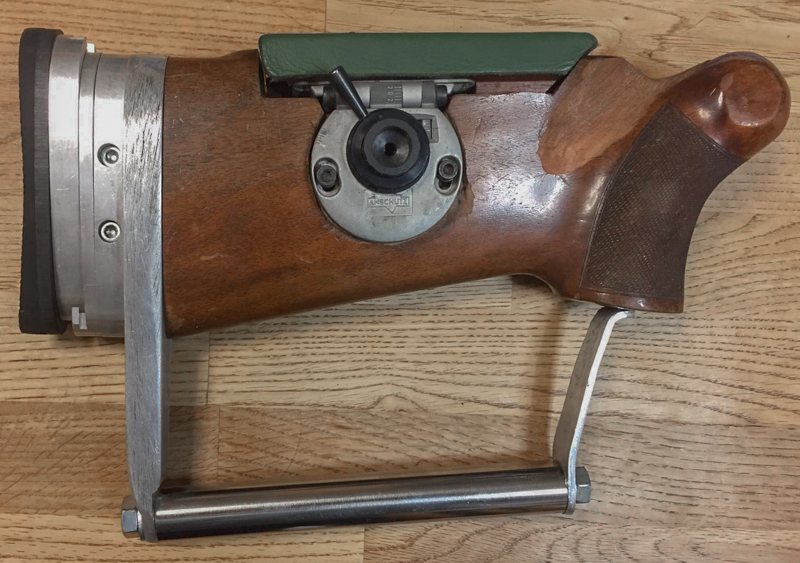
A close-up of the design shows a further modification to the butt-plate.
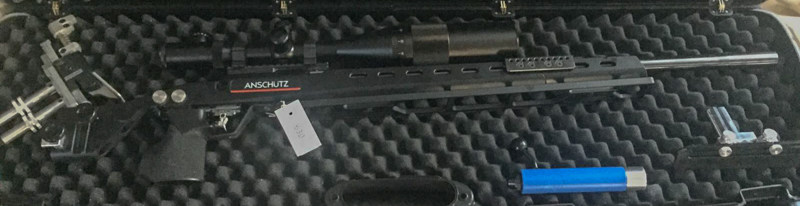
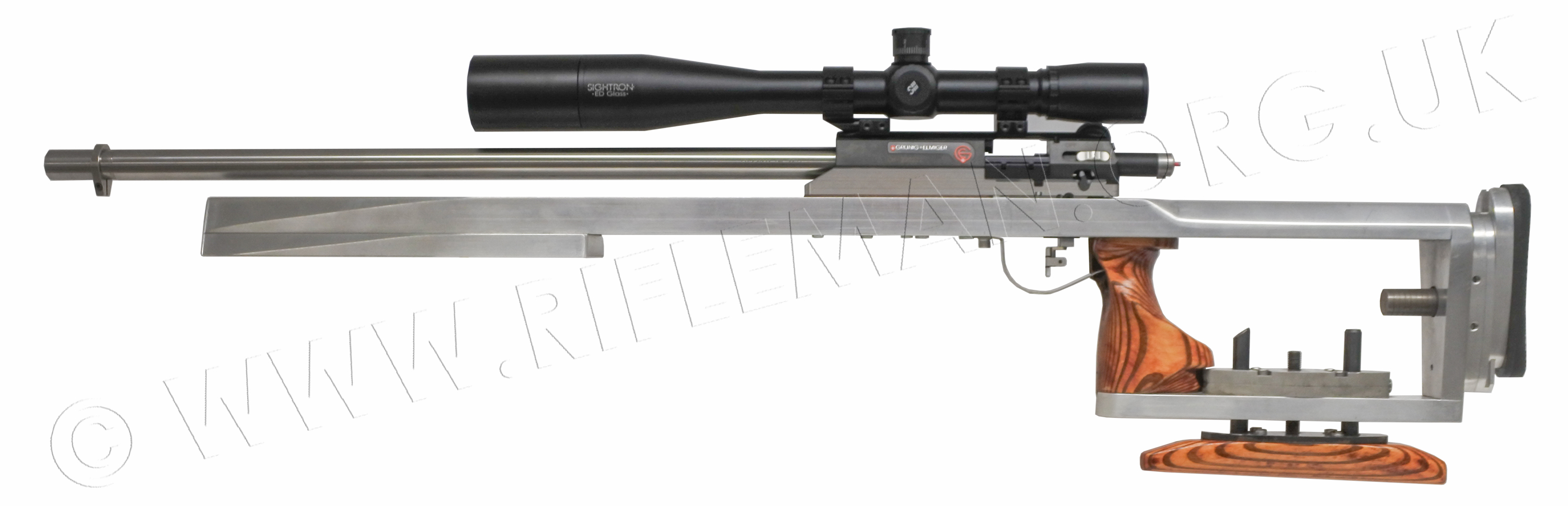
We had earlier been made aware of a very professional refit
of another Mk.III BSA International for benchrest shooting,
and acquired a couple of images of this fine looking and beautifully finished rifle.

One particular reason for choosing these rifles is the simple method by which the barrels are clamped into the action, permitting the comparatively straightforward fitment of a replacement.
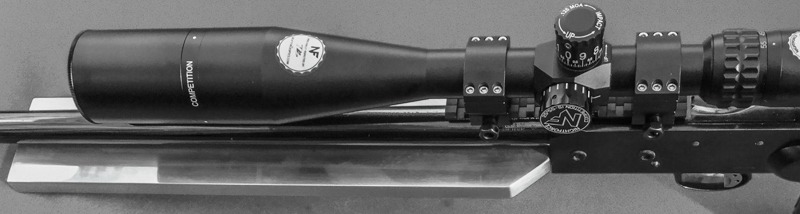
The Mk.III used a fully-floating barrel, with the fore-end mounted on a separate alloy "hanger" also clamped into the action below the barrel. It is apparent that the flate rest plate beneath the barrel on the rifle above has been fitted in that position, replacing the hanger.
On the Mk.I and II rifles the fore-end wood was fitted directly to the underside of the barrel with machine screws. Greater detail of this can be seen on the pages for the these rifles.
See: ......The BSA Martini International Mks. I & II ..... - ......BSA Martini International Mk.III
To convert a more modern prone rifle for benchrest use,
you could even just switch round the cheekpiece and buttplate units.
Perhaps surprisingly, a cheek-piece has proved to be not really necessary,
enabling a more head-upright position behind the 'scope,
and possibly affording a lower mounting of the telescope above the barrel.
A borrowed barrel tuner is shown prepared for experimentation.

Should using a normal pistol-grip hold seem to cause unwanted movement,
a "pinch" let-off between finger and thumb can be employed
with the necessary adjustment being made to the furniture.

Another early candidate was the Anschutz 2013 that once belonged to a late club member.
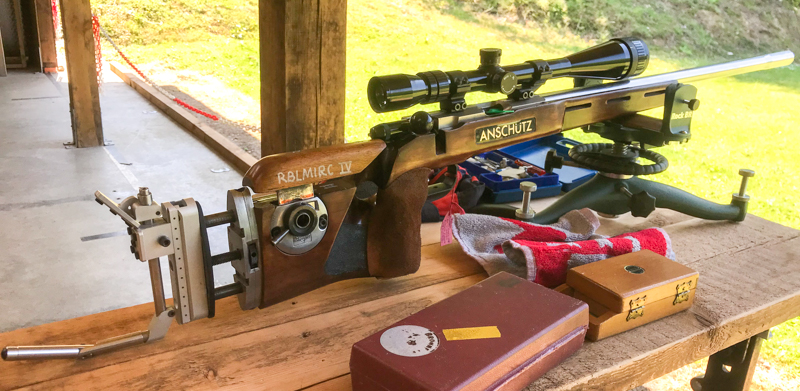
Later, a Walther KK200 was modified for use on the bench.
The lower butt hand support was the "Mk.I" fabrication.

Later the butt support was lengthened,
and the rifle is here shown under test.

The Walther's 50 mtr. test card during which weights were moved up and down the barrel,
while group testing with both R50 and Lapua Centre-X ammunition.
Yes; the position of any weights can make a huge difference.

The group testing target frame for the 50mtr. range.

Telescope sights already possessed were tried,
but a higher magnification than the usual 25x proved particularly worthwhile.
A (sadly Chinese produced) 'scope was the most economical option -
- a Vector Minotaur Gen II 46x60 model for less than £400, compared with the
more often favoured Sightron equivalent model at near three times the price.
The Vectron has an illuminated red dot reticle. but this is of little advantage for benchrest
unless you are trying to shoot after dusk.
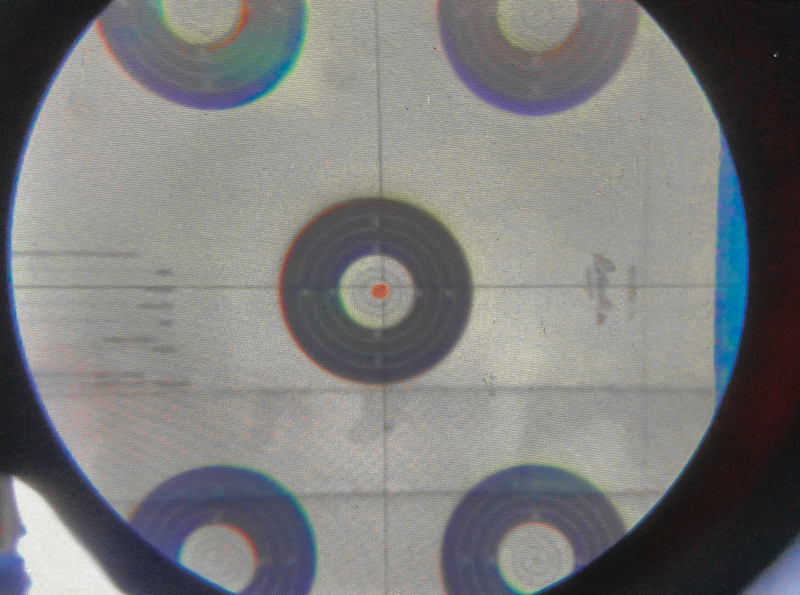
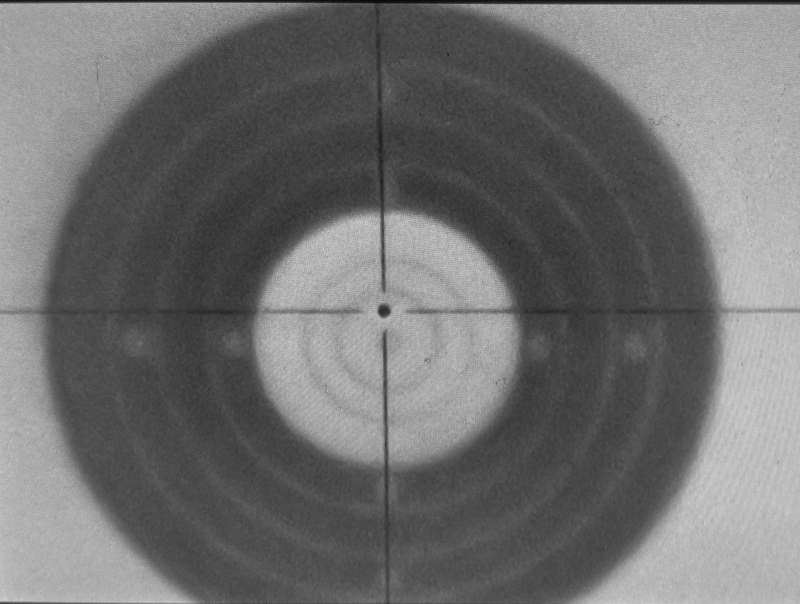
The plain target dot is far preferable.
The 'scope has 1/8th. minute clicks - only just about sufficient.
(The costly Sightron now comes with 1/10 MOA adjustment.)
The Walther cased ready for the off.

Having been fitted with a tubular attachment to the accessory rail for stability on the rest,
with no interference to height adjustment during a shoot.

It is possible to purchase a rest, at a price, that permits both elevation and windage adjustment.
This was a type considered, but not all competitions permit use of windage adjustment of the rest.

One team member opted for a brand new item that would adjust in both planes,
although the windage knob was all but out of reach without laying down the rifle.

Means were sought to put adjustments within easy reach,
and these fine wheels were offered by another helpful team member.
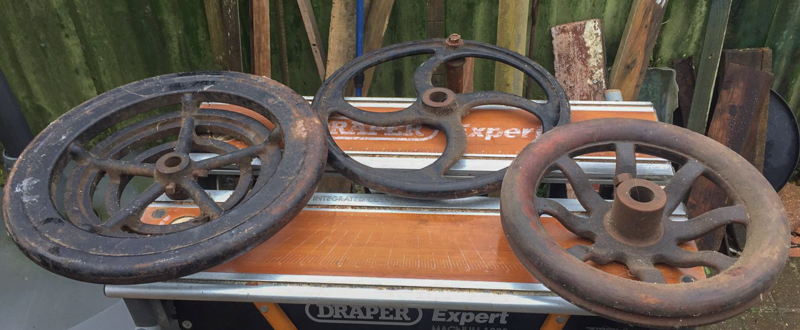
Desperation brought one team member to make a significant purchase,
here shown on its arrival. More of which later.
Here the earlier Anschutz in the foreground has its cheek-piece used as a butt-plate,
and the butt-plate used as an adjustable hand rest.
The well-known competitor who had acquired at auction a particularly good-value
almost new Anschutz "Perfection" model with a good 'scope included,
(retiring his trusty Leupold for the time being)
improved stability by the addition of a large aluminium beam to
replace the over-flexible and once expensive proprietary
benchrest ladder frame that came with the rifle from new.

The consideration of "pinch' trigger let-off led to the modification shown below,
a component of which may be recognisable to historic rifle shooters.
For the uninitiated, it is the trigger-guard cut from the unit of a Lee-Enfield rifle.
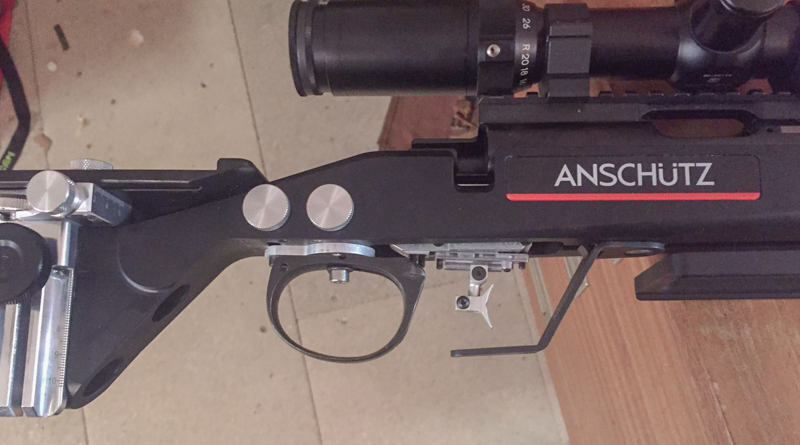
Not entirely happy with the arrangement, an alternative pistol-grip was designed and tested.
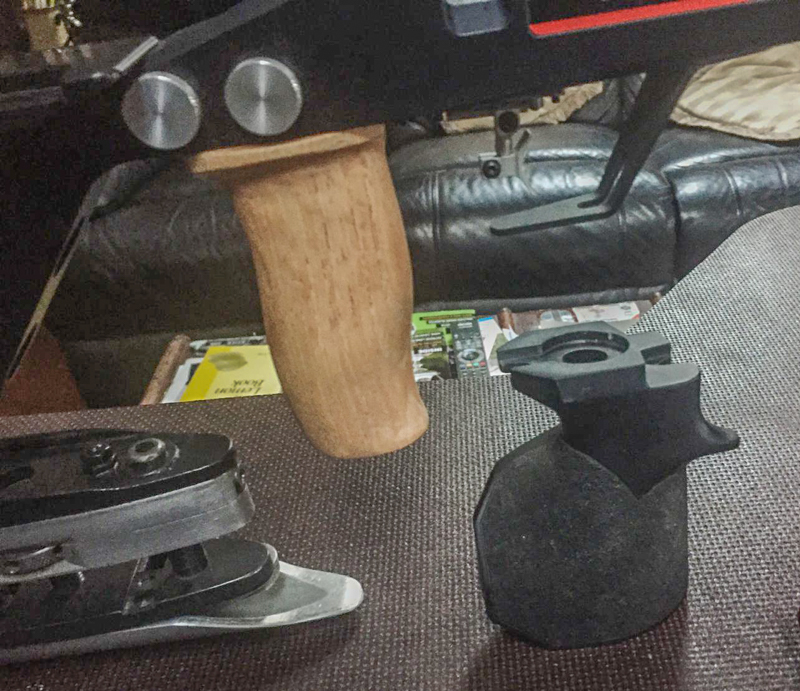
Further consideration was given to the butt arrangement,
with a fine curved under-butt hand rest being engineered.
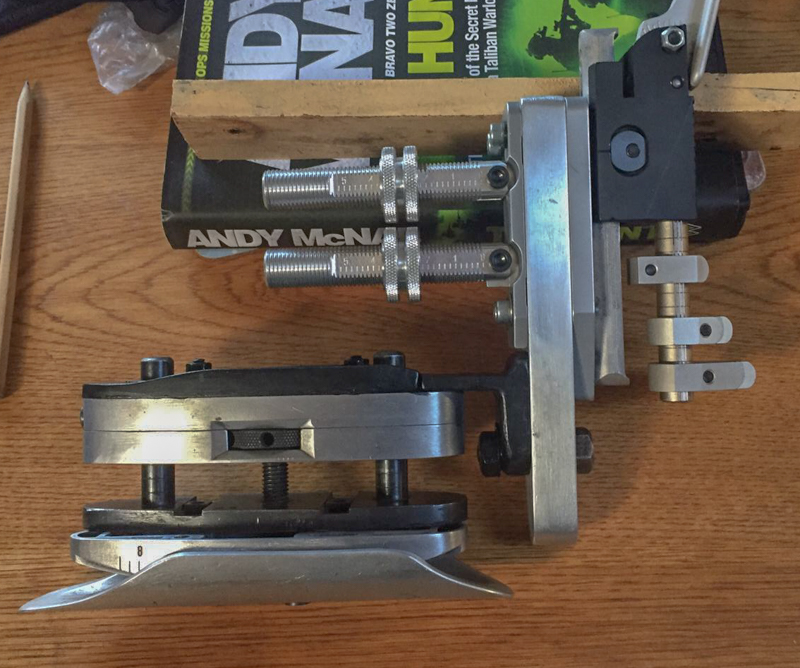
The above design allowed an unintended lateral "roll" to the hold,
and a flatter, warmer amendment took place.
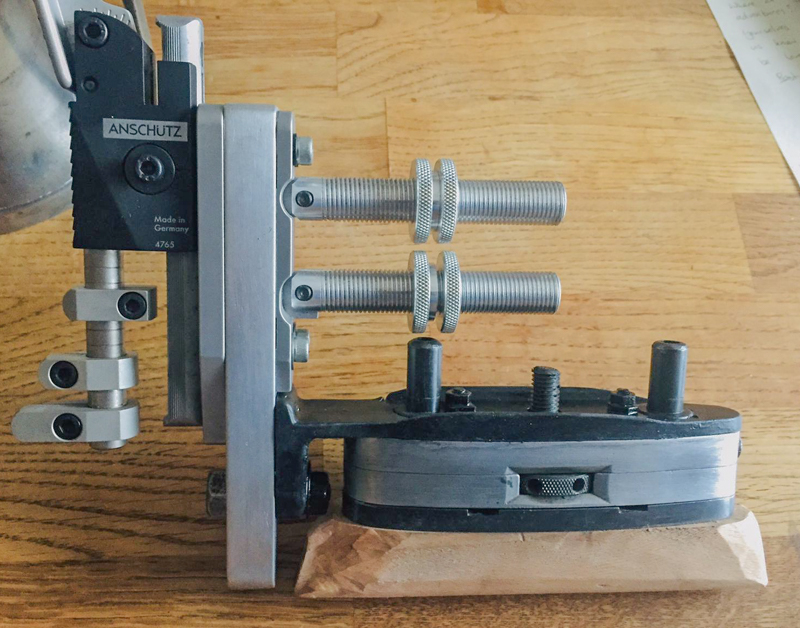
But proving too short 'front-to-back there came a further alteration.
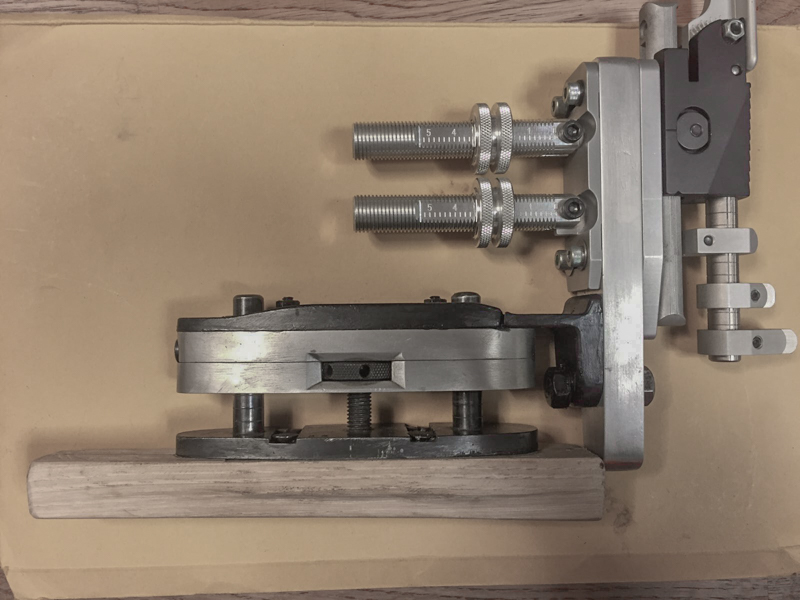
One member's further project has been the building of a one-off BR rifle.
Requiring the removal of an Anschutz 2013/2007 square action from its donor rifle.
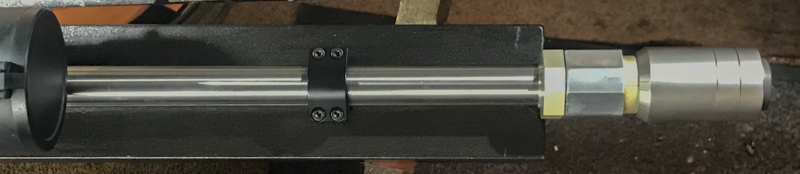
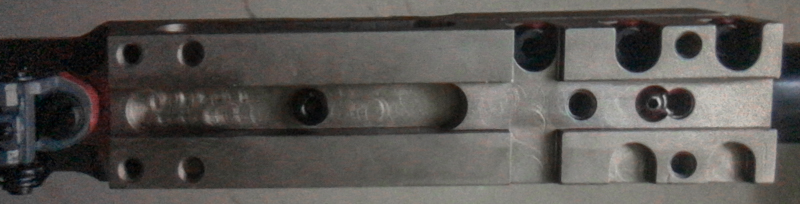
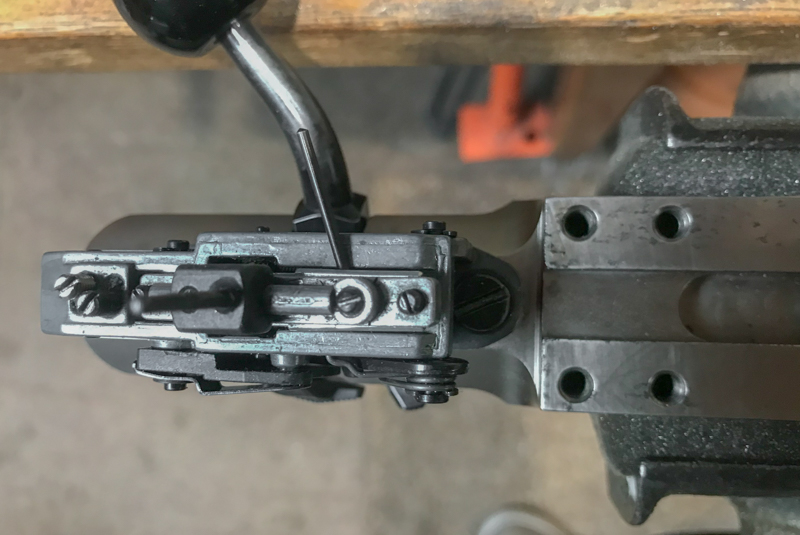

The acquisition of a new 21" barrel by Lilja.
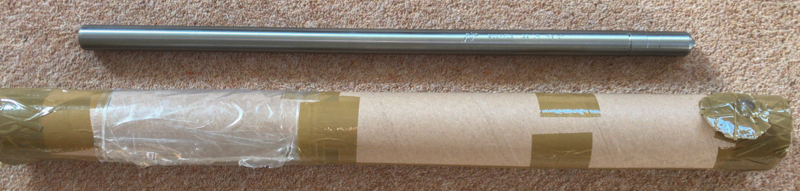

With its ability to rotate same to obtain the best harmonics regardless of extractor position.

Clamping into the action.

The purchase of a new all metal stock.

A barrel tuner.
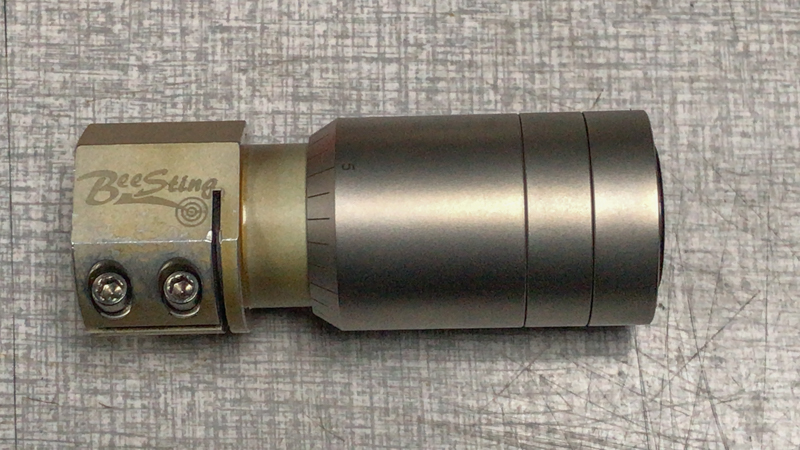
A sleeve to adapt the tuner to the lesser diameter of the new barrel.

The test fitting of the action to the new stock, prior to stock completion.
The careful bedding to permit access to the trigger!
Shaping of the stock.

Test fitting of action and 'scope.

Frontal view of rifle lying on its left hand side, with tuner in place.
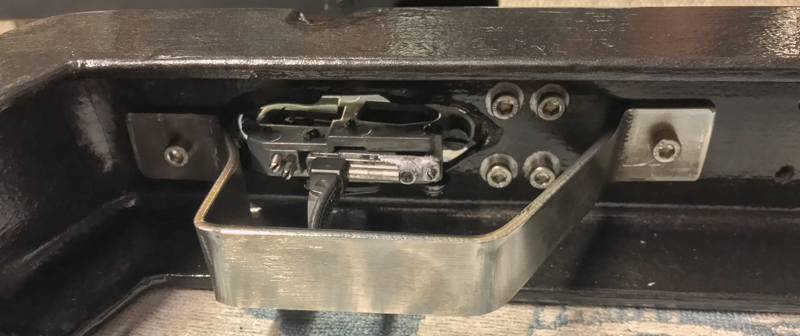
The elegant trigger-guard, designed for a thumb/fore-finger 'pinch' let-off.
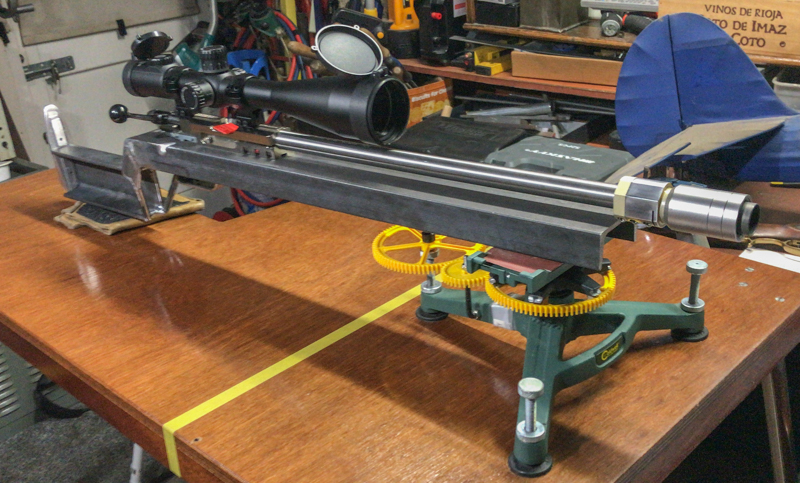
Trial on rest now modified to permit elevation adjustment using right hand,
allowing left hand to remain under butt between shots.
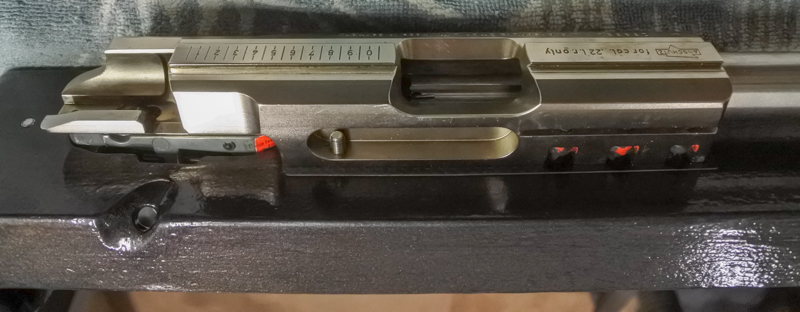
Stock finishing in the spray-shop.

Barrelled action fitted into finished stock.
Trigger unit complete.
Showing the rear four of the action's six bedding bolts.
A first trial and 'scope setup was achieved at a fine local 15 yard indoor range.

The 10-shot 7.2mm group shown below was shot at 15yds
on an NSRA diagram on that occasion.
The diameter of the 15 yard bull is 9.85mm.

Further group improvement and barrel tuning was undertaken using the CRC test bench at 50 mtrs.

Then first target trials on the upper 50 mtr. range.

The bench setup - showing elevation wheel gear extension now just within reach of right hand.
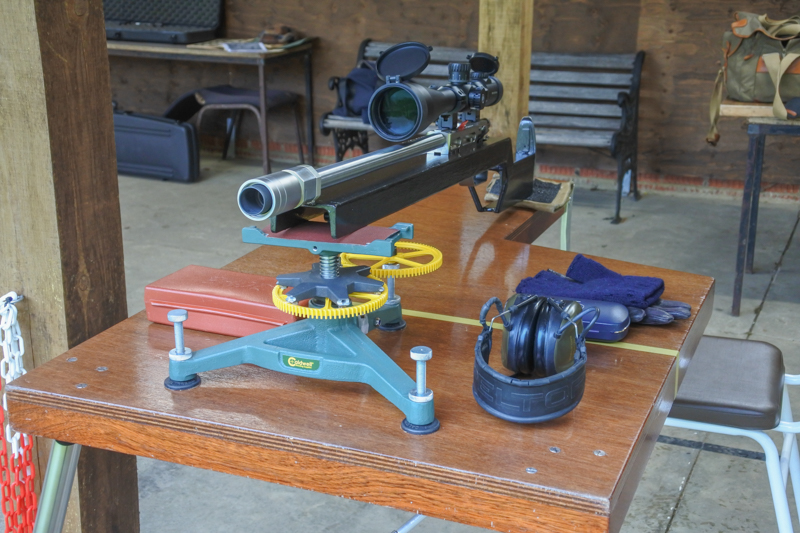
Already modified to permit its height adjustment to be more easily made with the right hand,
as previously mentioned, it was decided to modify the rest to also have
windage adjustment by fitting a lead-screw underneath that linked to a sliding plate on top.
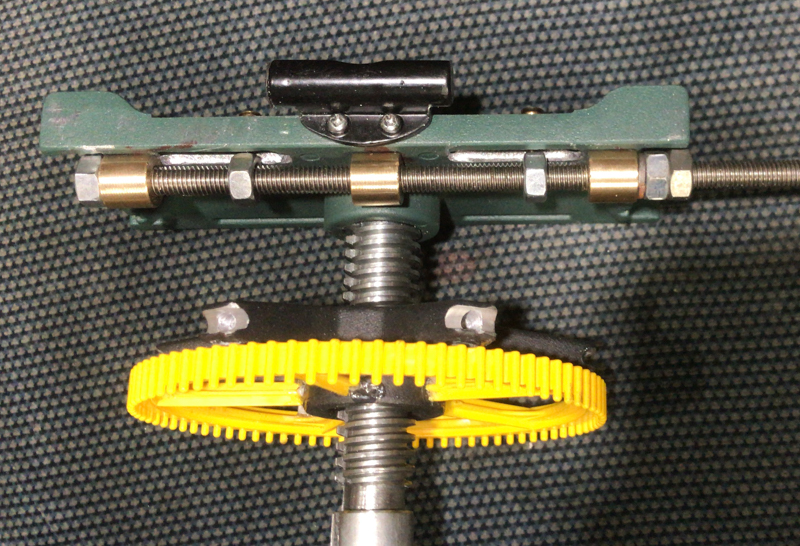
The sliding windage plate.
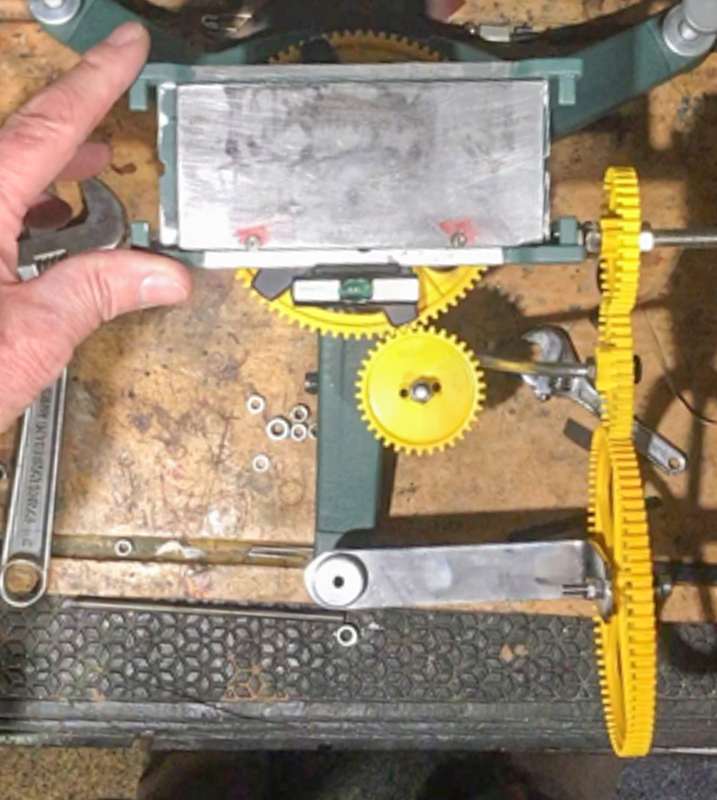
Arranging the gear linkage meshing to accommodate the accompanying
elevation adjustment proved tricky, although a sprung setup made this possible.
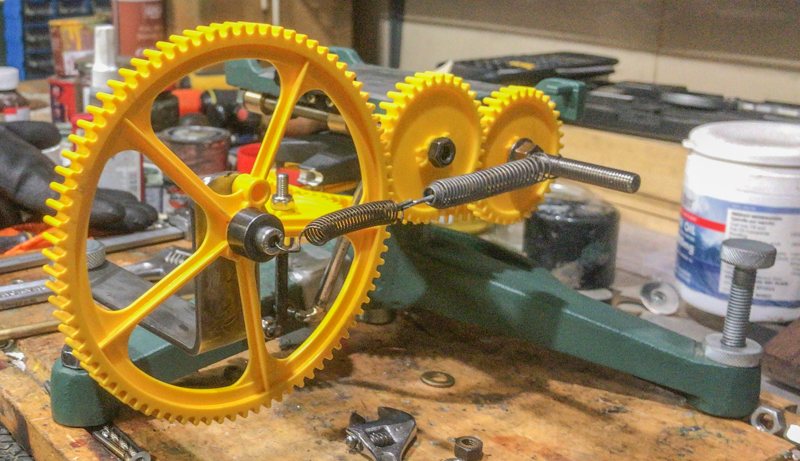
But the similarity to some of Roland Emett's and Heath-Robinson's inventions was likely
to cause mirth and unwarranted critical comment on the points.
So an alternative method was decided upon, using a right-angle gearbox
gifted by a bee-keeping friend who had motorised his previously hand-operated honey stirrer.
Operated by a model aircraft wheel, the system cunningly and
automatically adjusts position as the rest is raised or lowered.
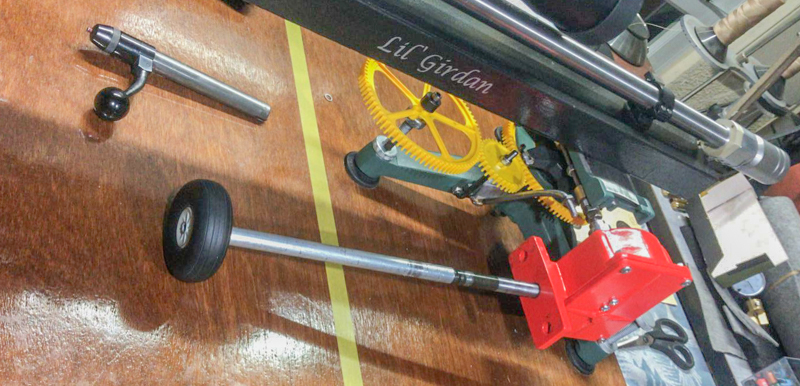
As may have been spotted above, the new girl has been named for the barrel, the action .....
............ and the girder to which they have been mounted.
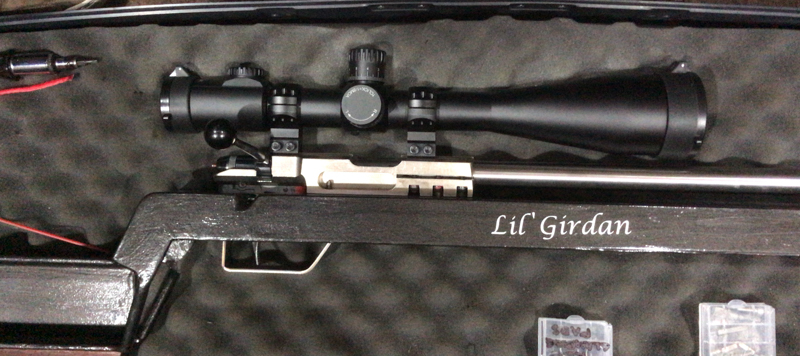
Here first used in competition on the indoor 25 yd. range.
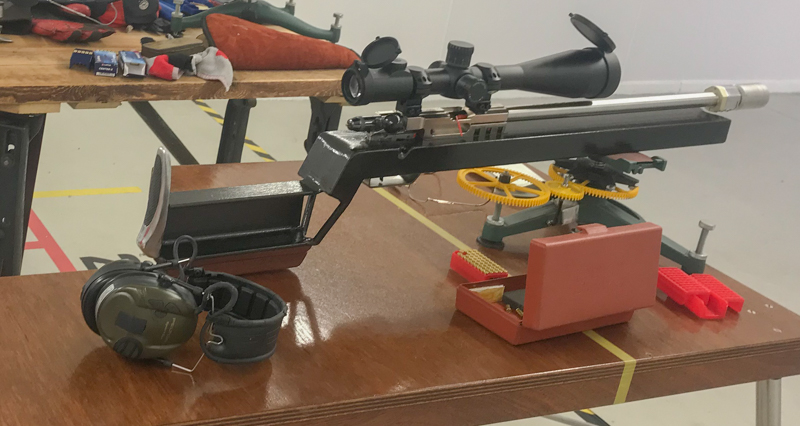
And, outdoor at 50 mtrs. - showing the business section.

The then more recent trial modification changed the rifle from using a free-floating barrel
to a clamped type, approximately 2/3rds. of the distance from breech to muzzle.
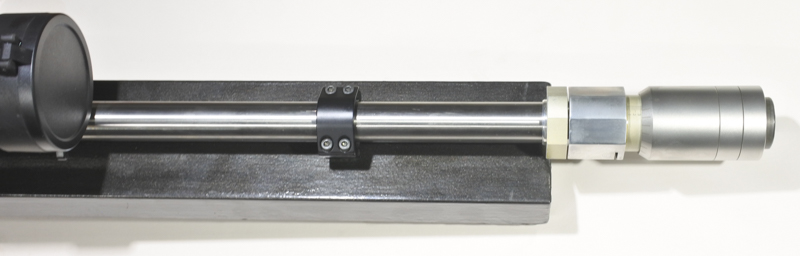
A 1-inch 'scope ring mount was used.
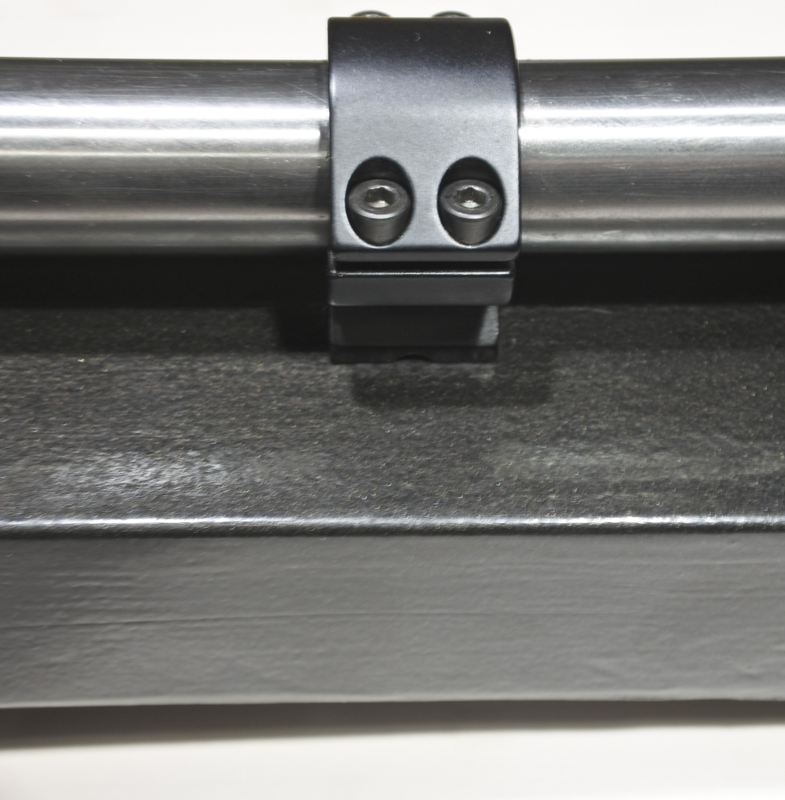
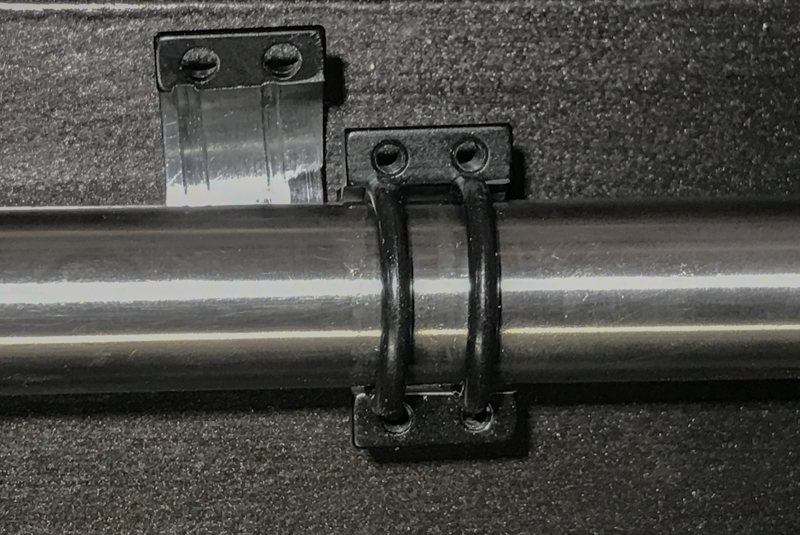
Twin o-rings are heavily clamped to the barrel,
permitting a flex of only about three 'thou' in each plane.
After fitment of the barrel clamp, a 25 yard test provided a ten-round 8mm group.
This is NOT equivalent to a 16mm group at 50 mtrs,
as a group that would be formed at the muzzle at zero range starts at approximately 5.6mm!
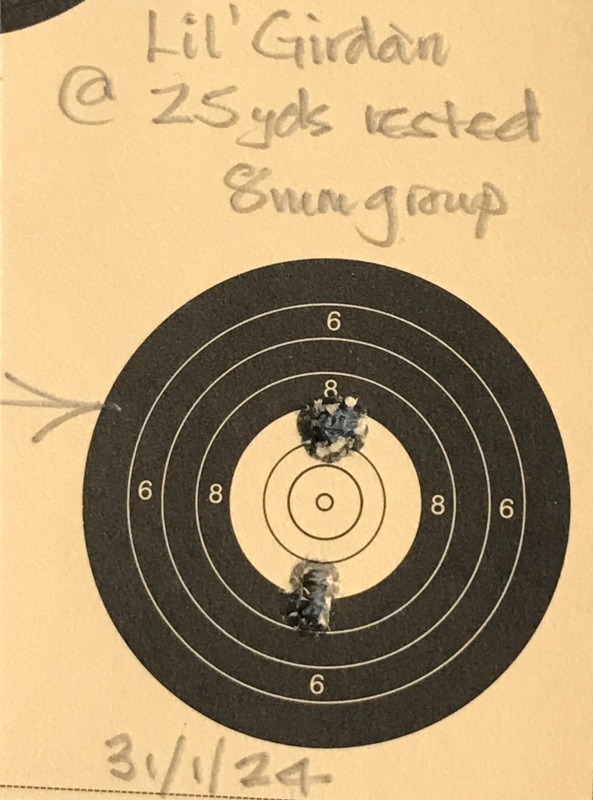
The lower group was prior to a tuner adjustment, proving that, even with the barrel
heavily damped at approximately 2/3rds. along its length,
a tuner remains surprisingly effective.
A good 25 yard practice card, (sadly and typically not a comp. card), is shown below.

With an evident need for more a more stable table, an approach was made
to a Northern supplier, who kindly brought two down for the club. (Not free).
Himself a worthy and successful benchrest shooter,
he brought his kit to demonstrate how our highly competitive opposition operate.
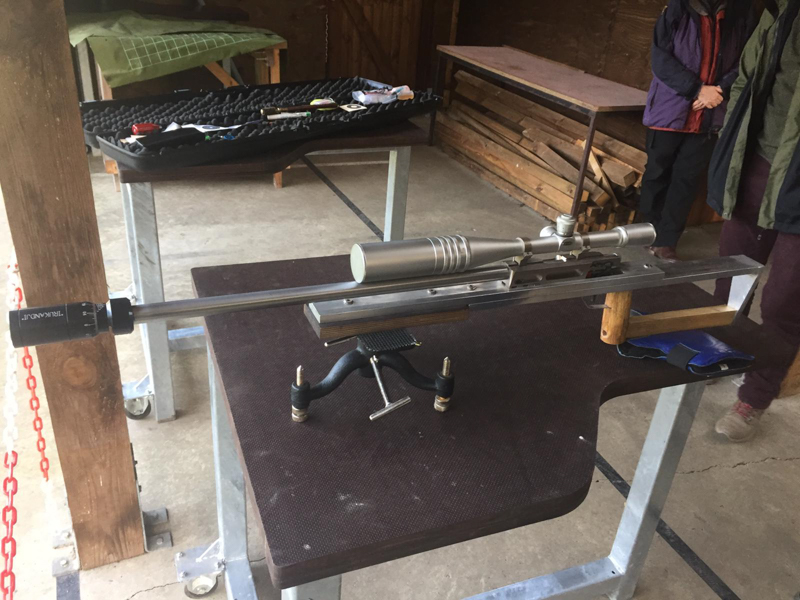
Photographs were surrepticiously taken, in the F1 manner, to afford later scrutiny.

With close-up shots of his 'scope .....
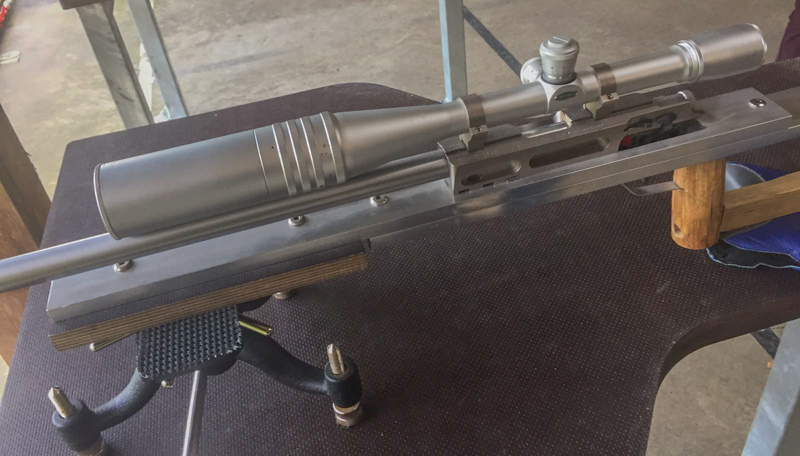
......... and his expensive tuner.

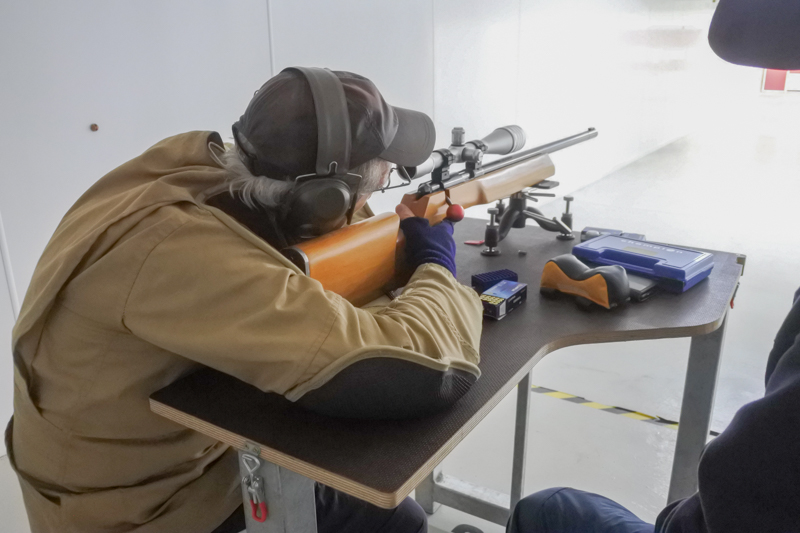
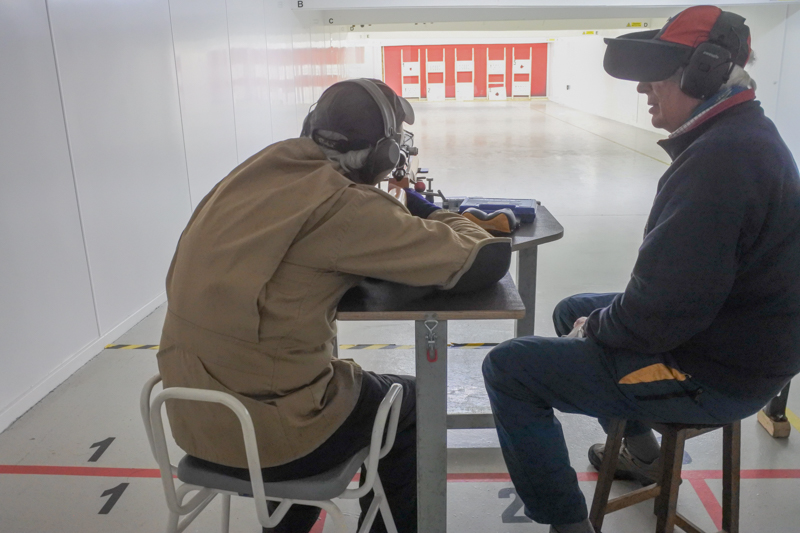
Two of the team shooting the last 25yd cards of the 2023-24 short range league.
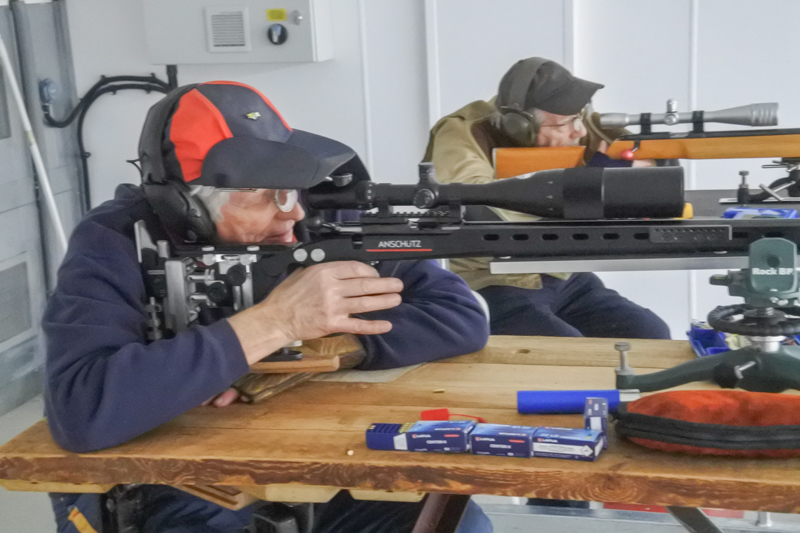
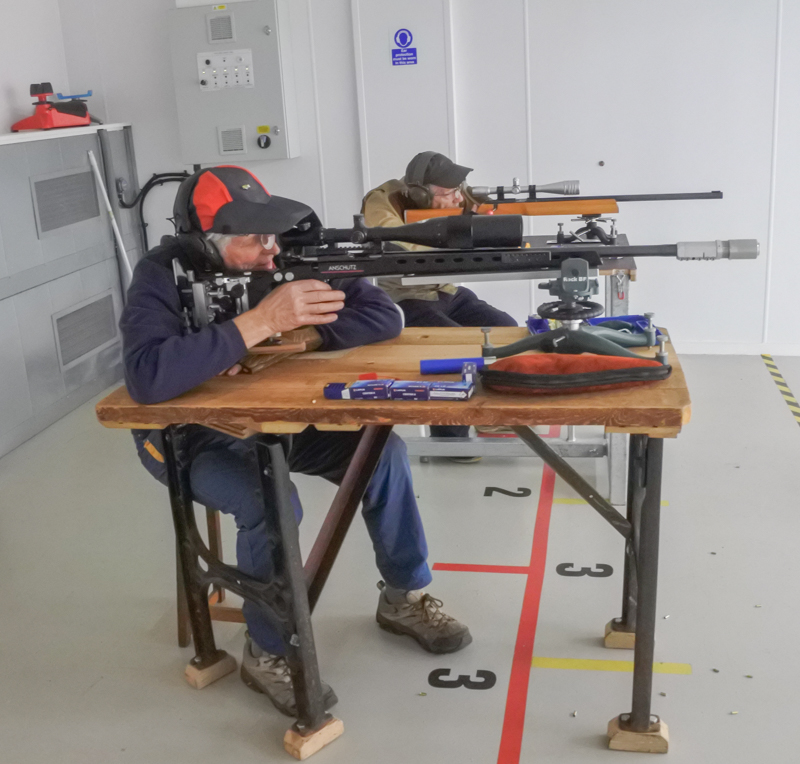
On the new "take-down" bench.
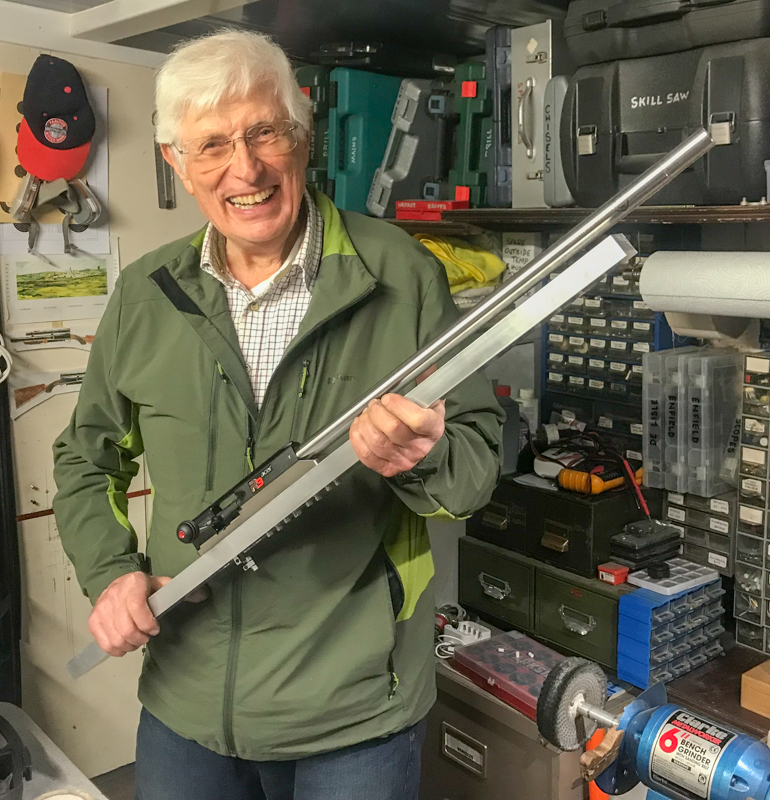
This elegant poor creature is threatened with retirement after only a few months.

The first sign of a new development - bar none!
The prototype of the latest model of "LEK" rifle - the 'LEK BR Special'.

Not exactly a hole in one.
Who bought an aluminium girder too long to fit across the lathe milling head?

Small bore activity?

Are you cut out for benchrest?

Evidently an attempt to Racer head.

Who among us can see the similarity to a Swedish 1896 Mauser?

The long and the short of it ............

....... and a sneak view of the aerodynamics of the undertray,
with the array of titanium bump stops that will shower sparks on the track.

After tidying in the filing cabinet.

Well, someone is pleased!
The test rig on the 25 yard range!
No sign of extraneous accessories;
just a clean-lined lightweight model of a heavy BR Rifle!
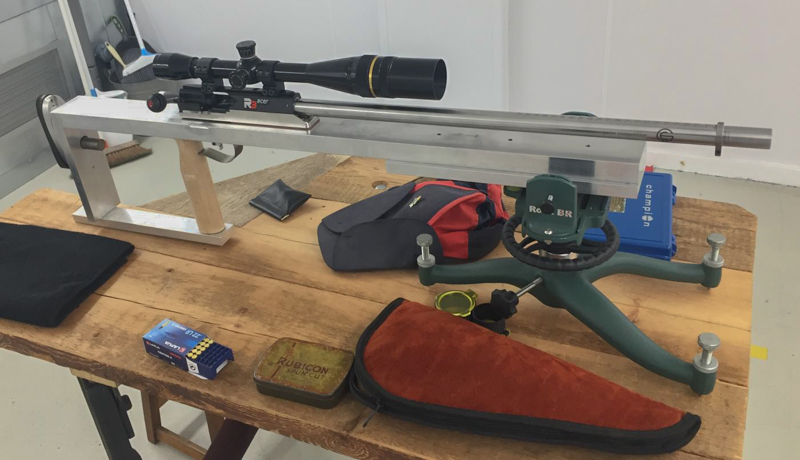
And, in the best tradition, the new girl is not completely devoid of fine timber,
well-seasoned hickory,
which carries her carefully chosen name - "Faithful".
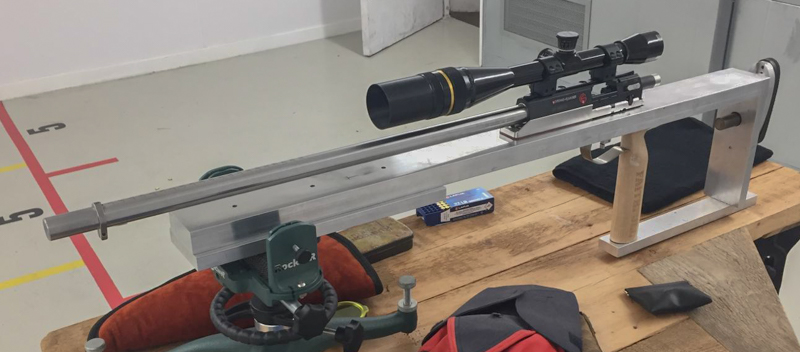
And, what's more, she is living up to all prospective hopes,
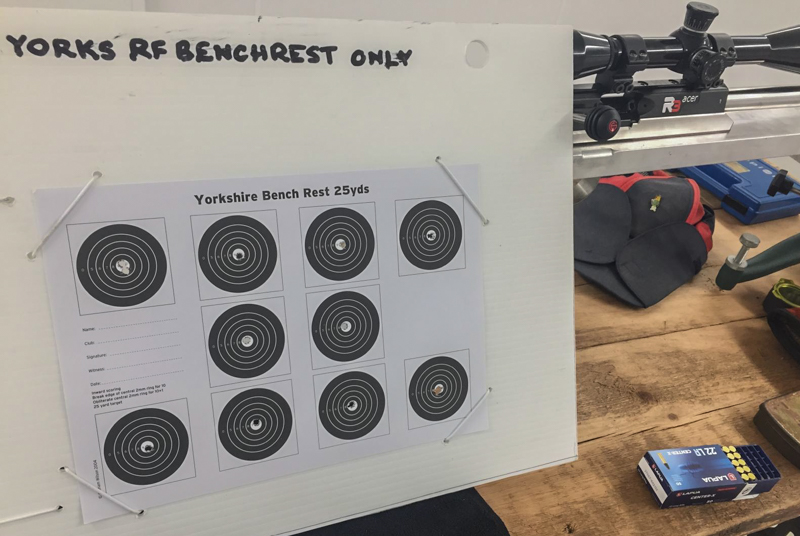
with a first test card (BR, not BBC) showing a score of "100.7",
worryingly challenging for competitors considering she has yet to be "tuned"!
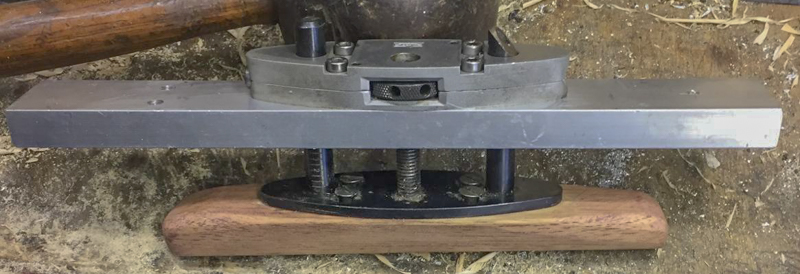
The next uplifting requirement is for a new slant in butt elevation systems.
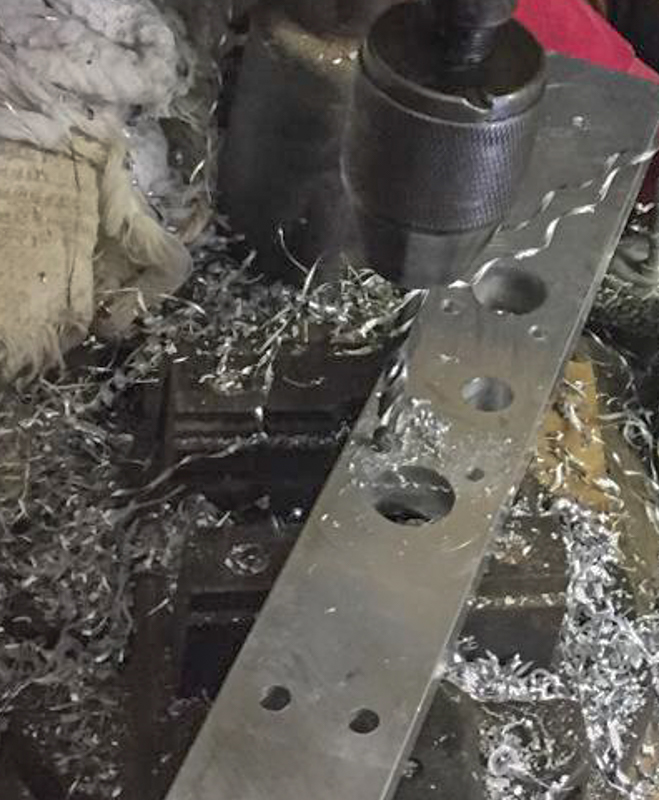
For which the engineer, after drilling many more holes,
must tap into all his resources .......
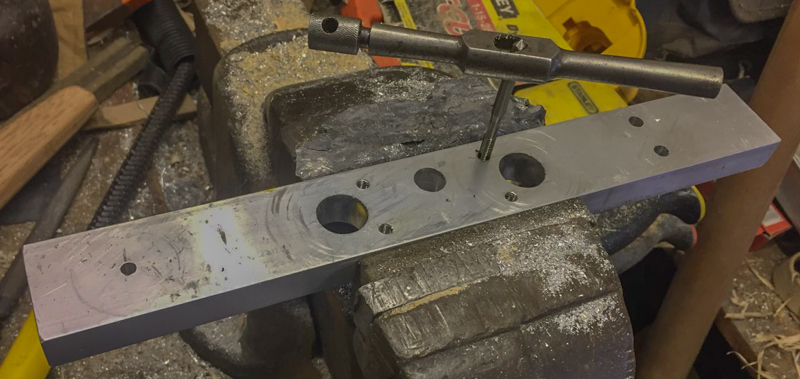
.......... including cannibalised Anschutz parts,
and perhaps more hickory,
unless you have used it all and find something else.
The "LEK" stock being finished and assembled.

AND FINALLY - "GERT" APPEARS IN COMPETITION

Hover over or Click image to bring up hi-res file
Mid April - 2024

Hover over or Click image to bring up hi-res file
Hover over or Click image to bring up hi-res file

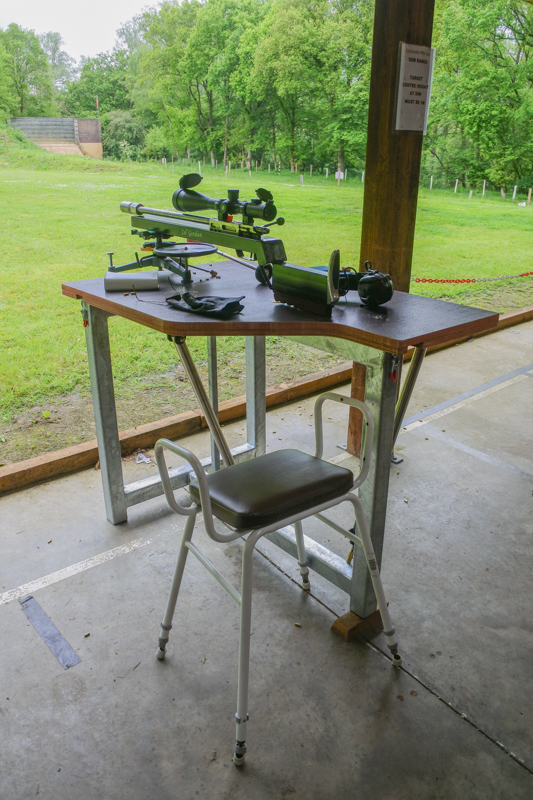
NEW BENCHES as of May 2024
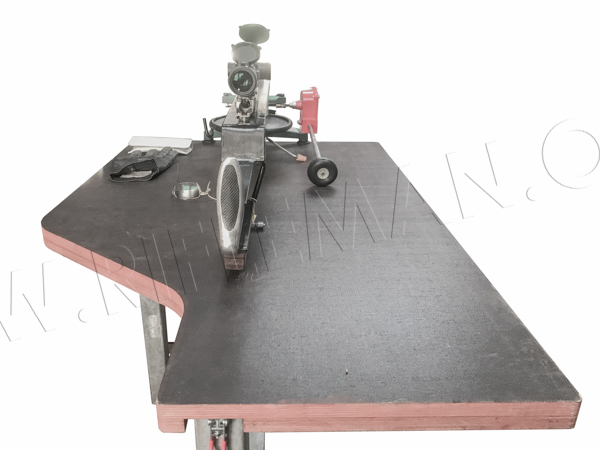
This excellent professionally produced collapsible portable bench replaced the old home-made folding model that was frankly insufficiently stable, showing significant movement through the 'scope around the target, particularly when moving to adjust the elevation and returning to the firing position.
But even the heavy, stiffer new table showed more than ideal movement in the same way, with the rear of the bench table only being supported centrally. This allowed a warping twist across the bench near the elbow, arm and hand resting points that showed up in the telescope's sight picture.
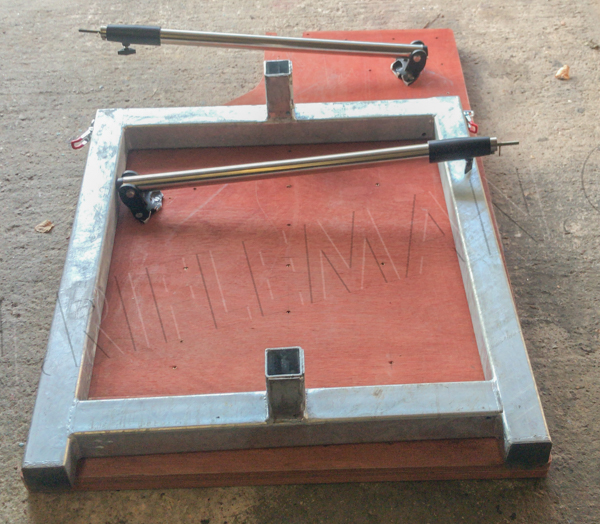
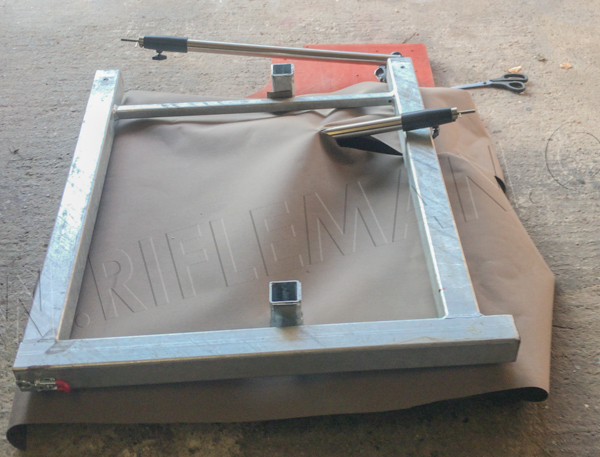
Stiffening folding supports have been added either side to alleviate problem and reduce the movement.
Click image for explanatory video
Below: the bench as it would be unbolted for transport.
Left: the base frame and bench top with supports folded.
Right: the whole as it would be put in the car.
 ..............
Click HERE for video giving detail of the additional stiffening struts.
And the new bench's first range outing.
A well-known member's well-used and hitherto adequate home-produced bench on the right
is also about to be replaced by another of the fine Yorkshire sourced de-mountable bench on the left.
________________________
2024 to 2025 WINTER SEASON
Part way through the Winter Leagues, the original homebuilt stock
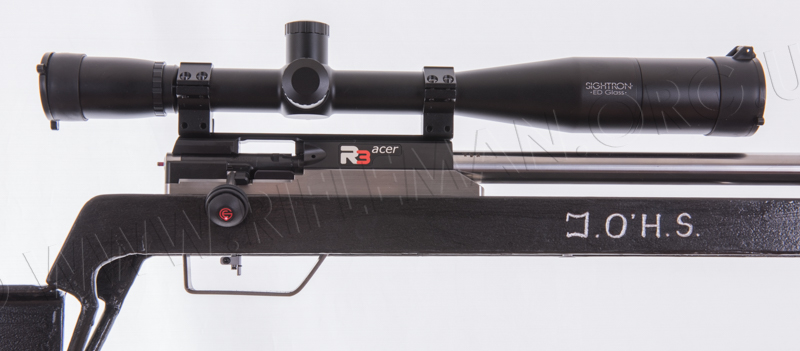
has been used to mount another Grünig and Elmiger Racer 3 barrelled action,
and fitted with with a Sightron 45 x 45 'scope replacing the Minotaur.
This became necessary due to difficulties finding ammunition
that suited the Lilja barrel when the supply of R50 ran out;
in fact, finding practically any ammunition at all!
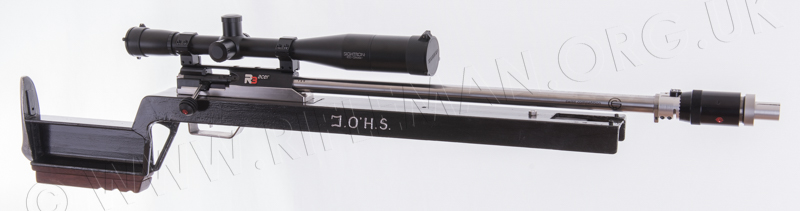
The Colchester team now has two members with home-built BR setups using G&E kit.
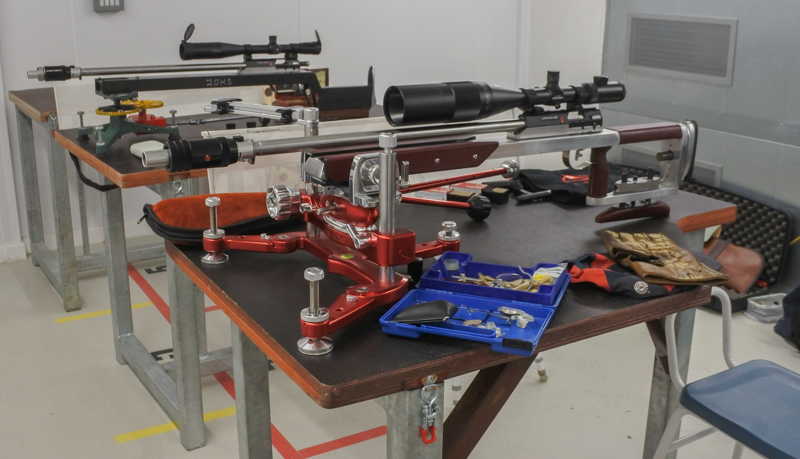
With one using a fine new "no expense spared" SEB rest
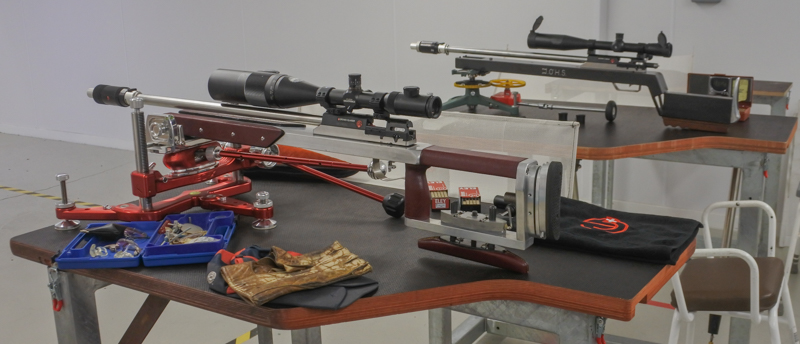
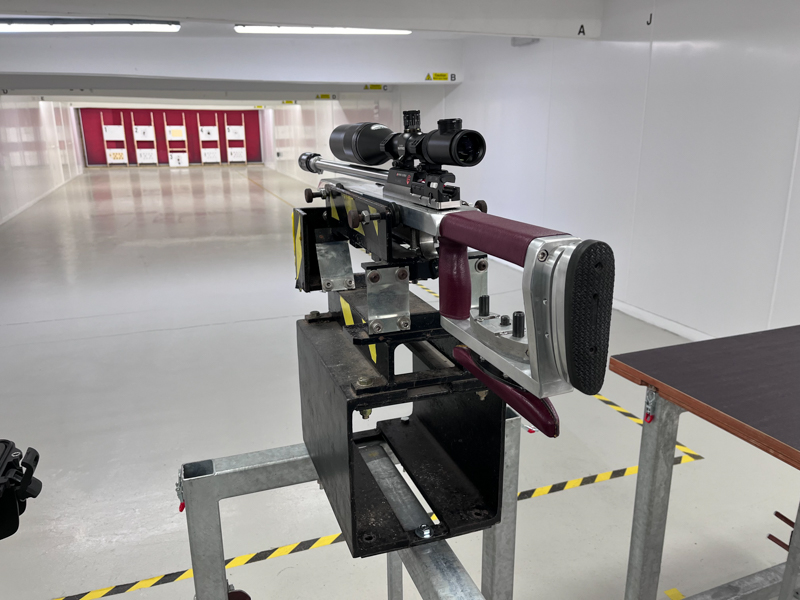
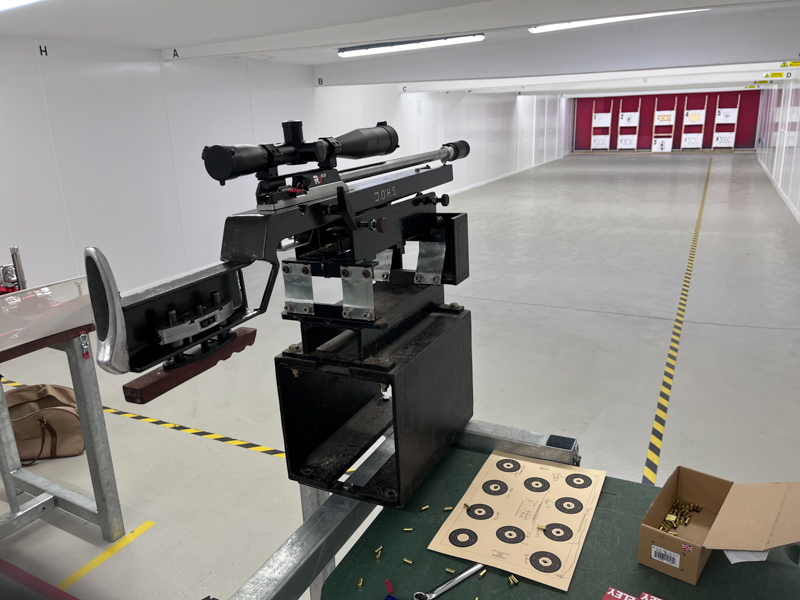
Both rifles were group tested in the club's test clamp bolted to a Yorkshire bench base frame.
The butt arrangement of this rifle has been further modified to improve hold comfort.
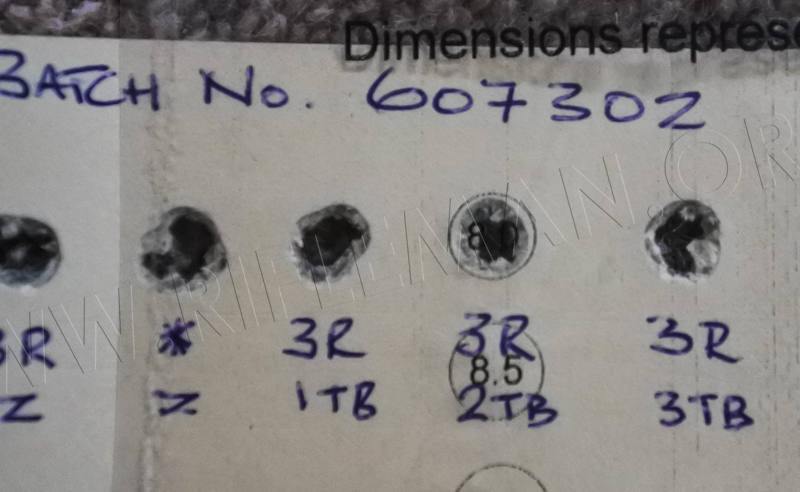
Ammunition tests were undertaken of Eley Tenex, the clubs' S&K Target, and Lapua Centre-X
The test card shows groups for both the Tenex and Centre-X ammunition.
Only one Tenex batch was available, but two of Centre-X.
There is a KEY top right identifying the abbreviated captions under each group.
The tests were started with the tuner at a previously used position deemed "zero".
The "TB" or "TF" relates to Turns Back or Turns Forward from that zero position.
All are five round groups except that asterisked - which is ten.
The "R" figures indicate the number of barrel weight 'Rings' (or none) fitted for each group fired.
Hover over or Click image to bring up hi-res file and magnifier
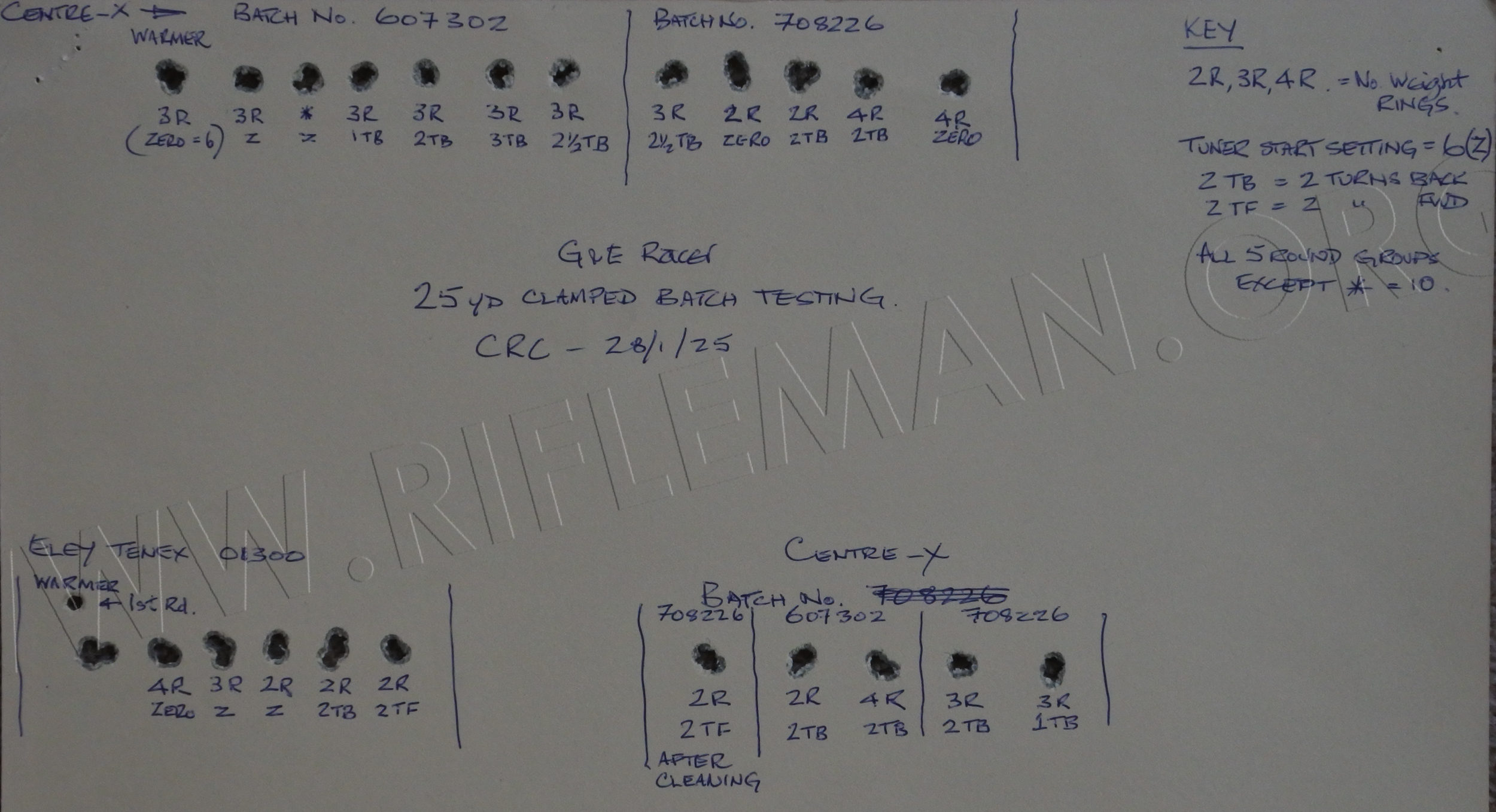
The best group obtained is shown close up below,
at two turns back from "zero" with three barrel weights fitted.
____________________________
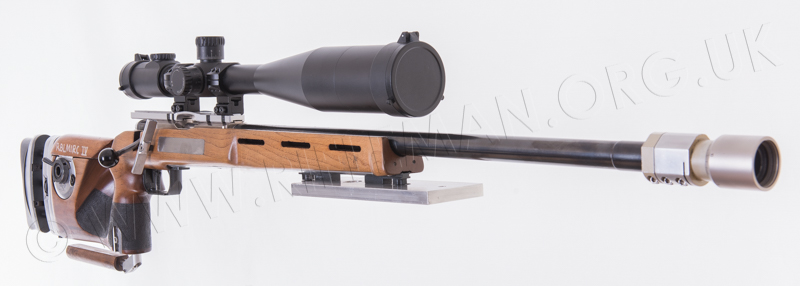
In the meantime, an old club rifle has been modified as a spare for any club BR newcomers.
The 2007/2013 action was fitted with an Anschutz 1813 barrel with a low shot count
and which had previously been successful in competition.
The barrel was reduced in length by about two inches with the rear reduced diameter, that locks into the 2013 action, recut to a fine tolerance into the body clamp, a coned breech section, and rechambered with a match target reamer. The crown was still in fine condition.
The 'scope is again the particularly economical and effective Minotaur 45mm x 60mm with Target Dot.
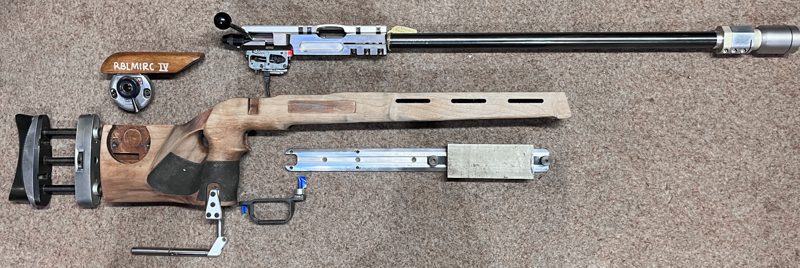
The resulting setup proved highly accurate, and precious little behind the new G& R rifles in group tests.
The grouping test card, shot using the Lapua Centre-X ammunition.
Hover over or Click image to bring up hi-res file and magnifier
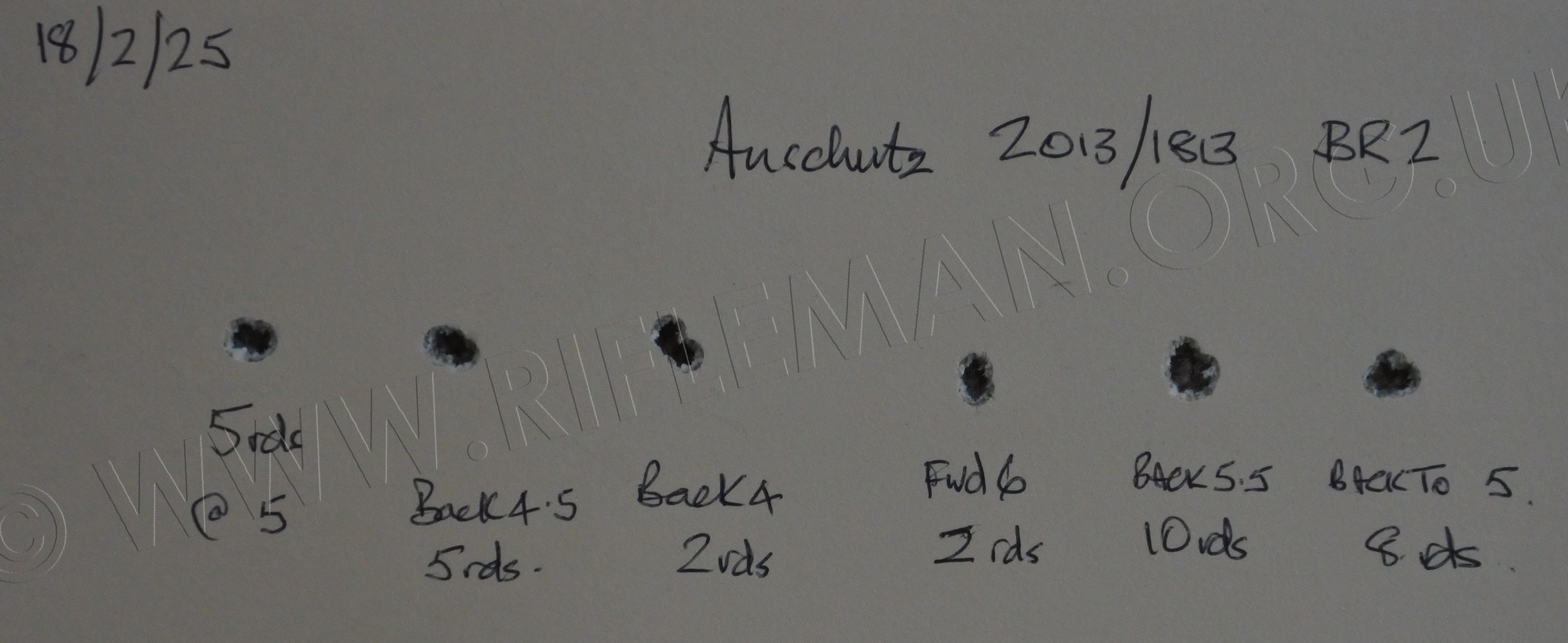
Approximately an 8.5mm group of 8 rounds was obtained at 25 yards,
compared with that for the G&E Racer 3 of 8mm.
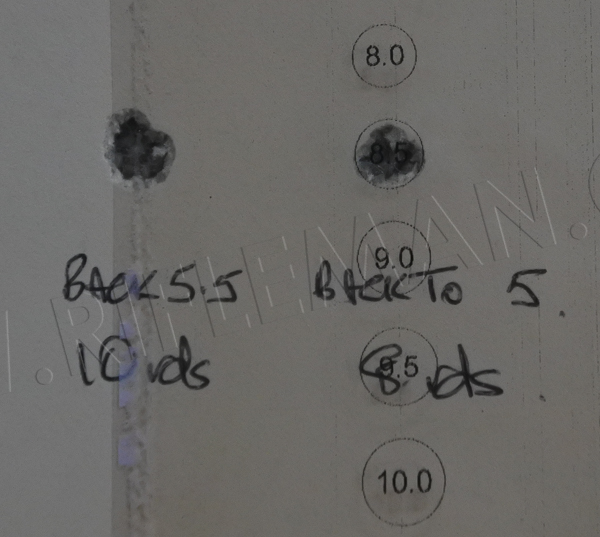
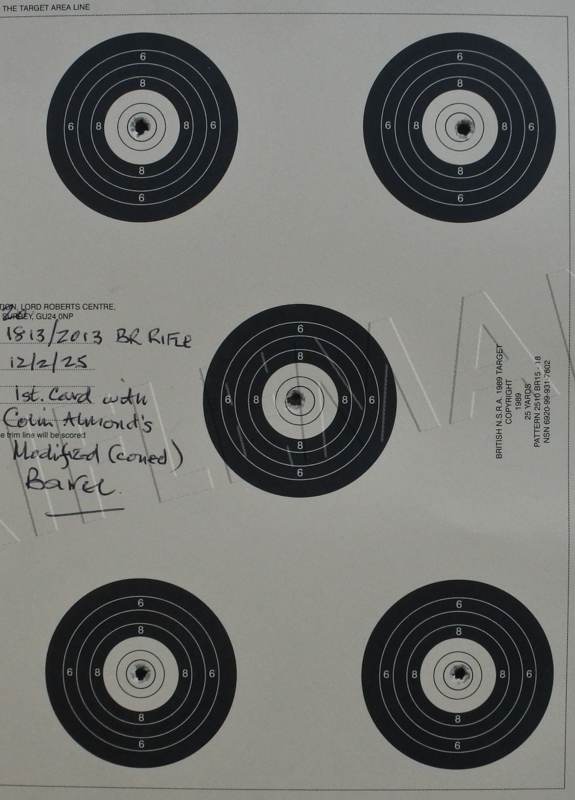
The very first practice target shot with this rifle
________________________
As of mid February 2025, the hitherto rather agriculturally modified Caldwell rest
was replaced by an old 2008 SEB model purchased very reasonably second-hand,
and on which an extended elevation adjustment was arranged
to obviate the need to remove the left hand from beneath the butt
between shots when adjusting elevation.
This initially consisted of a rubber-tyred pulley-type wheel machined up and mounted on
a spindle passing through an additional plate fixed beneath the main block.
The wheel, at the front of the rest, ran on the original horizontal alloy elevation wheel
which had been knurled on the top edge, raising and lowering the rest
as the extension spindle was rotated.
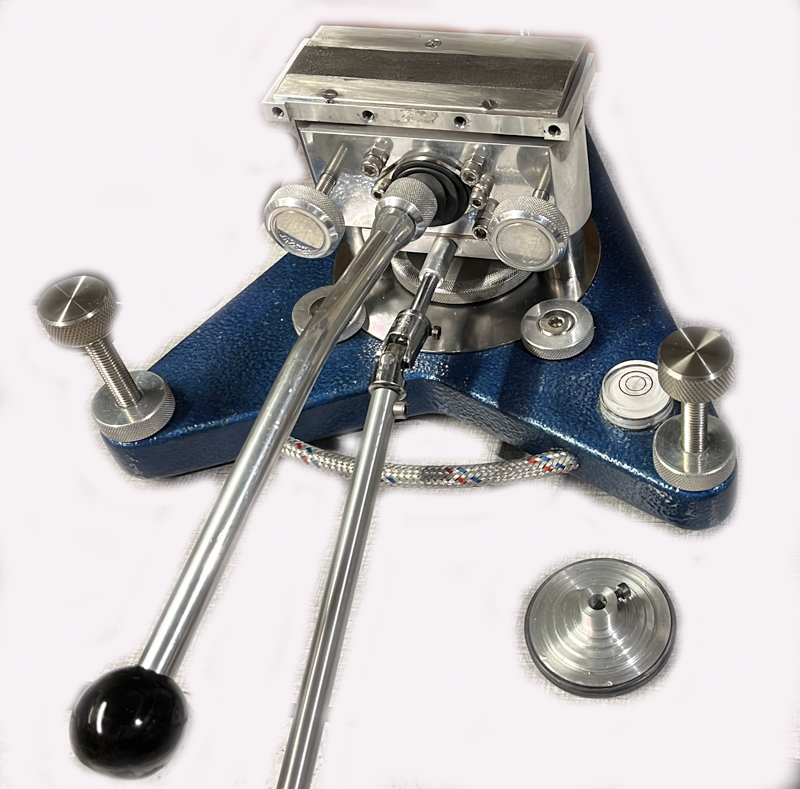
A later amendment, to fit a smaller rubber wheel, lowered the gear ratio,
permitting finer adjustment.
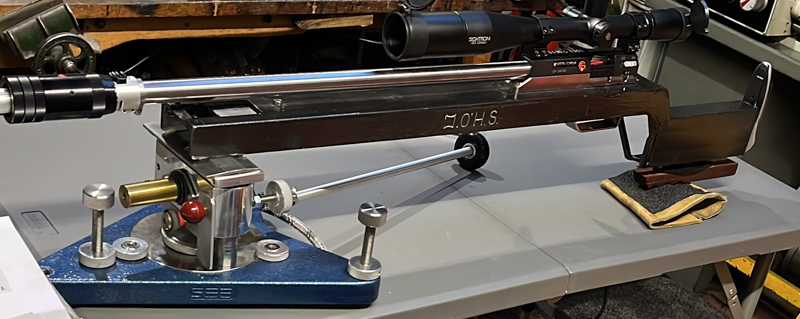
Most rests present the shooter with a flat top for the rifle's plate to rest on.
The problem with this is that, as you elevate or depress the rifle, its under-plate may be resting on the rear edge of the rest's top, or even on the front edge in extreme circumstances. It is unlikely to ever lay perfectly flat on the top of the rest unless the shooter adjusts the height of the butt at the same time. That would be hugely counterproductive in maintaining a constant position.
The simple answer is to radius the top of the rest, so that the rifle's under-plate can rock cleanly as the rest is raised or lowered. If you are concerned that this reduces friction, then it should be remembered that a point load can be better than two smooth flat surfaces running on one another. The radius does not need to be the diameter of a broomstick, and it can just be seen in the above image that the radius used is quite large; several inches in fact.
Whilst the above rubber wheel elevation arrangement worked comparatively well,
it was decided to engineer a more positive system, and a bevel gear set was acquired
and fitted in place of the original alloy knurled wheel.
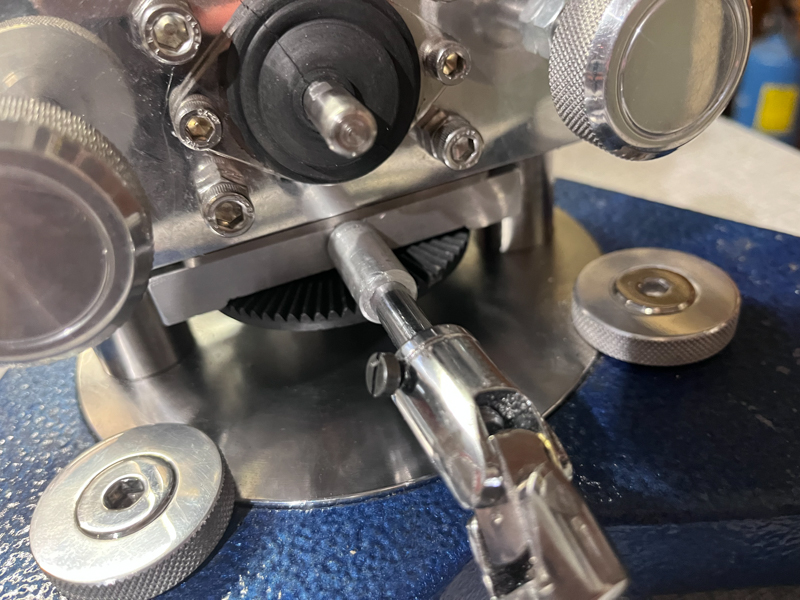
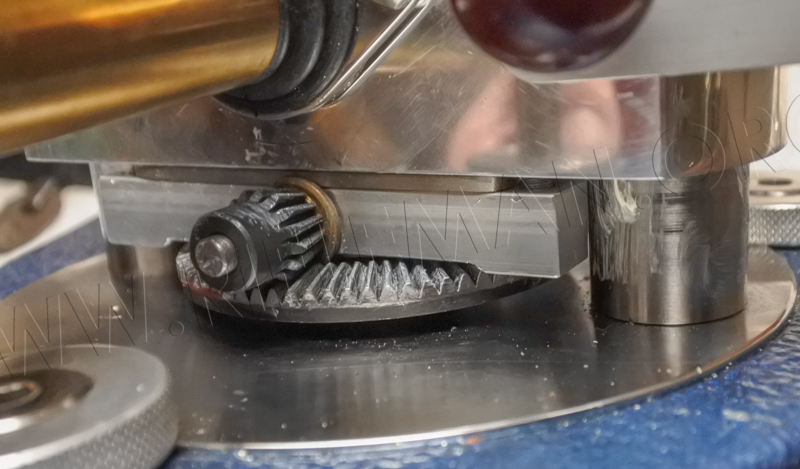
After initial testing, which revealed some tight spots in the gear meshing,
careful swiss-filing and polishing with a buffing wheel has resulted in very smooth operation.
The rest has now been used quite successfully.
_________________
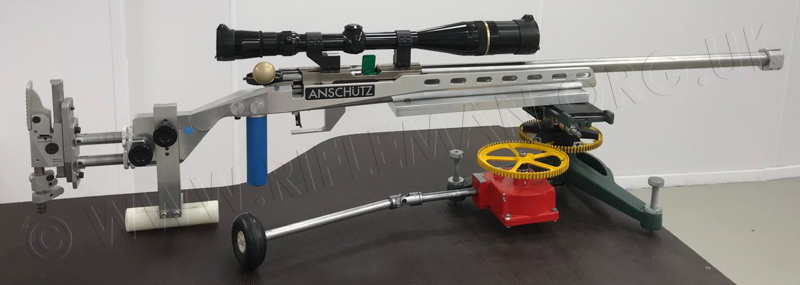
Another Springtime 2025 modification to a member's Anschutz for benchrest use
is illustrated below.
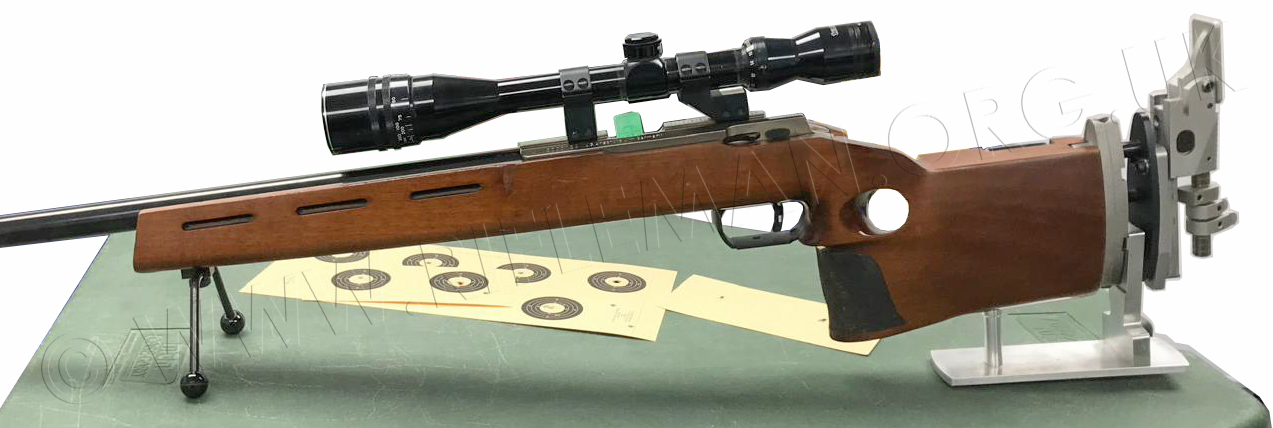
A close-up of the basic engineering involved.
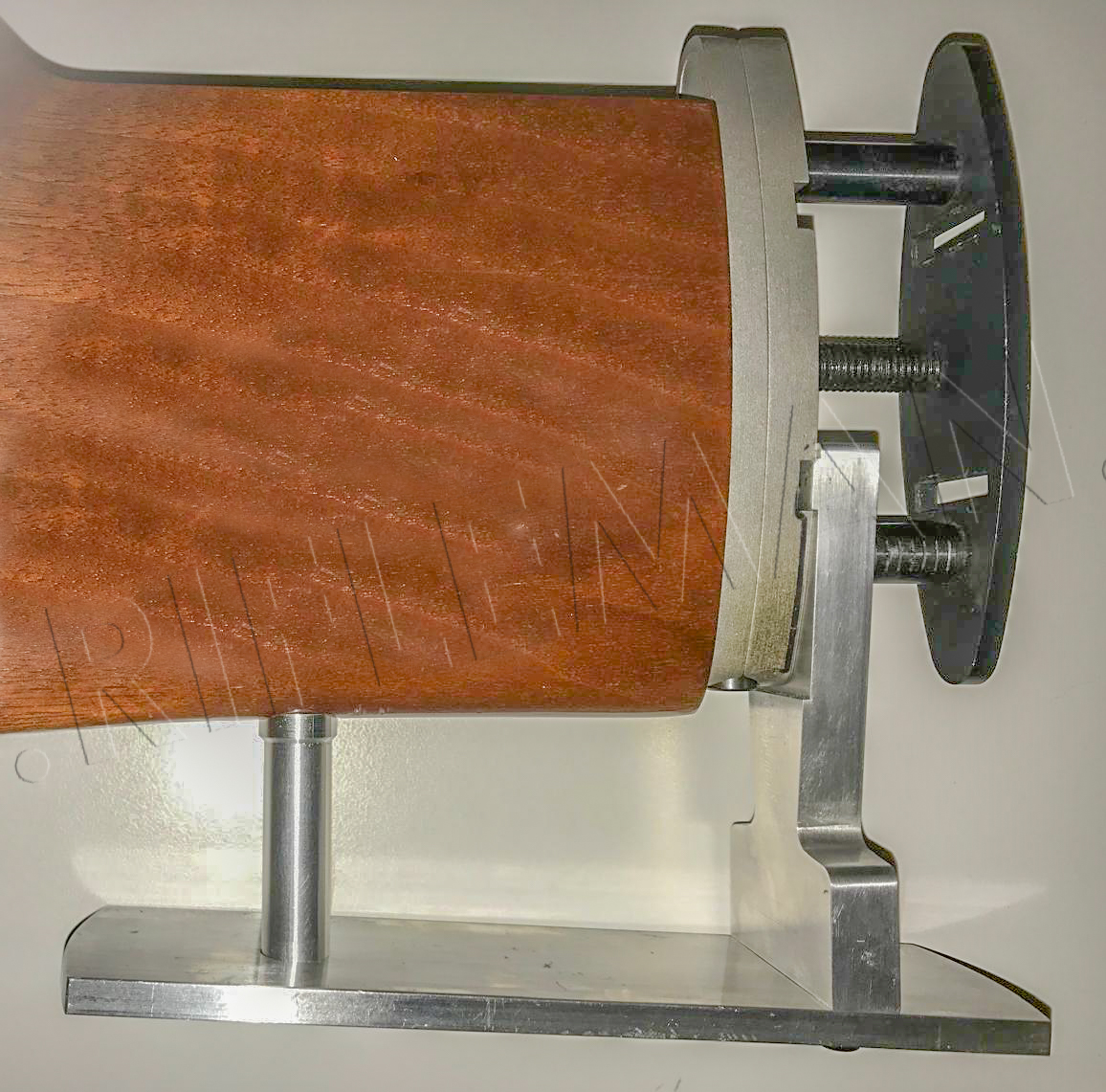
But the very latest BR modification of an Anschutz by another CRC member is shown below.
The first trial suggested one or two further amendments that are currently under weigh!
___________________________
The points on the CRC indoor 25 yard range.
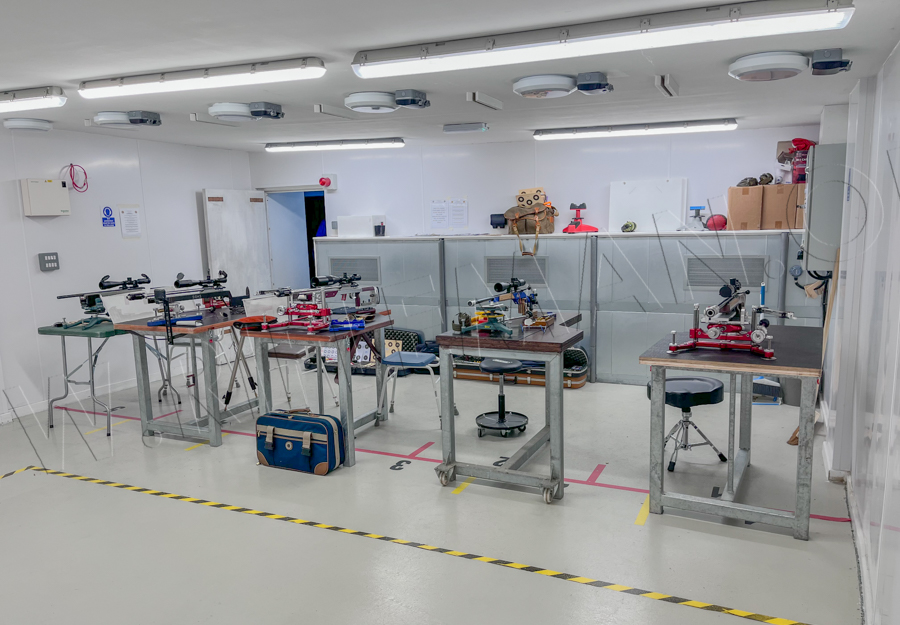
Winter 2025-2026 activity - late November 2025
Rifles and equipment are becoming very much varied,
but surprisingly consistent in performance.
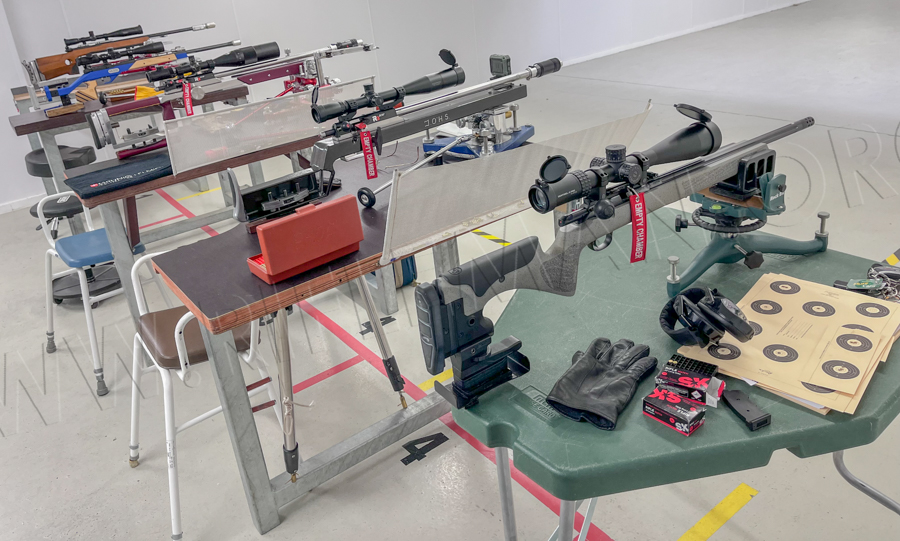
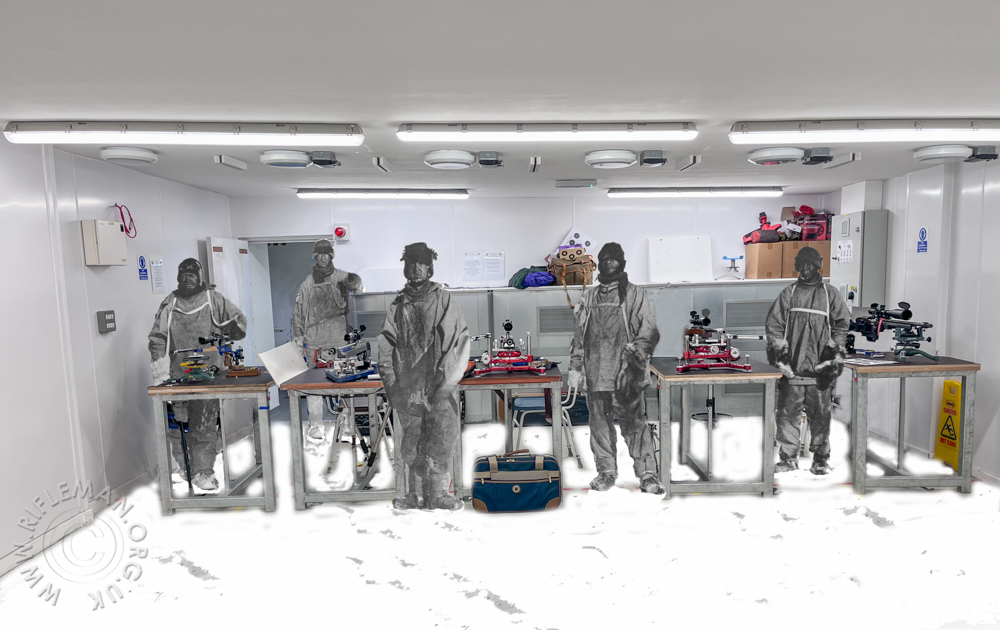
Members of the CRC Benchrest group set up for an afternoon's practice shooting
and shooting of Eastern Region and Yorkshire league cards for team members involved.
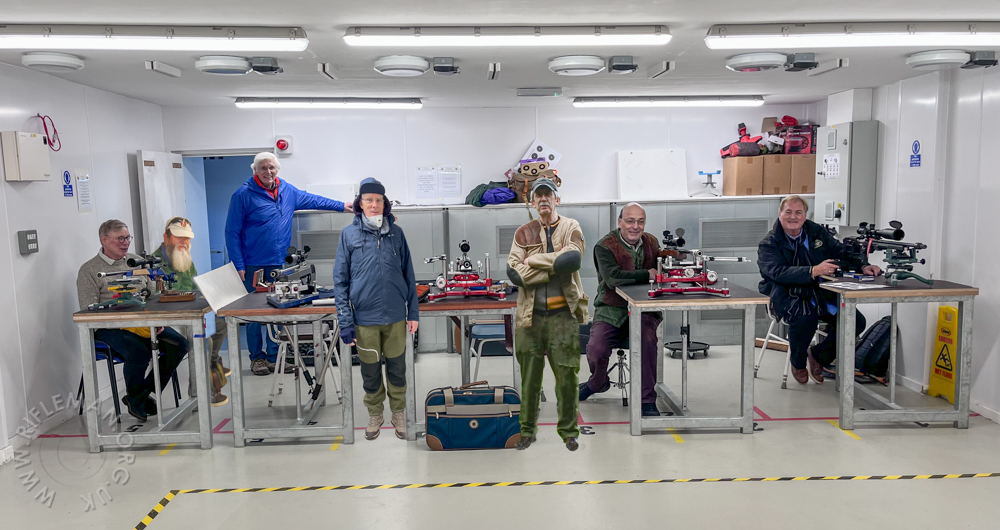
The CRC 25 yard range benefits from a highly effective ventilation system,
albeit exceedingly chilly when the outside air temperature is barely above freezing.
Hence the multi-layered clothing evident in next two images.
BEFORE THE DETAIL
AFTER THE DETAIL
___________________
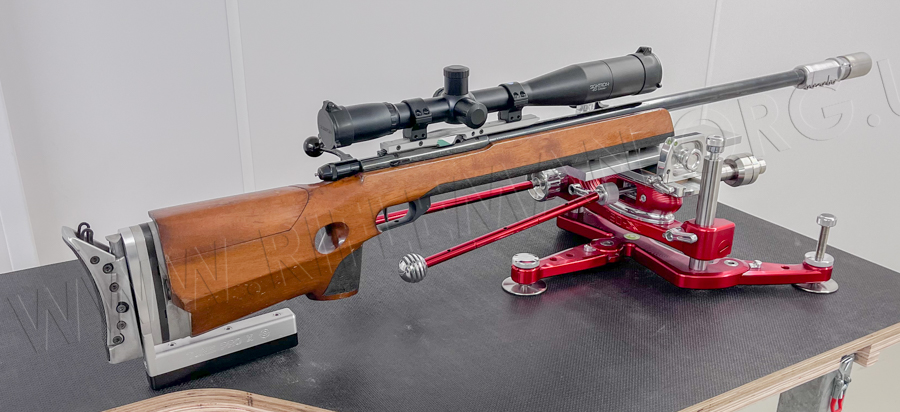
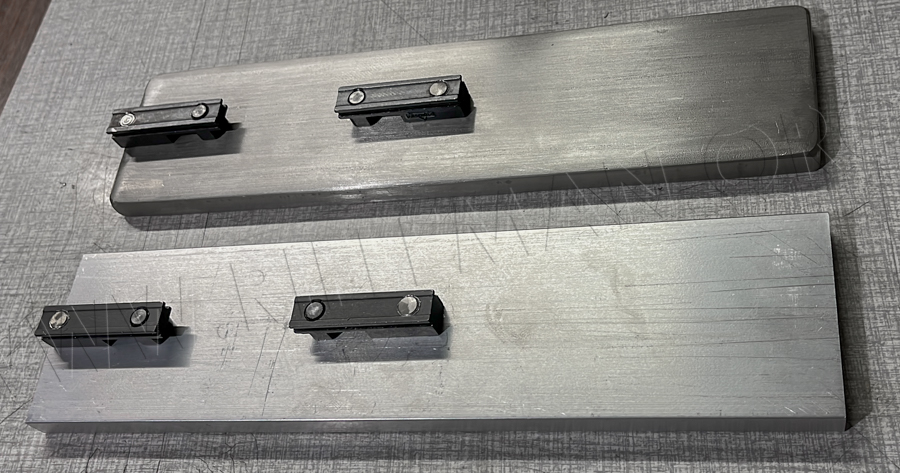
One member's newly modified Anschutz is rested on one of the new fore-end plates shown next below, and with its Tune-pro so-called "bag rider" that becomes a hand rest under NSRA rules.
A simple way of engineering a fore-end plate that can be firmly attached to
an accessory T-slot rail is to use the Anschutz hand-stop/sling-swivel from your rifle
that is perhaps no longer being used for prone shooting.
Obviously a pair is needed.
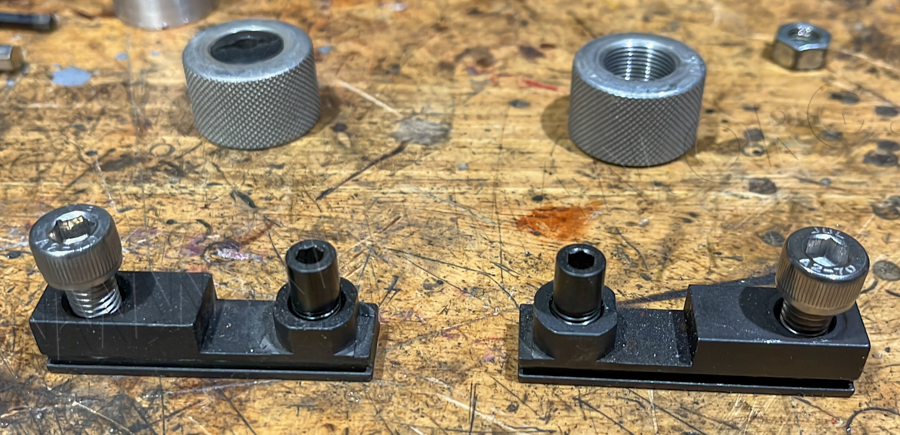
Simply remove the sling swivel block and unscrew the knurled hand-stop knob, drill and tap the hand-stop's stud hole to M5 and fit an Allen screw as a locking bolt. Open out the swivel's hole and tap the hole for the 8mm Allen bolt that will affix the new mount to the aluminium plate.
A 75mm x 12 or 15mm aluminium plate (approx 25cms long to suit) can be drilled with two 5mm clearance holes for the 5mm screws that will lock the plate into the accessory rail, and with 8mm clearance holes for the bolts that clamp the mounts to the plate. The latter holes will need to be counter-bored to slightly more than the depth of the heads of the Allen bolts to ensure none of the fastenings interfere with the free sliding of the plate on the rifle rest.
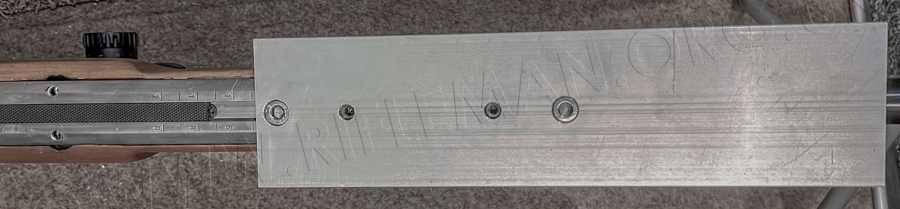
Weight can be an advantage, and a mild-steel or stainless plate (top below)
can be used as an alternative to aluminium, although the aluminium is easier to work.
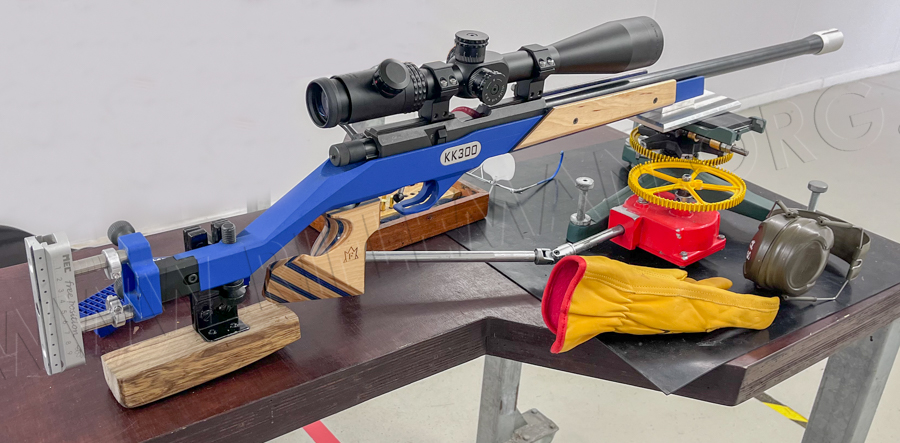
A member's fine Walther KK300 has been altered for benchrest use,
but remains easy to return to its prone configuration when required.
_________________
CAN A CHRONOGRAPH HELP WITH GROUPING?
This is a debatable point, but nothing is lost in testing the possibility.
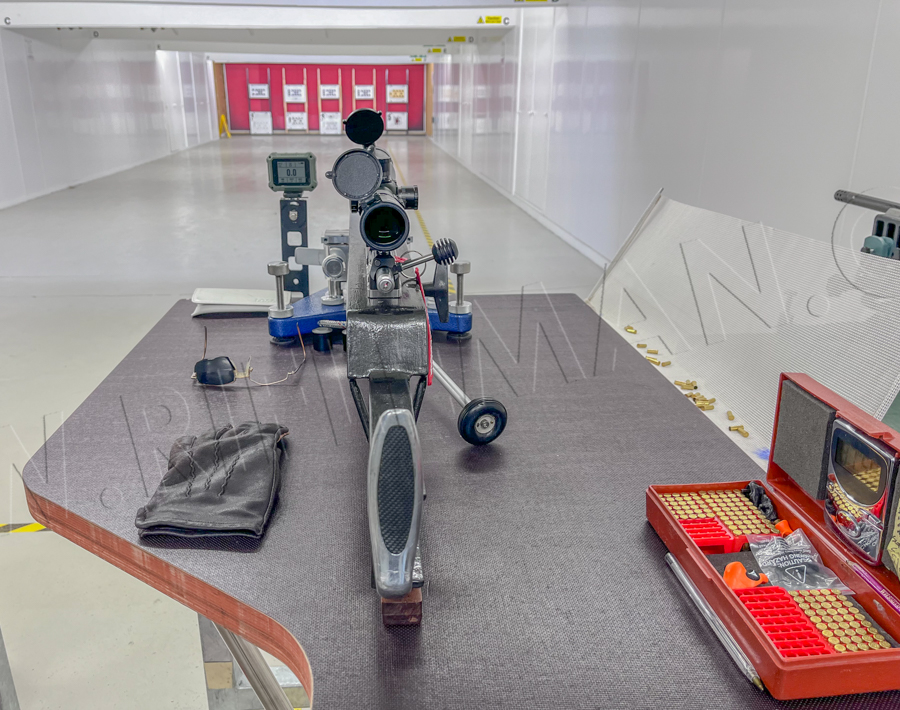
A suitable radar chronograph can be easily employed to check
the muzzle velocity of the ammunition in use.
It is an excellent means of testing the consistency of the MV
of different manufacturers' ammunition and batches.
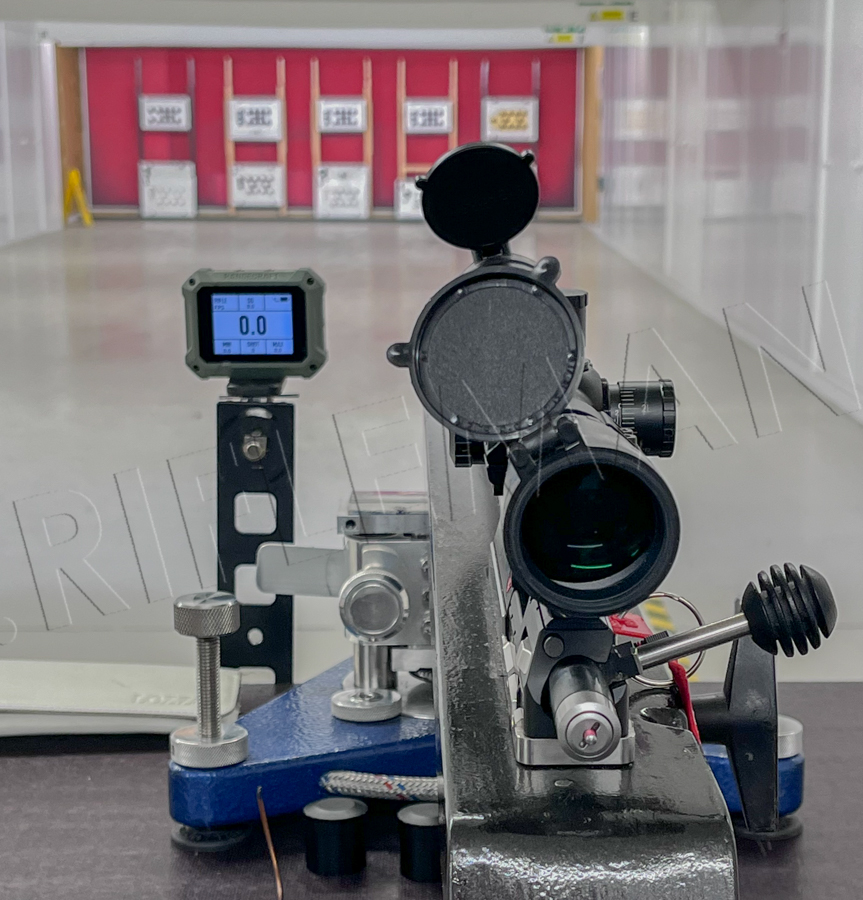
Additionally, it may afford a guide to variance of point of impact (POI)
in relation to muzzle velocity (MV).
Whilst the best information in this respect would be gained from a rifle firmly clamped in a test rig, and ideally at 50mtrs for group testing, the data acquired can be useful even at 25 yards.
Sadly, not everyone has an indoor 50mtr. range available, and few outdoor ranges are sufficiently sheltered for the most accurate results. It can take only very light gusts to spoil a group.
However, with a good rifle, well tuned barrel, firm bench and consistent hold and sighting, it is possible to shoot well enough at 25 yards to gain a rough idea of your ammunition's performance.
The 25 yard sighters and their targets shown below
have the MV figures overprinted below each diagram.
Hover over or Click image to bring up hi-res file and magnifier
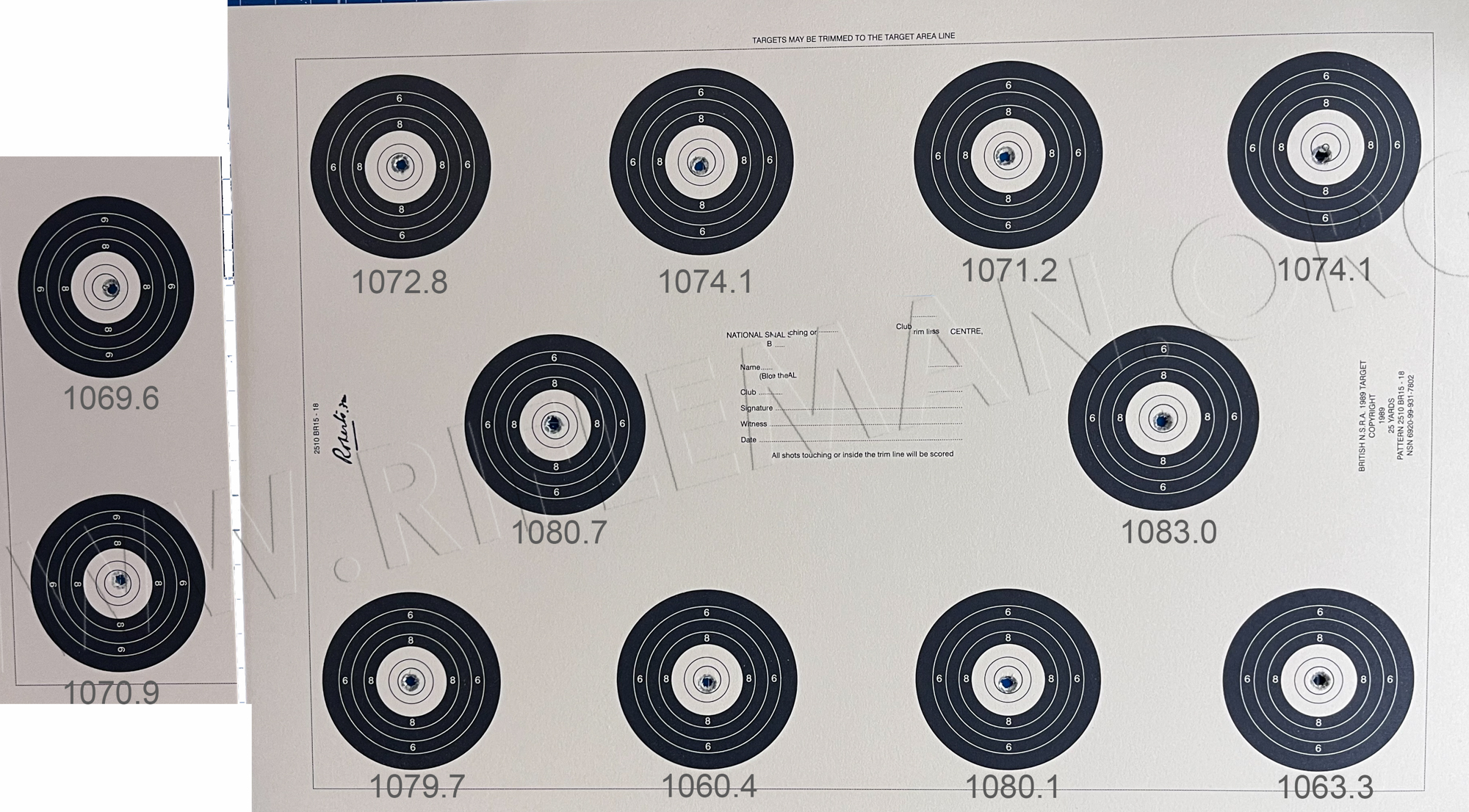
It is surprising how significantly speed can vary with only very small divergence in elevation.
It is also evident that, although one would naturally assume that the higher the velocity the higher the POI, careful perusal of these targets confirms this to not necessarily be the case. The height of the POI is not simply solely dependent upon speed, but also upon the position of the barrel's "flip" or "jump" as the bullet departs the crown. Thus it is possible for a higher speed to result in a lower POI due to the harmonics of the barrel. A tuner is particularly helpful in reducing 'flip' or 'jump', but this also relies on consistent MV to obtain best results. Batch testing helps significantly in this respect.
_______________
An explanatory piece about "jump" was written as far back as 1953 by Major W.G.B. Allen in his book "Pistols, Rifles and Machine Guns".
Whilst this extracted PDF file relates to the effect seen in full-bore service rifles such as the .303" Lee-Enfield, and the figures are therefore way above those for a .22 rimfire target rifle, the principle is precisely the same.
____________________
Returning to the subject in hand, and another representative target
Hover over or Click image to bring up hi-res file and magnifier
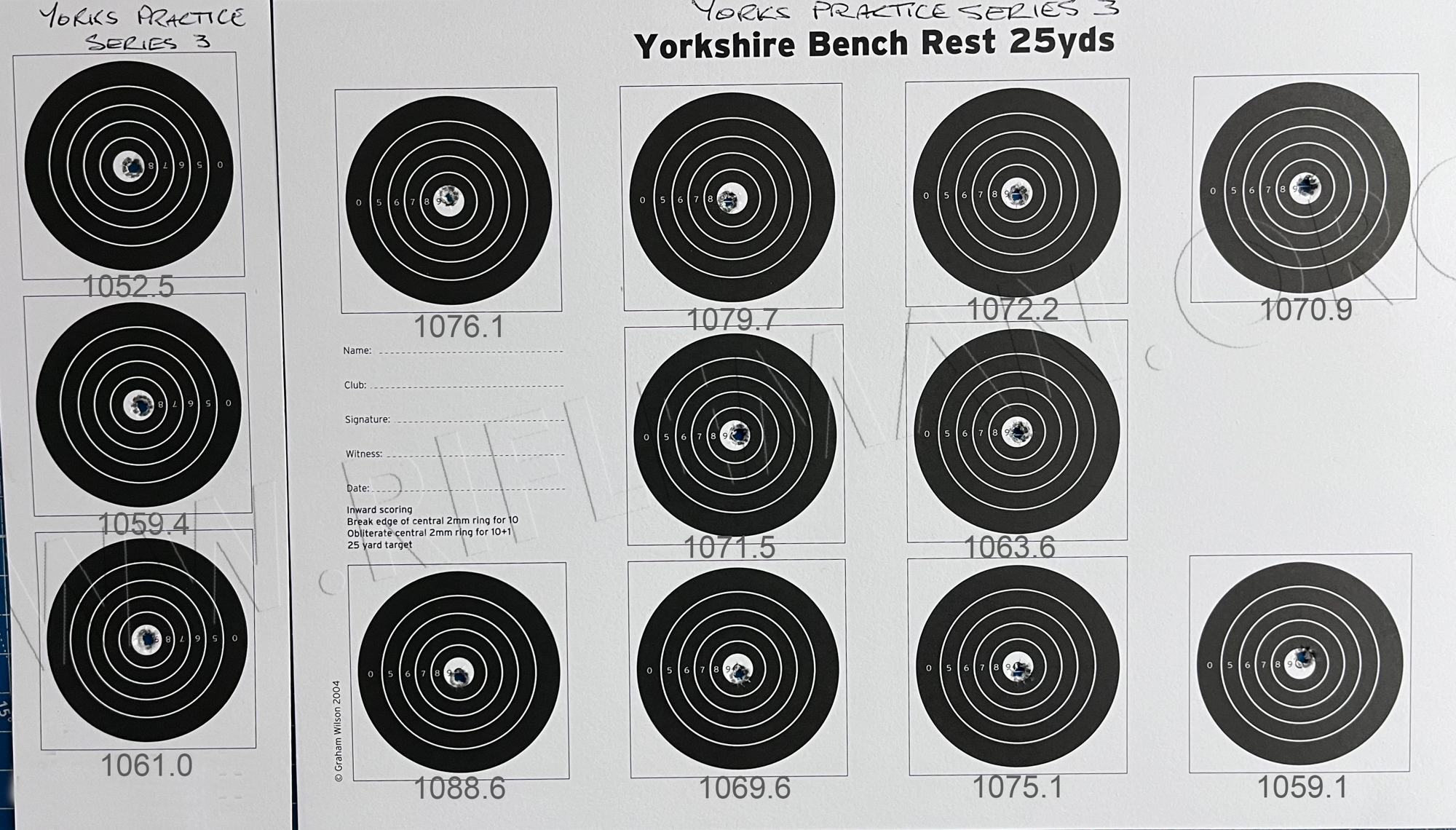
Whether there is anything markedly useful to be gained from an experiment such as this is open to debate - it may be of limited use; but it is interesting nonetheless, and we leave you to draw your own conclusions.
Hover over or Click image to bring up hi-res file and magnifier

However, we will shortly repeat the same experiment with a rifle in a test clamp -which should be more revealing.
The ammunition used for the above? R50!
_______________
One week later, the same rifle and ammunition are tested with the rifle clamped firmly in the club's test rig that has been illustrated earlier on this page. The Grünig tuner was still set for the Center-X ammunition that had been used previously, and the intention was to adjust the tuner to best suit the R50.
The target paper with eleven five-round groups is illustrated below, the first group being warmers without the chronograph set to record.
Hover over or Click image to bring up hi-res file and magnifier
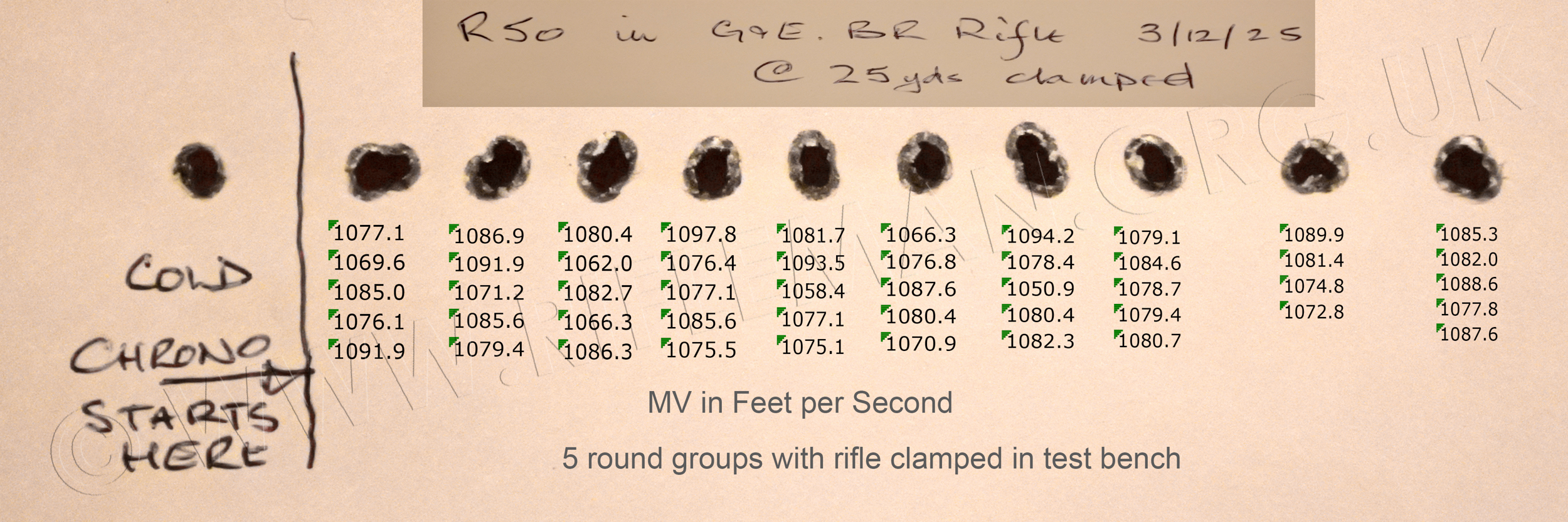
The first group in the series of ten was with the tuner set as mentioned. The 2nd. to 6th.. groups were each only one quarter turn forward of the tuner barrel. Group 6 was from the original zero just one quarter turn back, and evidently worsening. Group 8 reverted to the four quarter turns forward position and 9 and 10 were each a further quarter turn forward, again opening the group. A final position between groups 8 and 9 was selected.
It is apparent that, once an initial position for a reasonably good group has been located, fine tuning to the tightest group can involve extremely small corrections.
The muzzle velocities for each group were recorded and are entered beneath them. Correlation of these MV figures against POIs for each group cannot be remotely scientifically decisive under these circumstances, and would require accurate repositioning of a blank target for each shot, but careful perusal can afford some hints as to whether there may be "fliers" lurking amongst them; although it must be said that such deviation is likely to be incredibly small despite apparently quite large variation in projectile speed.
Groups showing either elevation or azimuth dispersion tendencies are certainly correctable with careful use of a tuner, much reducing and rounding group size and shape respectively.
One significant factor is that the worst groups for elevation spread are largely those with the greatest deviation of muzzle velocity - including the highest to lowest recorded speeds of the five shots.
_________________
It may be worth mentioning that the tuner settings required for 25 yards, 50 metres and 100 yards may not necessarily be the same; where possible it would be best to fire clamped group tests at each range to be certain.
If, like the Royal British Legion Mersea Island Rifle Club, you shoot at the shortest NSRA range of 15 yards, the .22RF projectile is still on the rise in its trajectory; at 50 mtrs it is on the fall. The result is that when you switch from one range to the other there are only a very few clicks of elevation adjustment required - as the projectile is at almost exactly the same height at both distances. Not that many shooters experience this!
________________
Just how far are you prepared to go to attain the greatest accuracy you can?
There are a number of actions that can be taken to improve consistency, but many shooters do not feel the effort to be worthwhile; indeed, with a good rifle and equipment, plus good quality target ammunition, exceptionally fine results are possible. It may simply not seem worth the trouble to weigh and measure one's ammunition, sorting it into batches of equal weight, length and rim thickness - which, if variable, can affect head-space. In fact, the ammunition sold by some manufacturers is sufficiently reliably consistent that one may be wasting one's time. Nonetheless, there are those that do this, particularly in the world of full-bore benchrest and F-class shooting - where much ammunition is anyway hand-loaded. This is patently impractical for .22 rimfire ammunition, but some high-level competitiors do attempt to minimise the possibility of an occasional errant round resulting in a "flier" that destroys an otherwise near perfect score.
An idea of what would be involved can be seen in the following images.
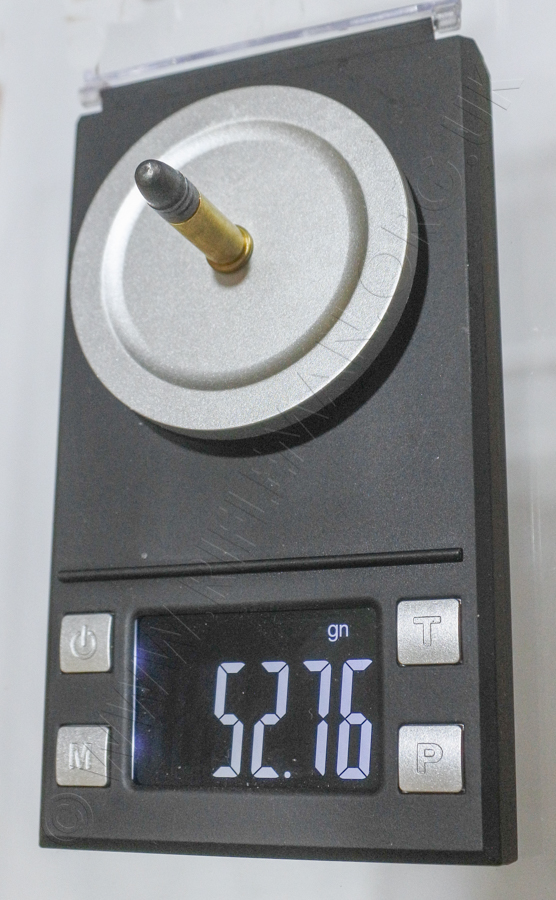
Left: a rim thickness gauge ....... Right: Jeweller's scale measuring in grains
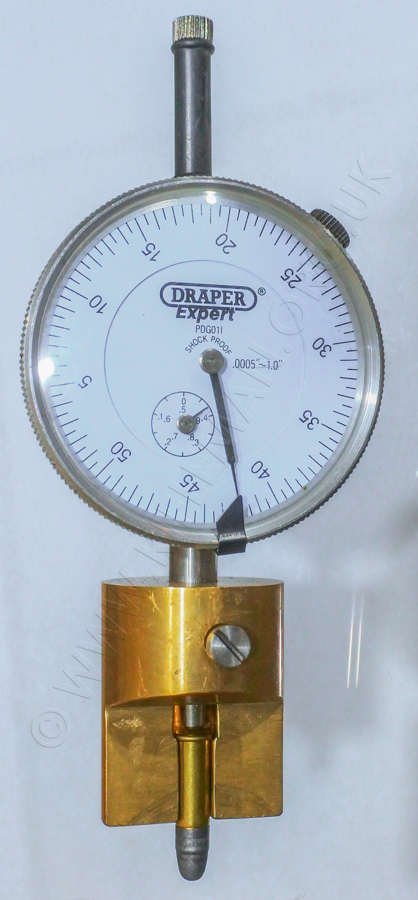 .......
The rim thickness here is 0.040" (40 thou),
and the cartridge weighs 52.76 grains.
The rim thickness for this ammunition is within ± 0.001"
and the weight of the cartridges lies between 52.70 and 52.95 grains.
A suitable batch selection would be of those cartridges
weighing a mean of between 52.85 and 52.90 grains.
Although it would be possible to select rounds of even closer weights,
the resultant batch quantities would be too small for practical use.
Below: Digital caliper for cartridge overall length.
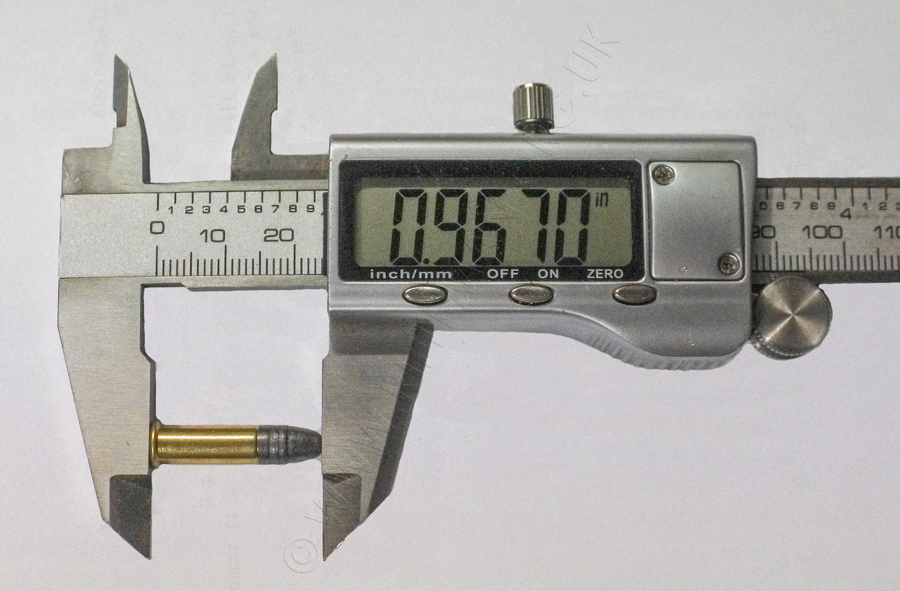
The overall length of these cartridges was impressively consistent
at an average of 0.9665" - between just 0.966" and 0.967".
Returning to the subject of cartridge rim thickness and the associated head-space, dimension recommendations for the latter vary from one rifle or ammunition manufacturer to another, as well as from one pundit or 'expert' to another. Here lies a second definition for the word "jump".
In this context, jump refers to the distance between the ogive of a chambered round's bullet, and the leed of the barrel's rifling. With full-bore rifles there must always be a separation of a few thousands of an inch between the ogive and the leed; for, if the ogive is engaged with the leed there is a definite possibility of a dangerous pressure build-up before the bullet sets up in the rifling.
With .22 rimfire cartridges this is less of a problem; indeed some chambers permit slight engagement of the bullet's ogive or driving band with the leed as the bolt is closed. Others are designed to maintain a "jump" before the fired cartridge sends its bullet into the leed of the rifling. Many older barrels had a virtually square-edge to the leed, some were very slightly chamfered, and a few, notably that of the military's Lee-Enfield .22LR No.8 target and training rifle, had a leed with a quite lengthy taper.
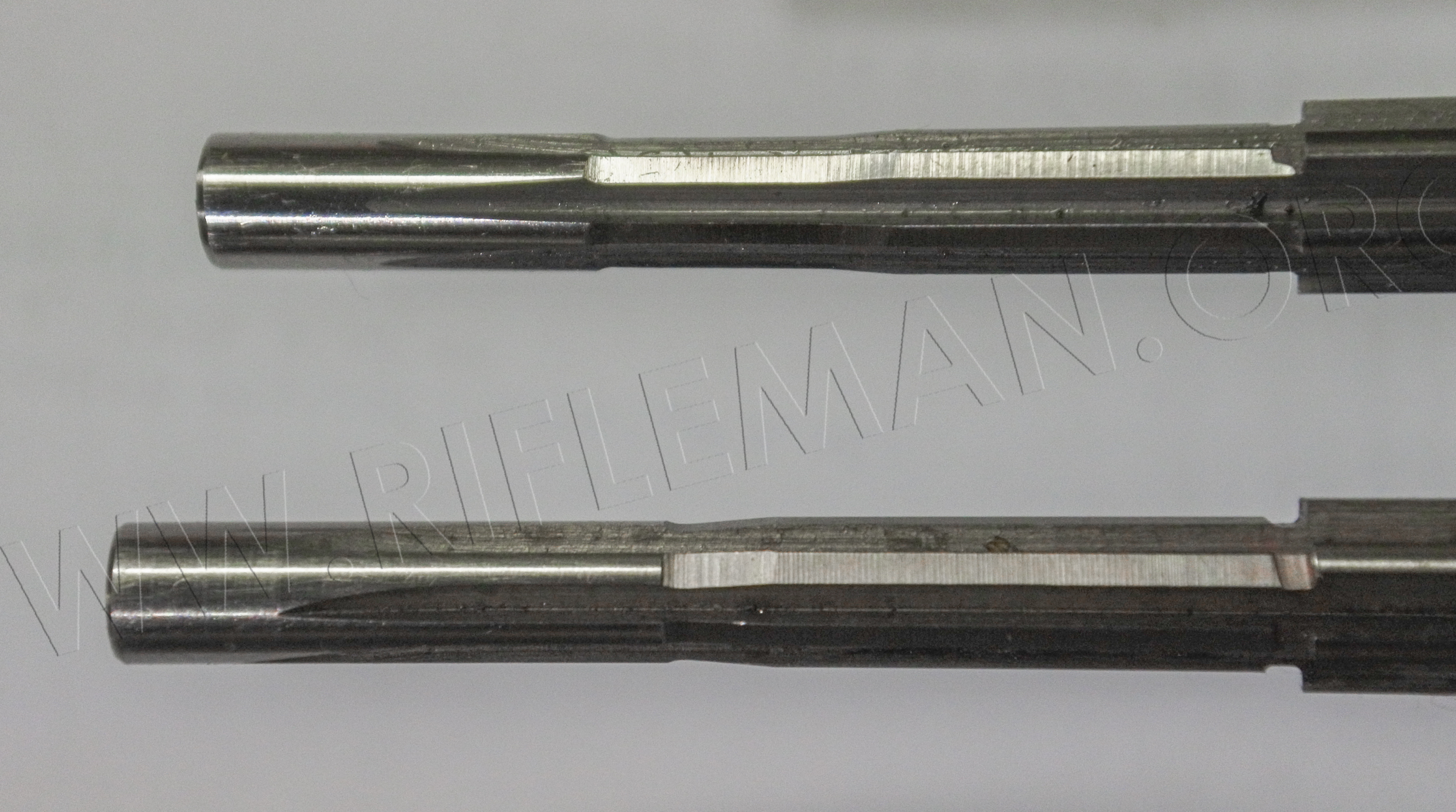
Modern match rifle chamber reamers often cut a curved entry to the rifling.
Top is such a current Match reamer that cuts a radiussed leed,
and beneath is the reamer for cutting the tapered leed of the Lee-Enfield Rifle No.8.
To illustrate the variations in the bullet's engagement of the leed between different rifles,
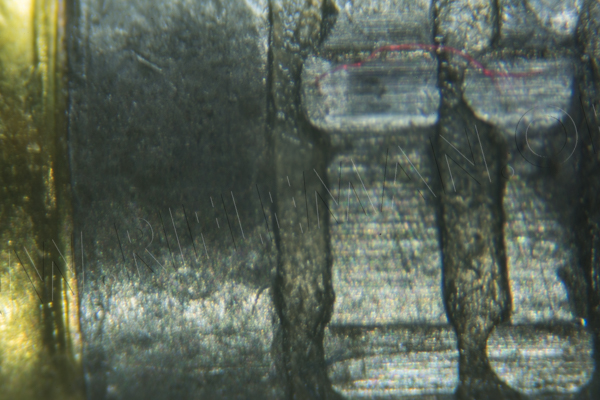
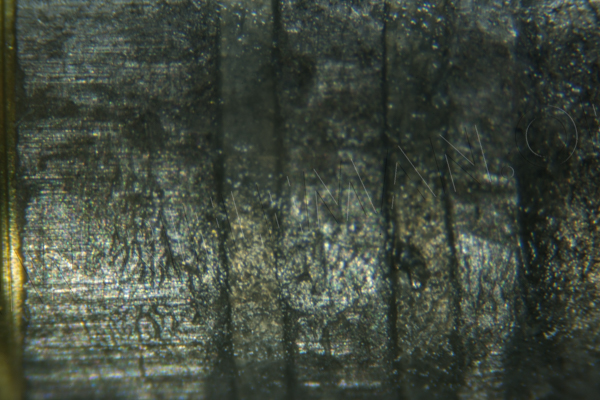
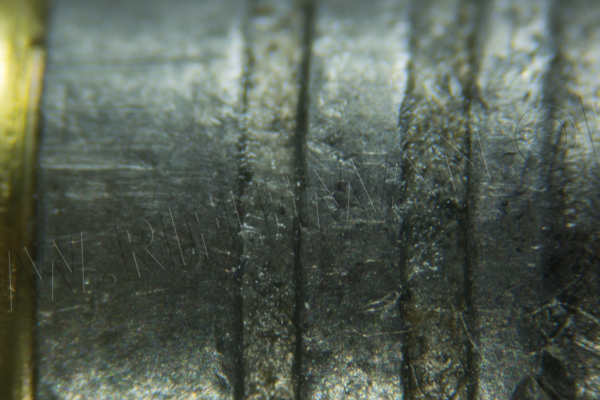
the following six microscope images are of the driving band of Long Rifle rounds.
The neck of each case just shows to the left, and the start of the ogive is to the right.
The two initial rings of the driving band are evident centre, with what might be considered two lubricant grooves between them and the main section of driving band, before the heel disappears into the case neck to the left.
The rifles into which each round was fed into the chamber, and the bolt closed, are identified above each image.
LEFT: Anschutz 2007/2013 with chamber machined by the Match reamer shown above.
RIGHT: The Grünig & Elmiger Racer illustrated earlier.
 ...............
LEFT: a .22 conversion of a Martini-Henry
RIGHT: The Lee-Enfield Rifle No.8, which shows no engraving, as would be expected when comparing the No.8 reamer's extended chamber length with that of the Match reamer.
 ...............
LEFT: The Walther KK200 illustrated earlier, also showing no engraving.
RIGHT: the BSA International Mk.III prototype s/n 2
 ...............
A set of head-space gauges is needed when setting up the head-space; the closing of the bolt onto a rifle's breech-face - the chamber and rim recess. This set of seven gauges start at 0.039" and finish at 0.045" in one "thou" increments.
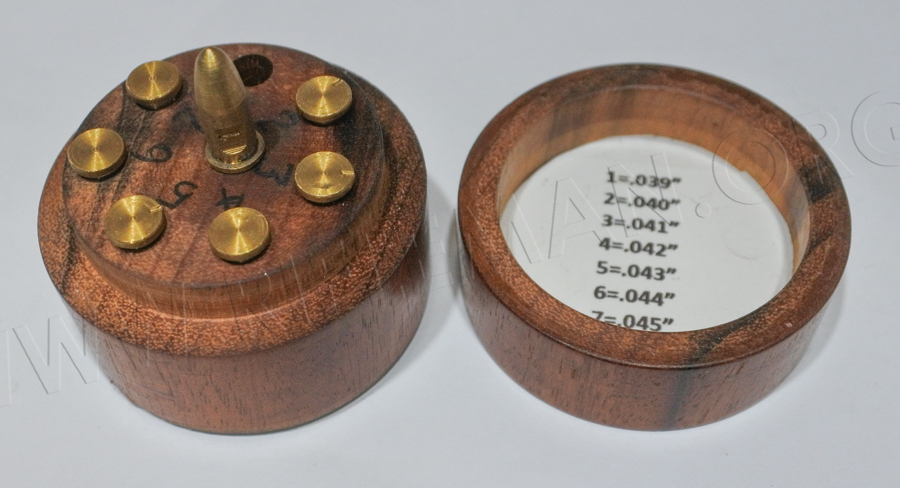
If lending yours to a fellow shooter to check his rifle's head-space, ensure they are aware these are not expensive dry-firing devices!
More news to come as the 2026 Summer season starts.
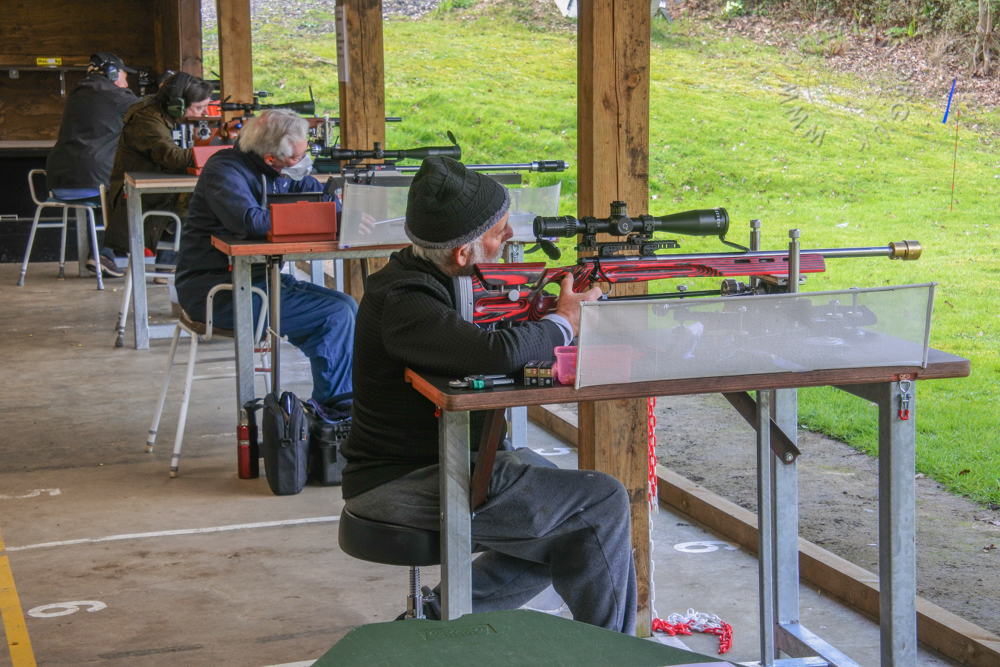
Colchester open Scottish Match 22nd. March 2026
_______________________________
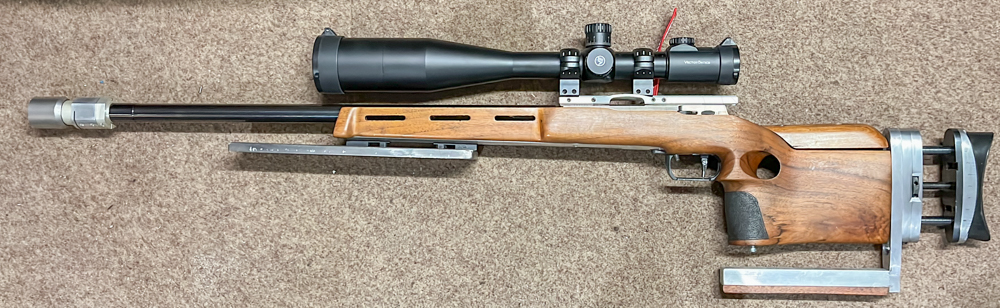
New scratch built "bag-rider" added to 2013-1813 BR rifle
___________________________________
Returning to the subject of modifying rifle bench rests to improve shooting technique, not everyone can justify the expense of the latest SEB engineering marvel; however, one of the most important things that can be done to improve consistency of aim is to avoid the necessity to remove one's hand, from under the butt between every shot, just to adjust the elevation of the rifle. The appearance of the later models of SEB rests, and others with joystick operation was an acknowledgement of the need.
It is a point of fact that some joystick systems are rather highly geared for the purpose, resulting in the shooter chasing the target dot around the target diagram. Another point is that some competitions do not permit windage adjustment usage, which practically renders a joystick unusable. There was a belief that this rule applied the NSRA short range competitions, but in April 2026 it was confirmed that windage adjustment CAN be used in any NSRA benchrest comp.
The point being made, though, is that fine low-geared rotation of a rest's elevation screw is most effective in accurately levelling the target dot or cross-wire reticle of a telescope onto the target.
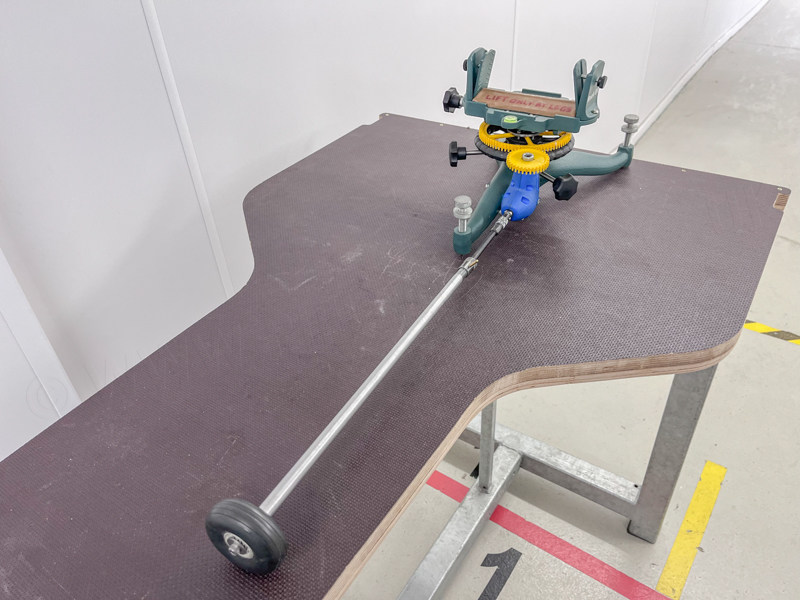
Even second-hand rests of the SEB type can command many hundreds of pounds - or more. But for the many shooters using such as the Caldwell range of rests, there is an economical way to render one able to adjust elevation with the free hand that loads the rifle and pulls the trigger, leaving the other hand unmoved beneath the rifle's butt.
We have shown an examples of the progress of such modifications earlier on the page, and can confirm that the latest mark of that first model, of the cheapest Caldwell rest, was used to great effect in competition, and has now become a "club" rest that is used by several Colchester members who do not have one of their own.
We have now modified two of the more expensive "Rock" Caldwell rests very cheaply on similar lines, and, if it could be helpful to other users of these rests, give a brief idea of what parts were used and the method of modification. This work should be achievable by any reasonably handy do-it-yourselfer; or could be handed to a capable pal if one is available.
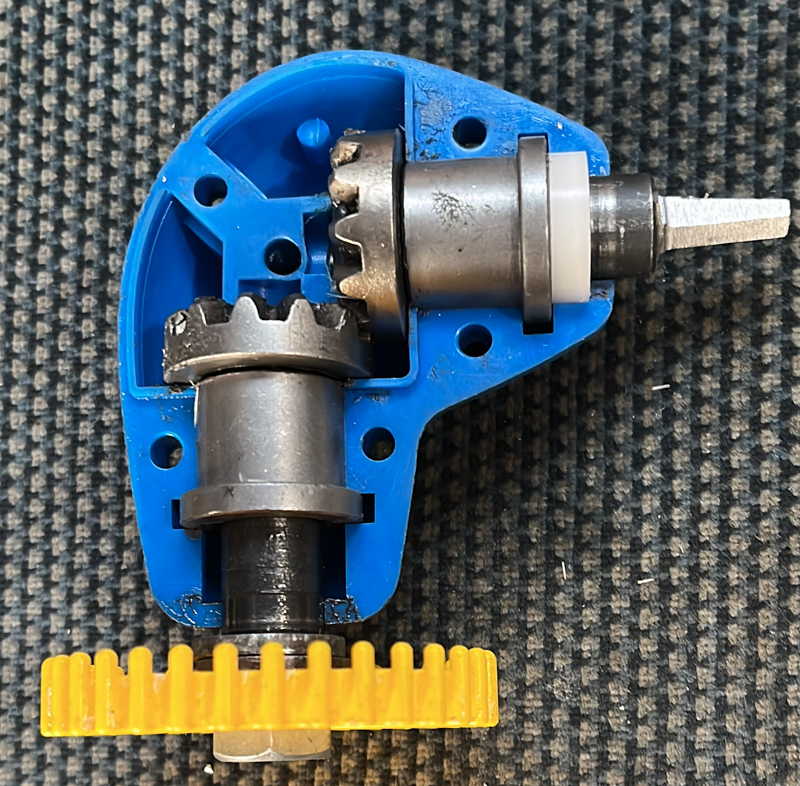
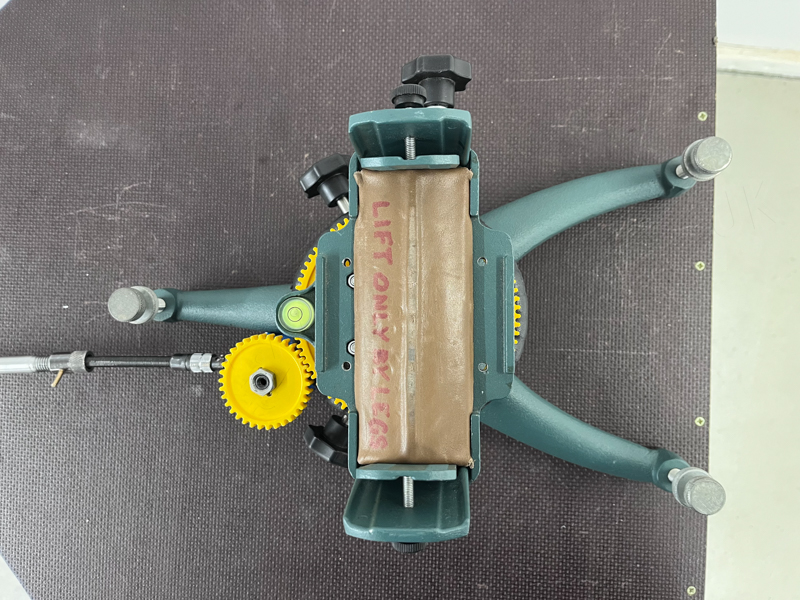
The parts needed are - one large and one small yellow nylon gear from the K'nex model building range, one right-angle drive for a drill, a 1/4" socket drive universal joint - or a spring or other short flexible drive, a length of alloy rod or tube, and a model aircraft wheel or similar. Many other options could be utilised according to whim.
The K'nex gears and angle drives are usually ready available on a well-known online auction site or the similar direct retailing site. The gears will cost perhaps five pounds, and the angle drive between ten and thirty depending on type. Ours was £11, and can be drilled through the central handle mounting holes to enable bolting to the arm of the Caldwell rest.
The Caldwell model involed.
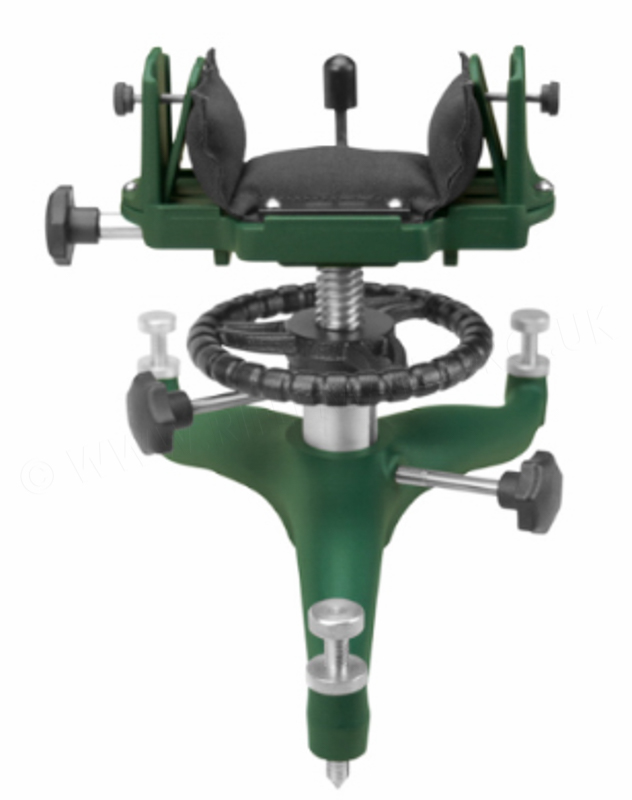
The first before modification, with the two gears just visible.
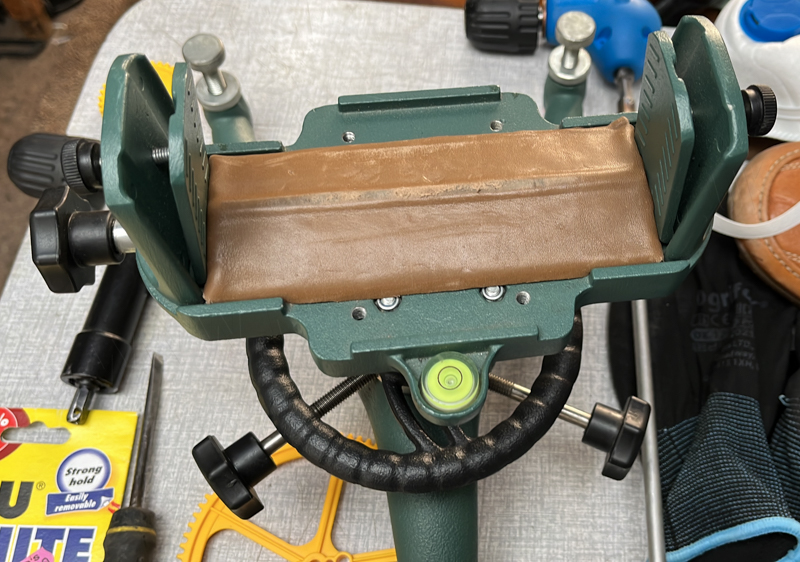
The elevation screw removed.
The angle drive is easily opened, bevel gears smoothed and fully greased.
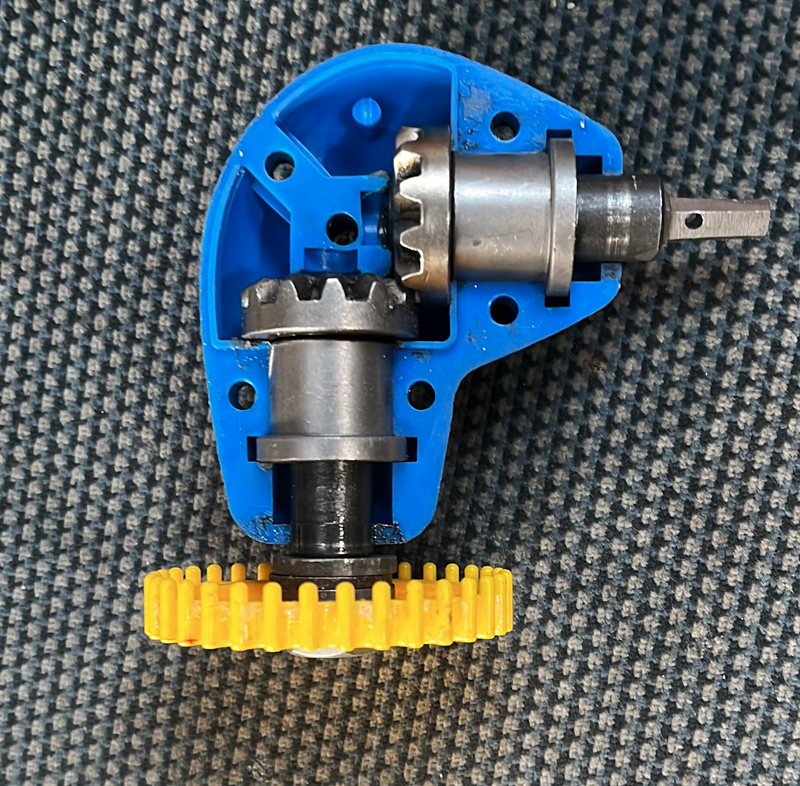 ............
A small amount of shaft thrust movement and play was removed
with a machined up nylotron spacer,
but this may not be a significant problem;
it was just done to minimise backlash in the "system".
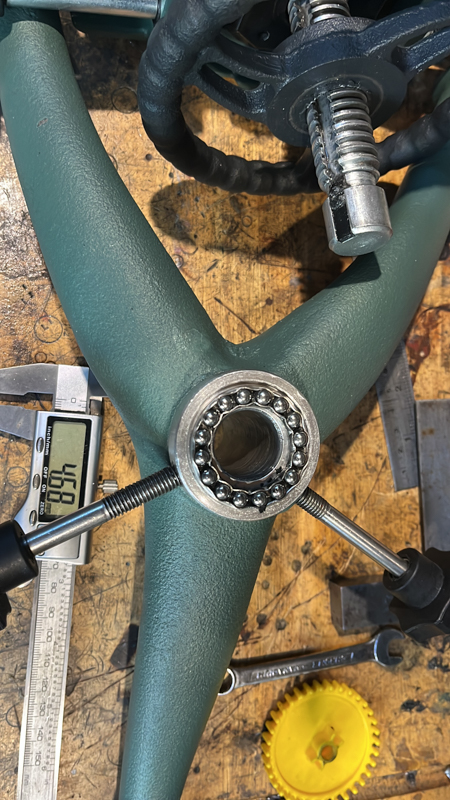
The top of the rest has to be removed to unscrew the windage plate from the elevation screw
before the wheel can be spun off at the top. It cannot be run off at the bottom - shown here.
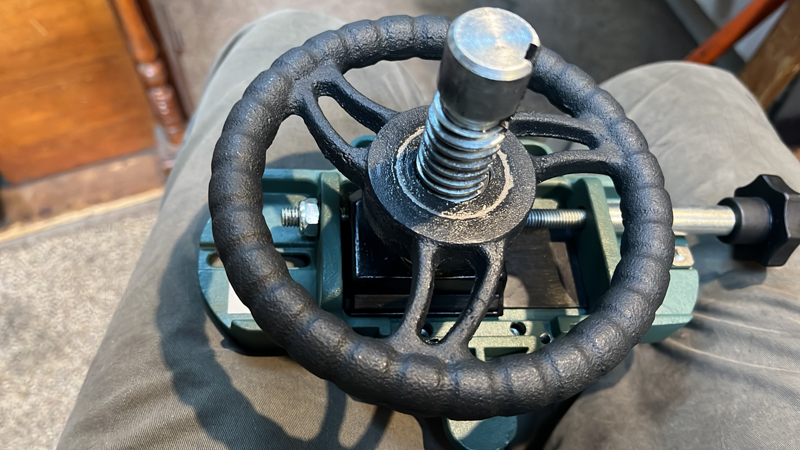
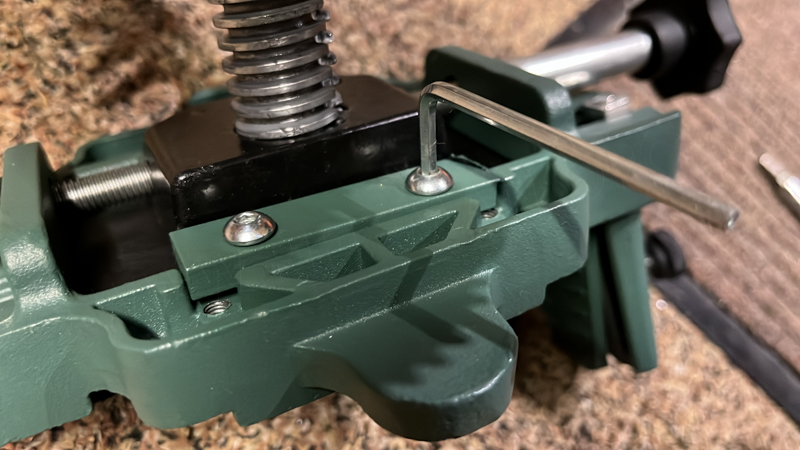
The centre of the gear has to be carefully cut out to fit accurately over the elevation screw,
with slight clearance. A large 20mm I/D washer is then drilled with 5 clearance holes for
the machine screws that hold the gear to the wheel hub, drilled and tapped for them.
Accurate centreing is obviously critical, but if the gear spokes are given just sufficient clearance
around the elevation screw it can easily be adjusted and clamped down.
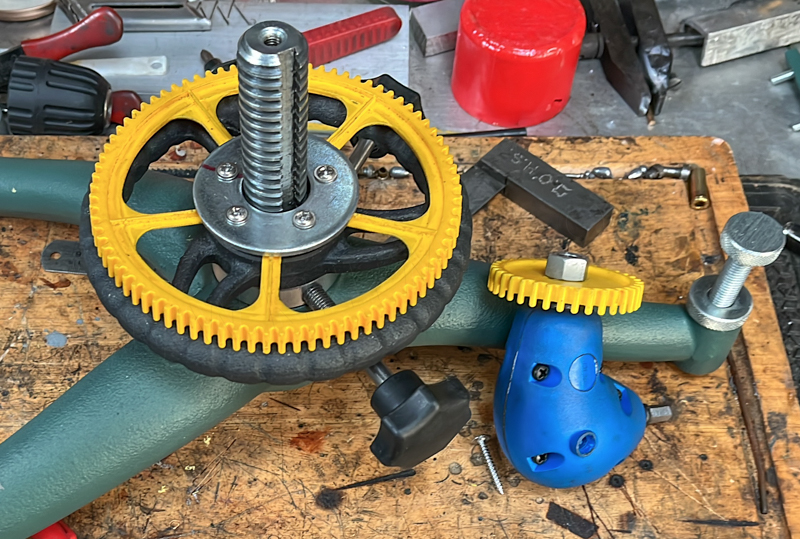
The small gear hub is drilled out to suit the angle-drive's output shaft, and the gear fitted with packing washers beneath to ensure correct meshing with the main gear.
Here comes the tricky part. The curvature of the arm of the tripod base means a flat needs to be filed on it before the fixing hole for the drive can be drilled. Using this particular drive meant the hole was very high in the arm. An extension to the output shaft would make the task easier, but perhaps render a tight meshing of the gears more difficult.
The 5mm hex fixing bolt must be carefully positioned to ensure correct gear meshing.
When that is achieved, another (with a tube spacer betwixt the drive and rest arm) can be drilled to lock the drive into place.
Offering up the drive to mark fastening points.
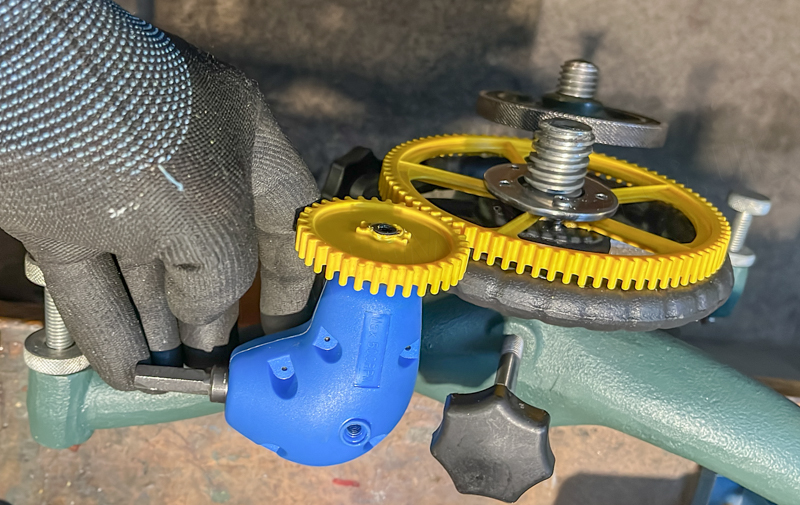
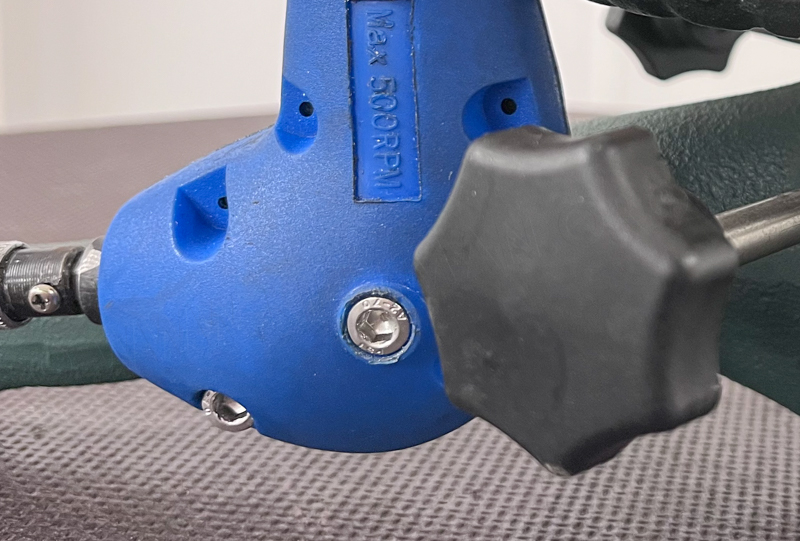
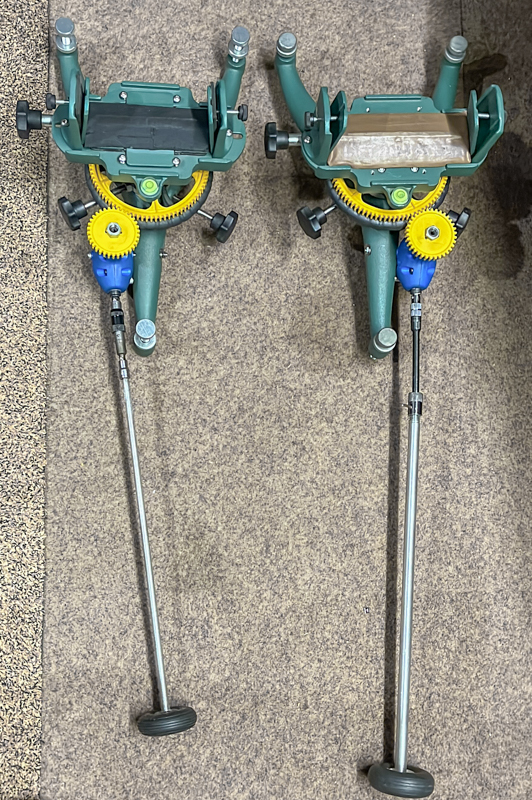
Below: The left and right-handed conversions.
The LH model uses a £7 swivel drive to permit angular freedom of the adjusting rod,
while the RH one uses a slightly more expensive spring-coil flexible drive.
The latter probably offers the least backlash.
The rest, here in its rightful place on a fine Yorkshire take-down bench.
The finished article from above.
THE CONS!
These are really but one. The course adjustment right-hand locking knob
must remain locked off at its lowest setting. Moving this will take the gears out of mesh!
Height adjustment of the whole caboodle can still be achieved using the
considerable length of the three tripod pins.
This modification dramatically cuts down unnecessary movement between shots,
and actually speeds up the detail, making everything easier and less tiresome.
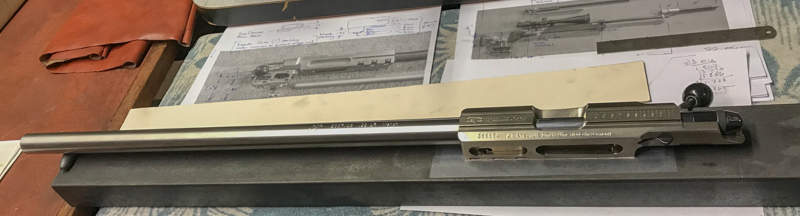
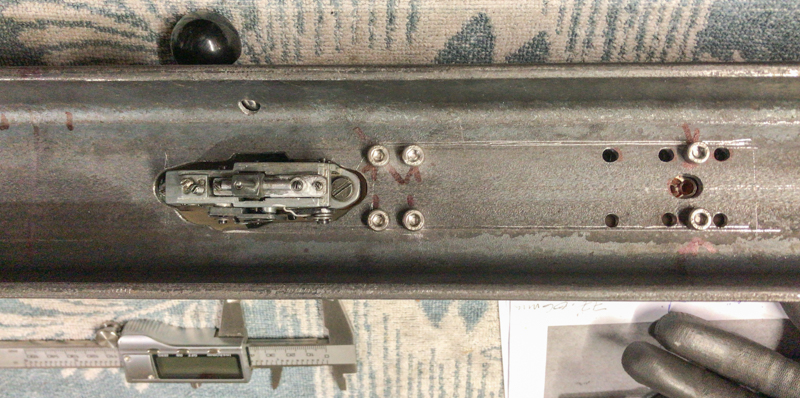
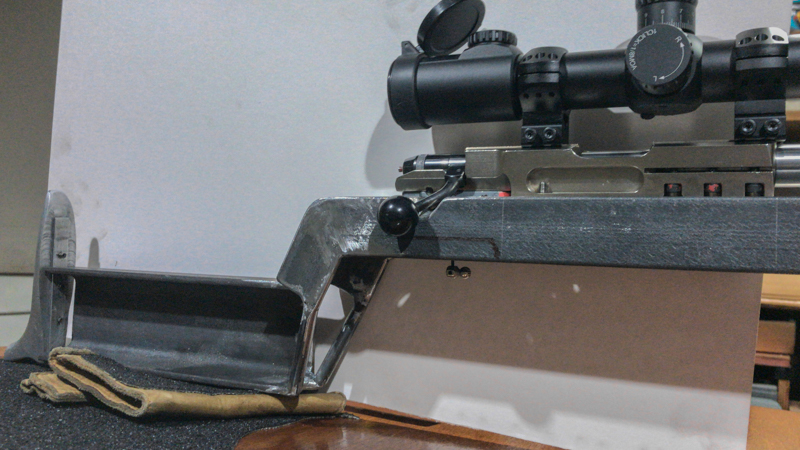
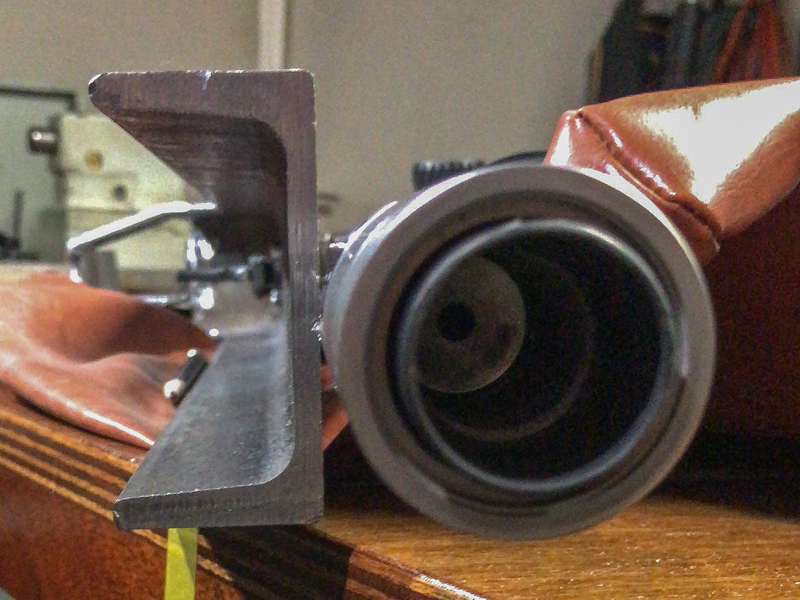
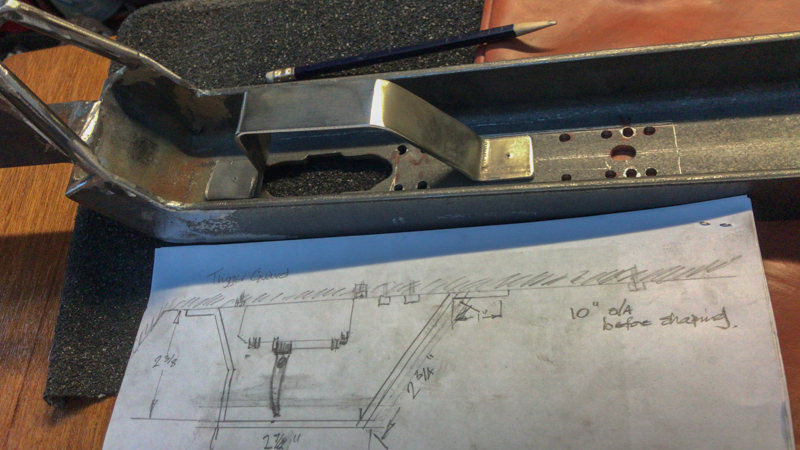
Latest - in June 2026 - is the upgrading of the LEK designed Grünig & Elmiger Racer BR rifle.
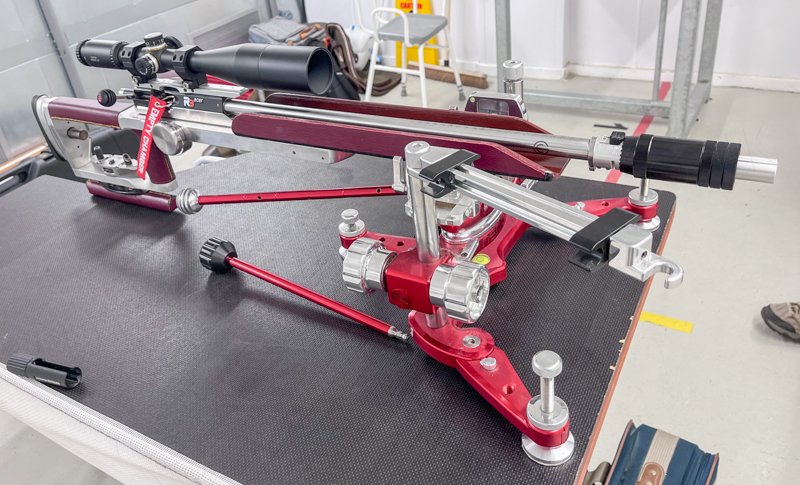
The intended purpose was twofold; firstly to add weight and, secondly, to lower the bore-line closer to the rest plate. The original all alloy-bar stock was shortened, and a section of 75mm wide steel channel bolted to the aluminium stock in place of the offcut. The channel was fitted with its sides upwards, with the barrel lying between. It remains to be seen whether any improvement has been gained. Time will tell, and we will report on the subject; or perhaps the results sheets will prove matters one way or another!
Grü
u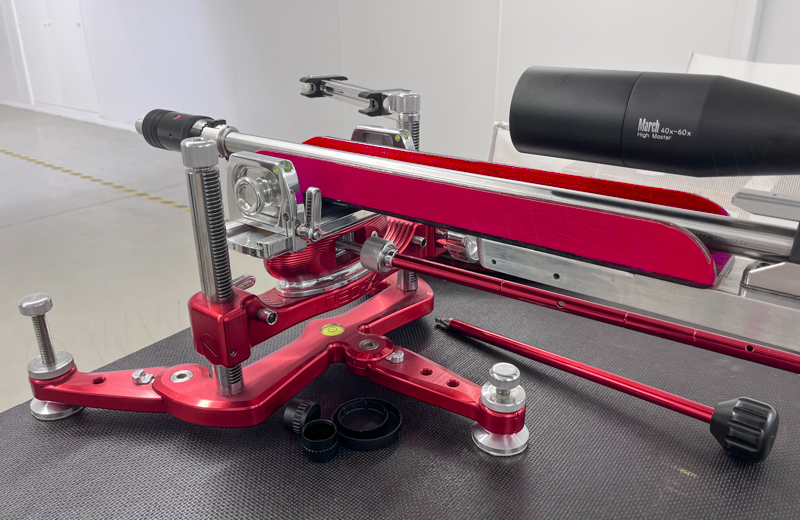
Team results for Yorkshire Winter 2025-26 competition - Division 1
1 2 Easingwold B 3 Parkland A 4 Ilminster A 5 Sutton Coldfield B 6 York R I C 7 York R I D 8 Louth Old Mill A
Yorkshire BR Results Summer 2025 ..... - ..... Eastern Region BR results Summer 2025
Yorkshire BR Results Winter 2025-26 ..... - ..... Eastern Region BR results Winter 2025-26
See also: Colchester Rifle Club Benchrest competition
On the main site: ENFIELD TRAINING RIFLES ...... - ......SMALL-BORE TARGET RIFLES
and the:..BSA Martini International Mks. I & II ...... - ......BSA Martini International Mk.III
Return to: TOP of PAGE
See this website's Raison d'être