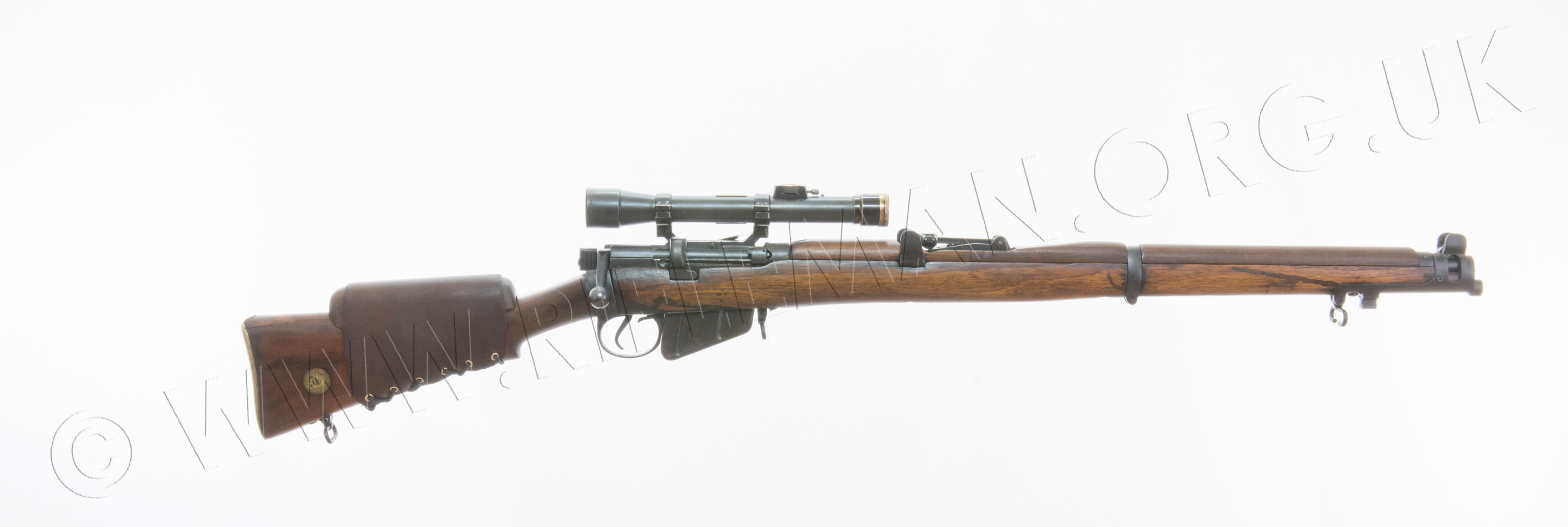
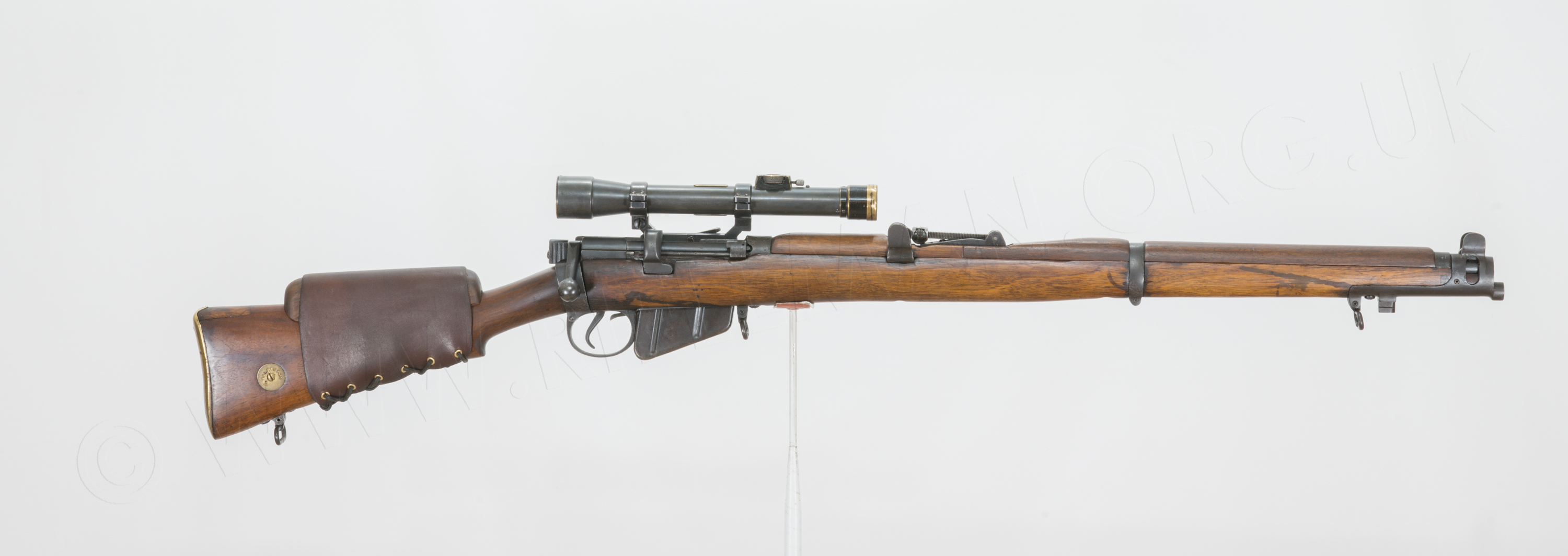
.22RF Lee-Enfield No.1 Mk.III* (SMLE) with Pattern 1916 'scope
and a comparison of WWI and WWII telescopic sights on SMLE, P'14 and P'17 rifles
Please be aware that some specialist imagery may take time to load.
This site is designed for dedicated researchers, and is best viewed on desk or laptop.
See also: ......No.1 Mk.III SMLE Sniping Rifle...... - ......Enfield No.3(T) Mk.1 (P'14) sniper rifle
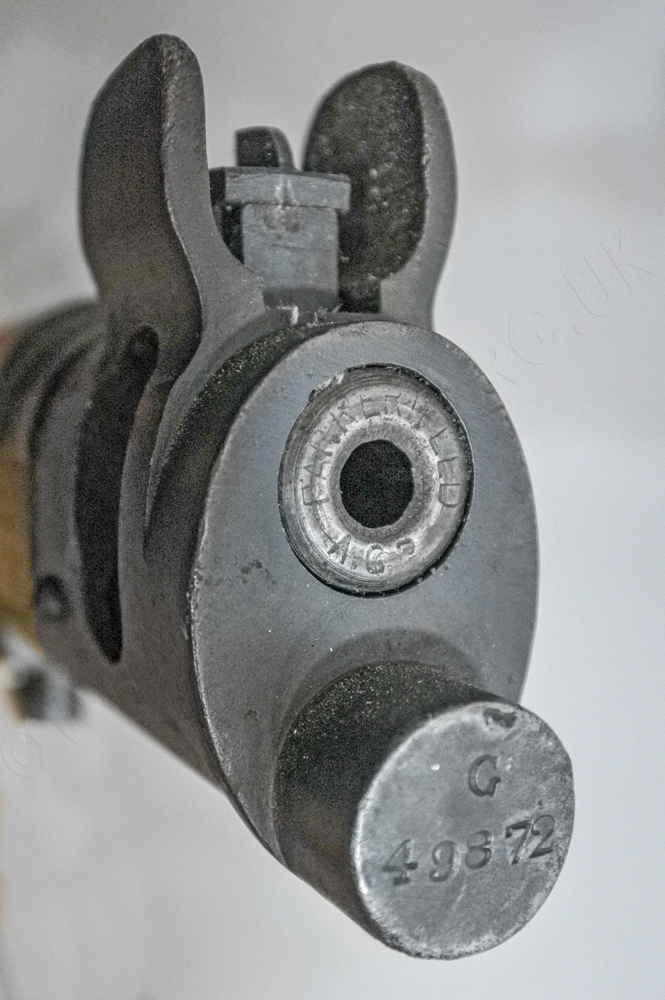
This is a 1918 dated Lee-Enfield Short Rifle Mk.III* that has been Parkerifled
by the A.G. Parker company.
Left: the barrel muzzle's crown is marked " PARKERIFLED AGP ",
and the usual brass olive soft-soldered in with the sleeve is not present in this case.
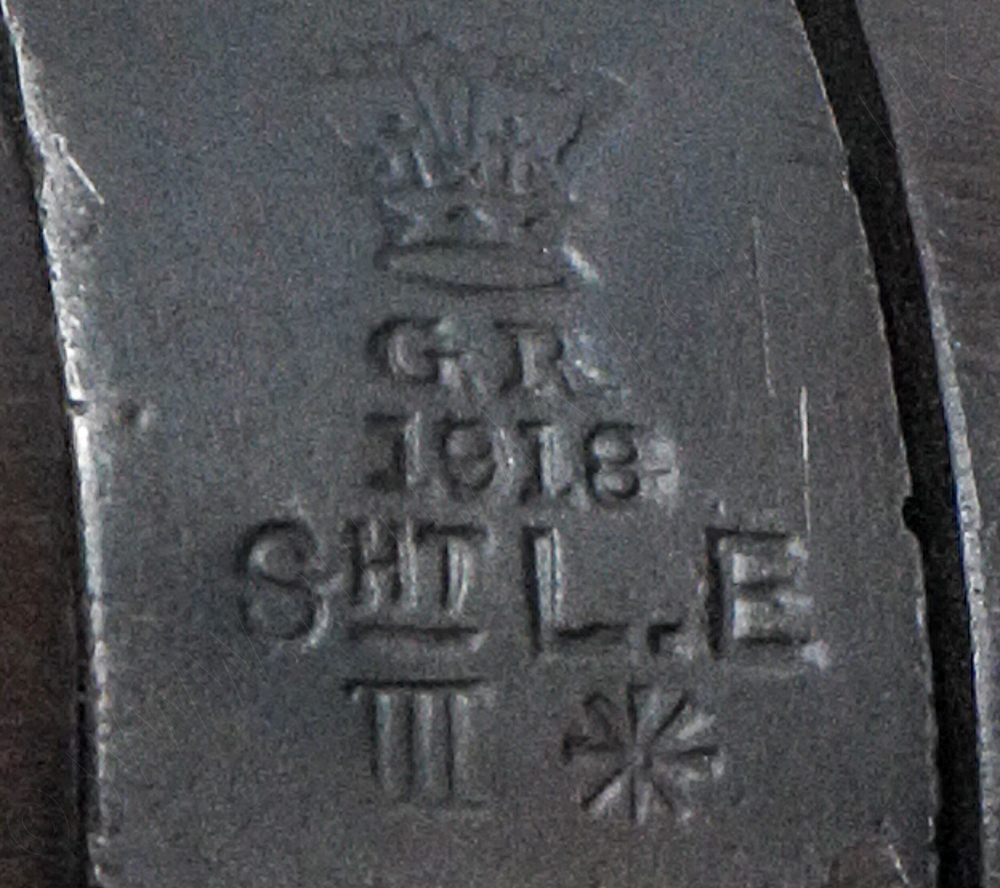
Right: The other crown is that of 'George Rex' (George V)
above the original nomenclature stamped on the RHS of the butt-socket.
1918
SHT L.E.
III *
(Short Lee-Enfield Mk.III*)
 .........
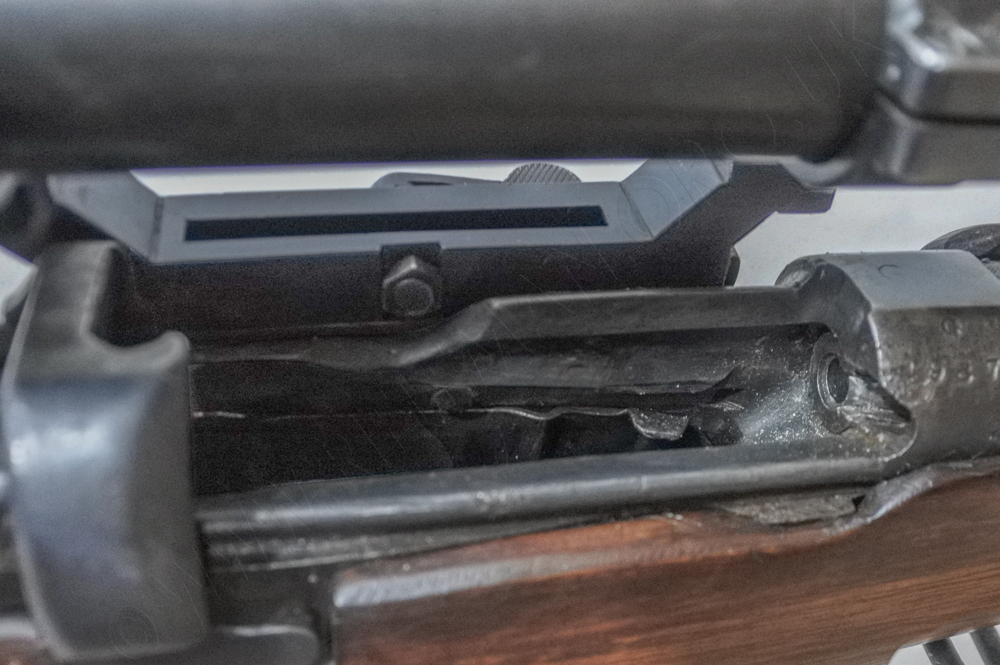
As was the norm with the .22 training conversions, the spring and follower were removed from the magazine, leaving just the empty magazine shell to collect the fired and extracted cases, as there was no ejection system.
Anyone who has used one of these training rifles, such as the No.2 Mk. IV, will tell you that a fair degree of dexterity is required to load a rimfire round into the chamber without dropping it into the magazine shell!
The underside of the telescope, and inner face of the mounting braket, are visible.
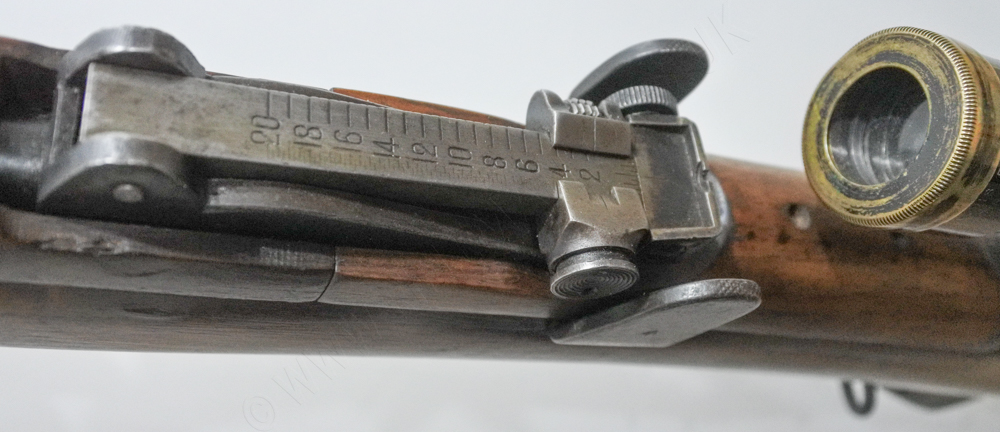
Many of these rifles used for target practice were fitted
with the windage-adjustable rear-sight tangent leaf .
The magazine in this rifle shows evidence that it has been widely travelled, with several previous serial numbers having been barred-out.
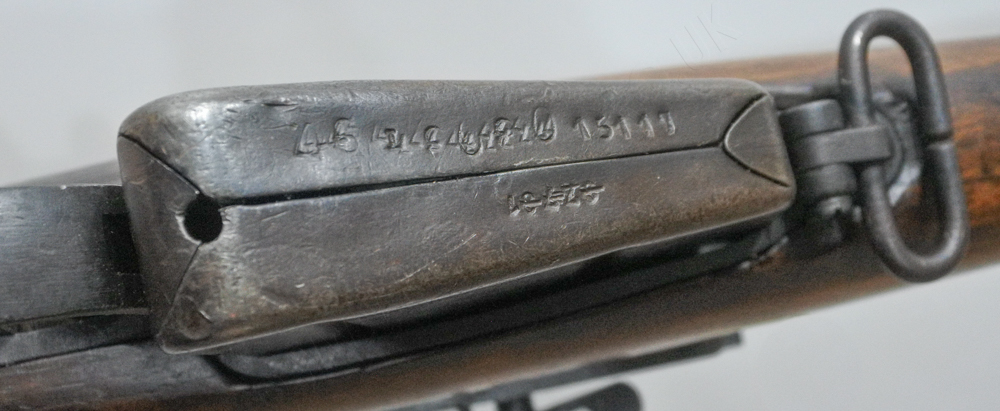
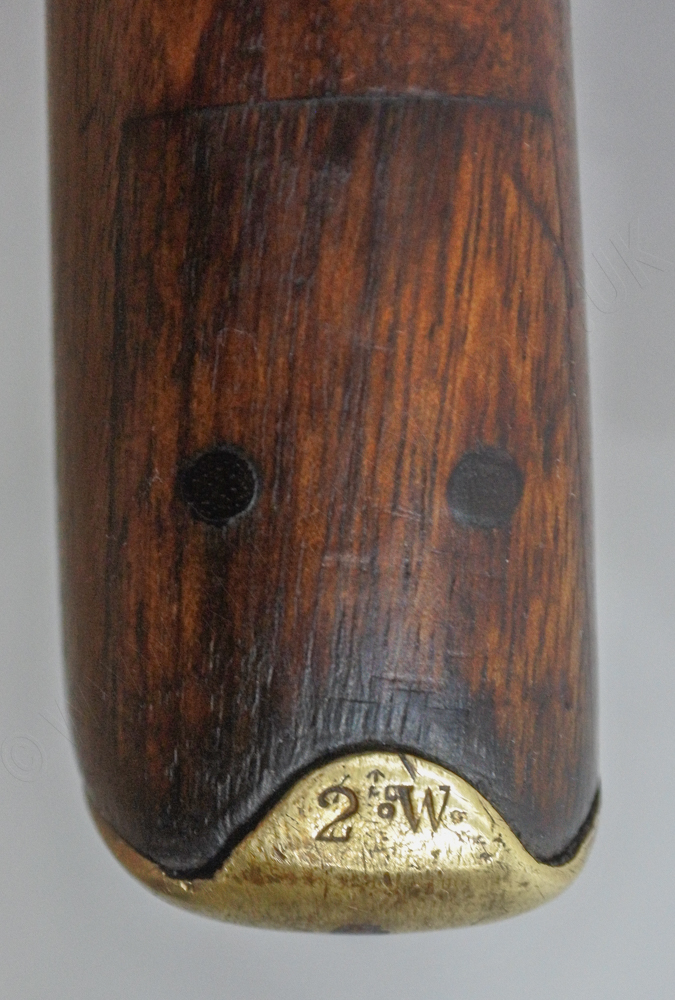
The tang of the butt-plate bears a unit mark, along with the smallest "Broad Arrow" we have ever seen. The rear part of the comb has undergone an armourer's repair, perhaps as a result of damage during "square-bashing" at some time in its career.
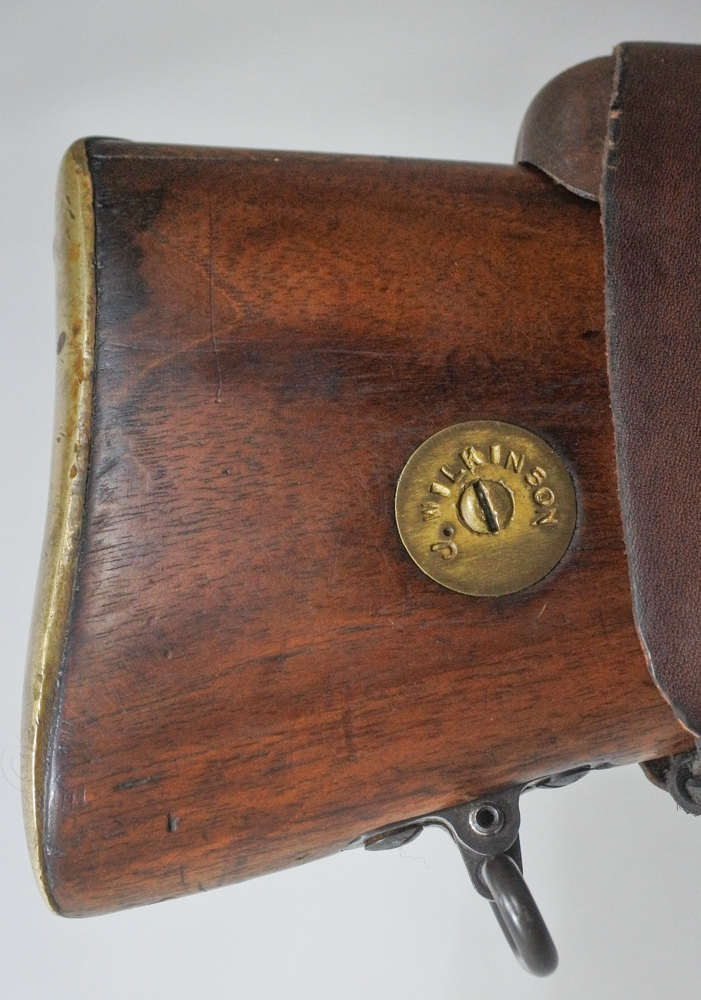
The rifle was at somepoint in its latter days owned by one "J. WILKINSON", whose name is stamped into the butt-disk.
 ...........
The rifle has more recently and unusually been retro-fitted with an Aldis Pattern 1916 sniper 'scope, such as might have been intended as a training weapon for the .303-inch SMLE sniping rifle, usually issued with a Pattern 1918 Aldis or Periscope Prism company over-bore telescope.
It is planned to use the rifle in historic small-bore optic sights competition for military training rifles.
Hover over or Click image to bring up hi-res file and magnifier
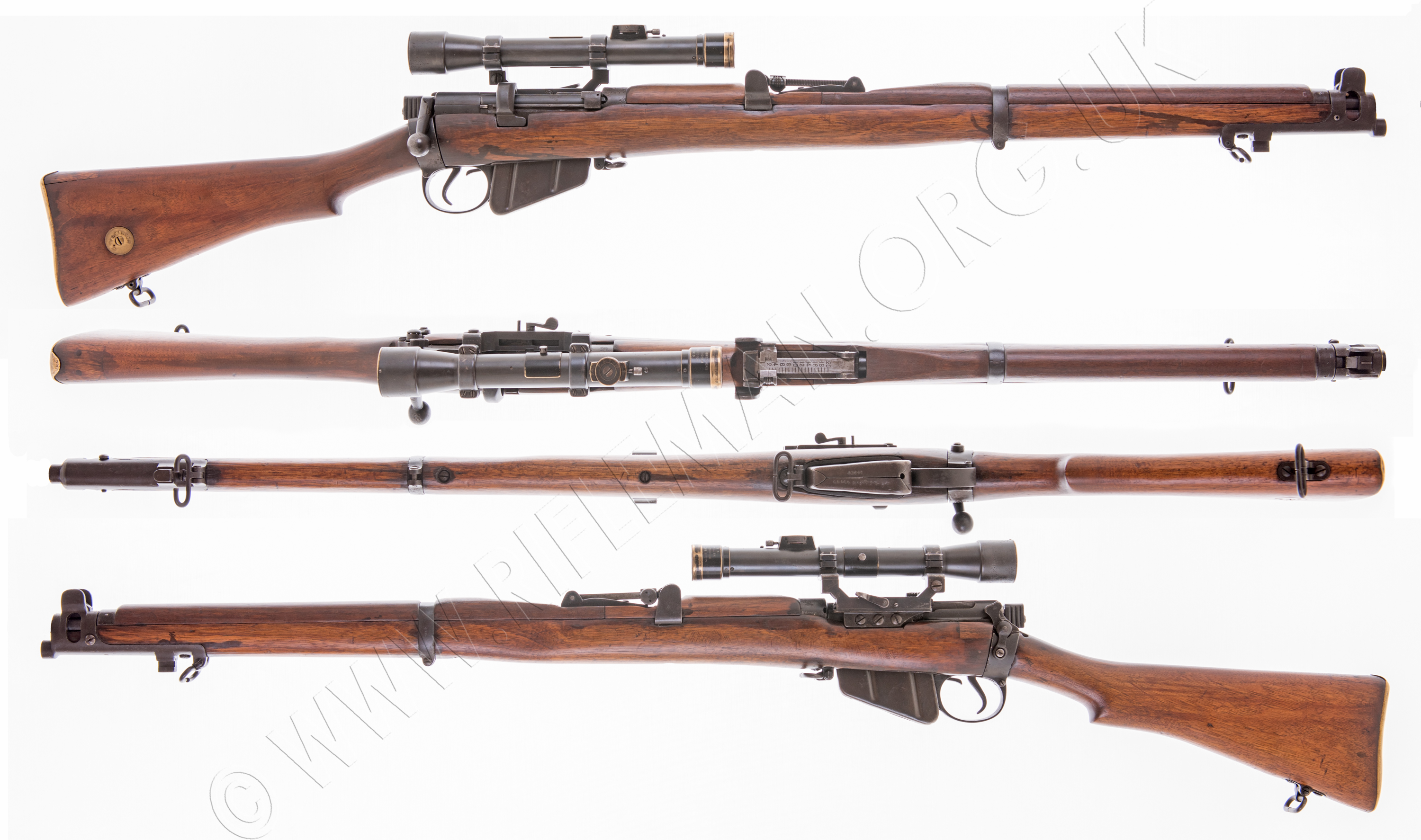
The Aldis telescope has been fitted over-bore using a Griffin & Howe type mount screwed to the left-hand-side of the action. The G&H American-made mounts were usually produced with double locking levers, but some of the earliest were just single lever as the example here. It is likely that this mount is a British-made clone, as it does not carry the usual G&H marking, and the 'scope rings are each clamped with four screws, whereas all the G&H mounts we have seen have only two screws holding the ring upper halves in place - one each side.
The rear part of the mount has a dovetailed lateral slide for azimuth zeroing. This is adjustable with a pair of machine screws bearing on the ends of the slide - one either side. The front ring mount is pivotted.
It is interesting to compare a few of the various over-bore telescopic-sight mounting arrangements used during the First World War on both the Lee-Enfield Short Rifle and the .303" calibre Pattern 1914 (Enfield Rifle No.3T). The most commonly fitted 'scopes were those of the manufacturers Aldis Brothers and the Periscope Prism Company. Various examples of these models, along with the U.S. made Winchester A5, had earlier been fitted on left-hand side mounts - ostensibly to retain the ability to clip-load and still utilise the iron sights. It was not long before it was appreciated that snipers did not usually need a rapid-fire option, and that the offset telescopes provided extremely awkward sighting - either with the left eye, or with a cheek pad to bring the right eye into line with the 'scope.
The obvious and ideal answer was to mount the 'scopes over-bore, and this became the more usual configuration mid-to-late war. However, even the lowest mounting possible, to keep the objective lens clear of the barrel's tangent leaf sight, meant that it was more or less necessary to rest the chin on the comb of the butt rather than the cheek. It was perhaps as well, with the rifle firmly rested, not to hold the cheek to the butt at all; but it is known that various means of padding the butt comb were used to afford a comfortable hold on the rifle and a steady sight-line. Few rifles known to have been in use during the 1914-18 war show any sign of having had any form of cheek raiser, any that there were presumably having been removed when the rifles were returned to armouries after the Armistice.
Most collectors nowadays shooting such rare and rifles in historic competition no doubt fire them in their original factory configuration, or add their own cheek raiser to bring their eye up to the 'scope - with a sensibly long eye-relief - as a recoil hit on the eyebrow from too close a hold will inevitably result in a need for stitches.
An attempt to emulate the type of cheek raiser that has been used on such rifles, prior to the arrival of the well-known fixed cheek-piece screwed onto the butt-comb of the issue WWII No.4T sniping rifle, we produced one of our own to test its practicality.
Making assumptions as to what may have been available in the field at the time, a typical laced leather strapping was used to hold in place a walnut cheek-raiser cut from the comb of an original SMLE butt. The cut passed through the hole for the butt's fixing bolt, easing the task of relieving the underside of the comb offcut to the shape of the top of the butt of our "sniper" rifle, in much the same way as the No.4T cheek-piece. Many such leather-strapped cheek raisers simply have padding sewn into the top for a cheek-rest, but it was felt that a more solid rest for the cheek would have been preferred, resulting in a hold in the same manner as that of the original butt-comb.
The rifle with cheek-piece in place.
Hover over or Click image to bring up hi-res file and magnifier
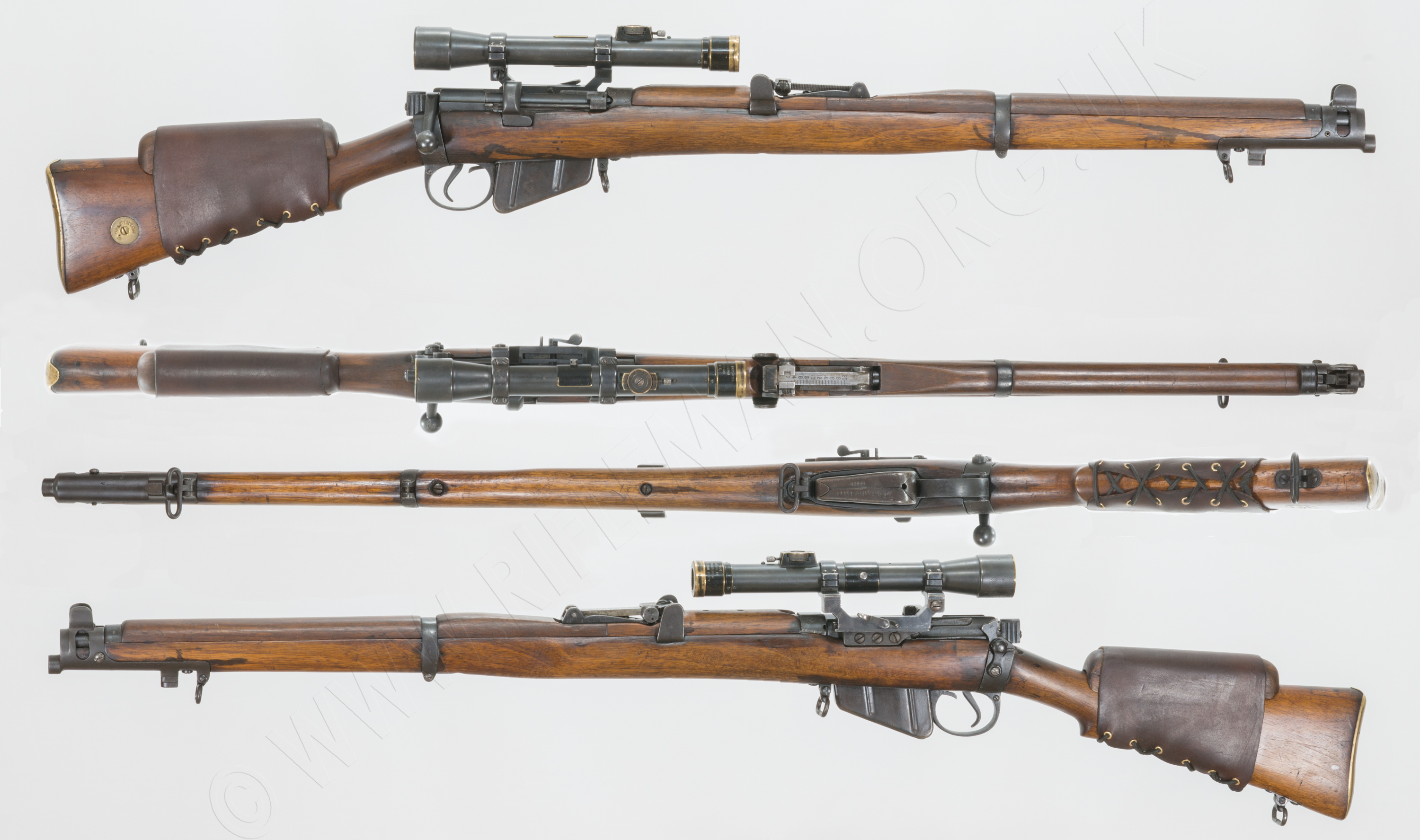
The height of any such raiser depends upon the relative height of the mounted telescope, and it became apparent that this varied considerably with the type of mounting arrangement used. It is therefore perhaps worth including a section affording a comparison between a few configurations of over-bore mounted 'scopes that we have come across - with one or two side-mounted ones included to illustrate the differences.
The Pattern 1918 'scopes were usually found of Aldis manufacture,
such as those also fitted to the Enfield Rifle No3(T),
the First World War (1914-18) sniping version of the Pattern 1914 (P'14) rifle.
The Pattern 1916 'scope shown below on our .22 Rimfire SMLE training conversion was manufactured by the Aldis Brothers company of Birmingham, who also made earlier side-mounted 'scopes similar to those of the Periscope Prism Co., fitted to selected standard issue S.M.L.E. rifles, - then becoming the Lee-Enfield No.1 Mk.III sniping rifles - early in the First World War (1914-18).
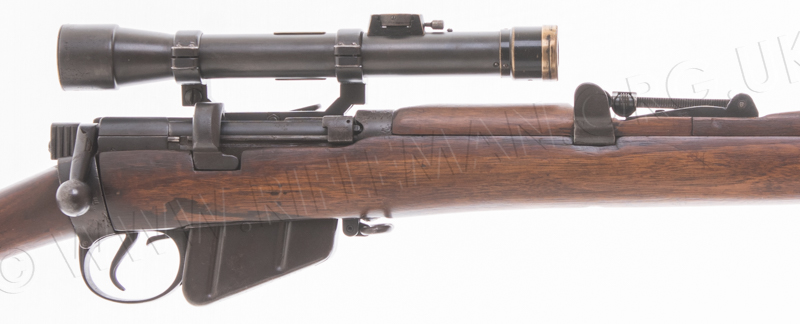
The marking on the objective lens' outer tube.
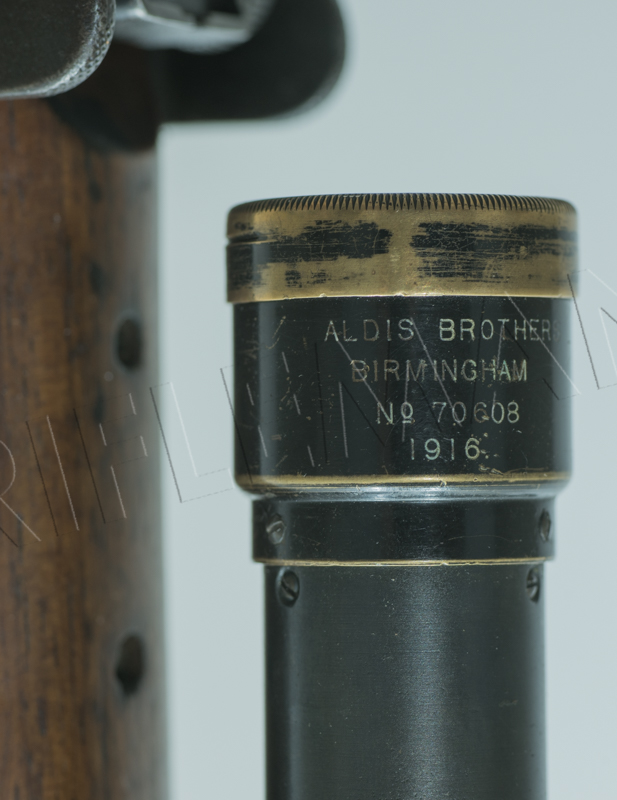
The Enfield Pattern 1914 rifle in its guise as the No.3(T) MK.I sniping rifle
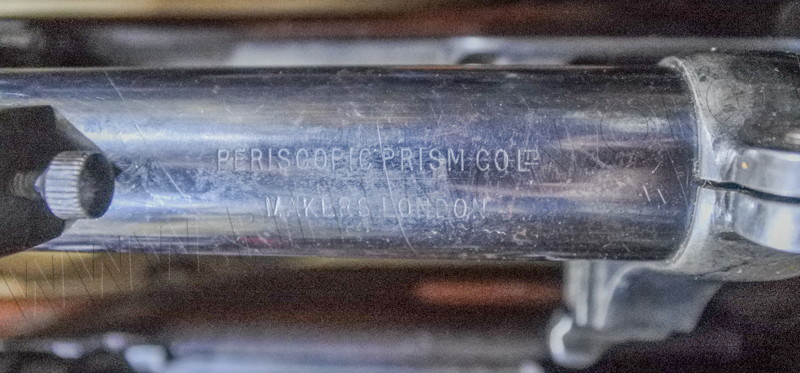
with the over-bore Aldis-style Periscope Prism Company telescopic sight.
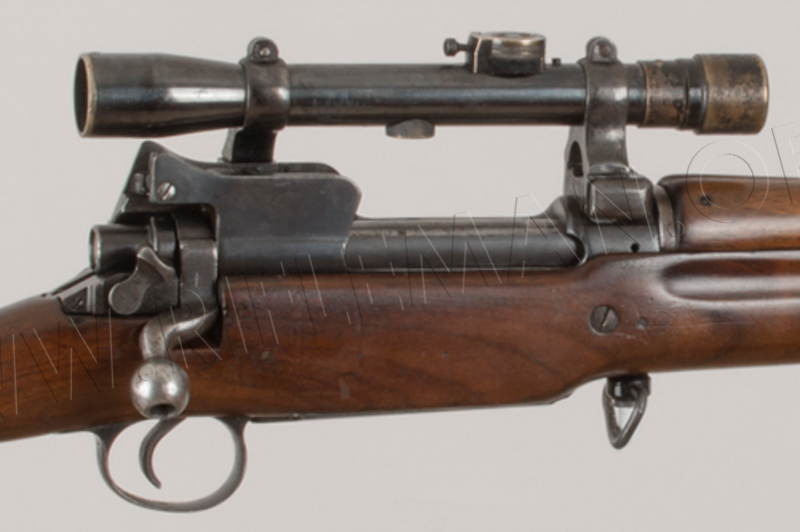
The marking of the Periscope Prism Company Pattern 1918 telescope
mounted over-bore on a No.3(T) Mk.I* SMLE.
_________________
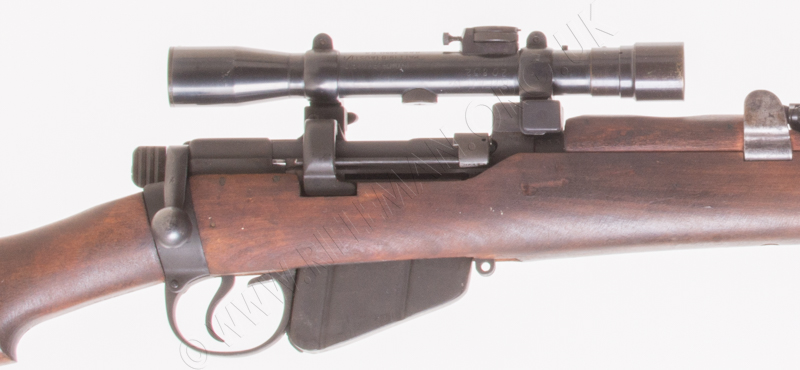
Below: The Australian WWII SMLE Sniper Rifle in .303-inch centre-fire calibre
with its 1939-45 War Australian made Pattern 1918 'scope.
During the Second World War, when Australian Forces sought a sniper rifle of their own, due to a dearth in the Pacific theatre of the Lee-Enfield No.4T sniping rifle, and because Australia still only had machinery for the manufacture of the SMLE rifle, they necessarily developed a rifle of that pattern. Without a telescopic sight of their own, nor time to design one, they built new 'scopes using the drawings of the WW1 Pattern 1918 telescope. Australia also trialled their own "Jungle Carbine"built on the SMLE action (see the Shortened and Lightened Rifle and the Australian Rifle No.6), but in the same way as these latter carbines never went into production because an atomic bomb brought the war in the Pacific to a sudden closure, their SMLE sniping rifle shown here never went beyond prototyping and trialling.
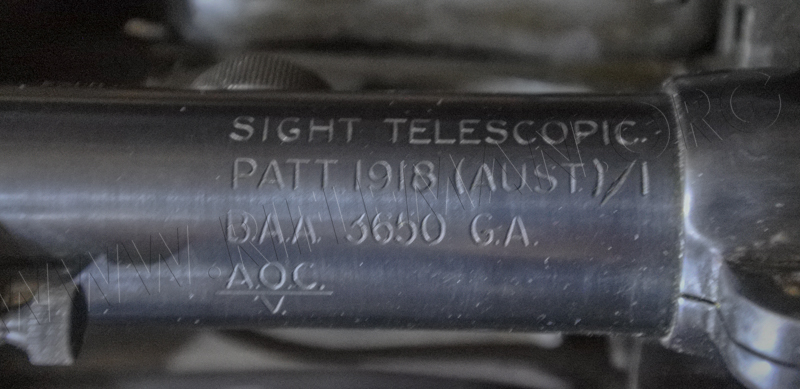
The marks for the Australian Pattern 1918 WWII manufactured telescope.
SIGHT TELESCOPIC
PATT 1918 (AUST)/1
B.A.A. 3650 G.A. ......
A.O.C. ......................
.V. .....................
___________________
To illustrate the point about telescope height variation, and to imagine how awkward it may have been to use some types of telescope mountings in the field, here is the appropriate section of the photograph of a rifle sold in a Rock Island auction in the U.S. in late 2025.
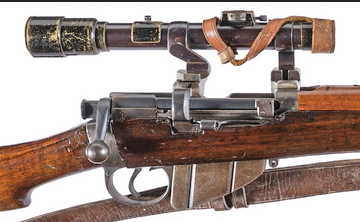
It will be seen that the telescope is considerably higher than any others we have noted. The side-mounted pair of mounts apparently has a rear ring engraved for Holland & Holland. However, we suspect there may have been an error in identification, as the auction write-up quotes the configuration as being of the type reported by Ian Skennerton in his reference book "The British Sniper" (pages 230-231).
In fact, that telescope on the rifle illustrated by Skennerton, which does have an Aldis 'scope - though of slightly different type, and which is on the more usual Holland & Holland mounts, lies significantly lower, and much further forward, as would be expected of their usual rifle adaptations, than that of the auctioned rifle.
The auctioned rifle's telescope is set unusually high, and the ocular section is at least an inch or two further rearward than the norm, suggesting that the greatest care would need to be taken with eye-relief before letting off a round. Skennerton's example has the rear mount by the front receiver ring, and the auctioned rifle has it by the charger bridge. Even if shot using the left eye, the positioning of the chin or cheek on the butt could perhaps be problematic.
OTHER SIDE-MOUNTED TELESCOPES
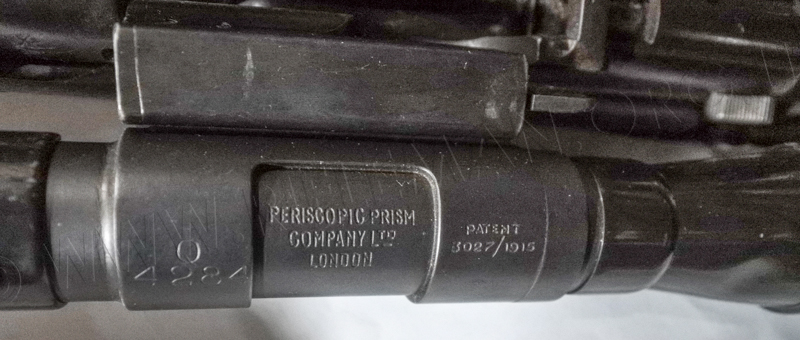
The earlier side-mounted Periscope Prism Co., telescope patented in 1915,
here fitted to a 1916 No.1 Mk.III SMLE
The markings on this 'scope bear a serial no. "O" over "4284"
and the Patent reference "PATENT 3027/1915"
The company marking reads
" PERISCOPE PRISM
COMPANY L
LONDON "
The image is obviously inverted to best show the marking.
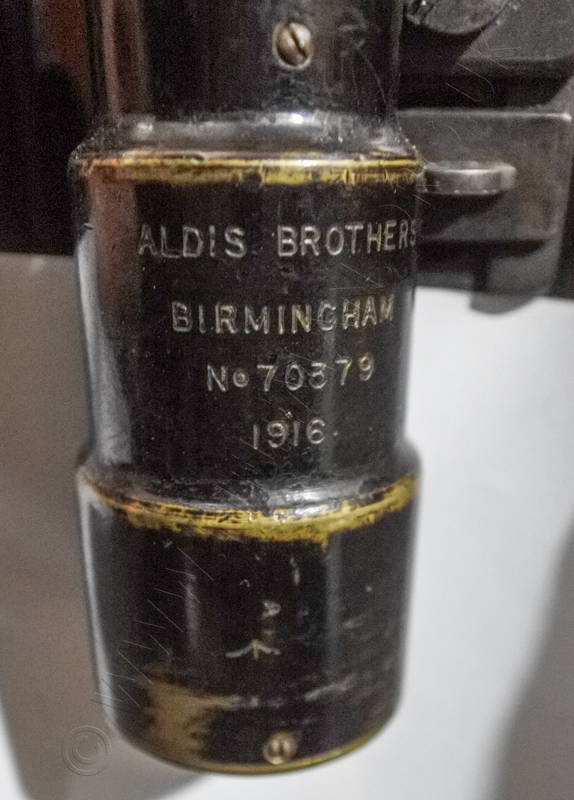
A further side-mounted Aldis Brothers Pattern 1916 'scope
is fitted on Alex Martin mounts to a Pattern 1917 sniper rifle -

The marks, including the serial number of the above Pattern 1916 Aldis 'scope,
along with the Broad Arrow acceptance stamp, are on rear optic lens' stepped tube section.
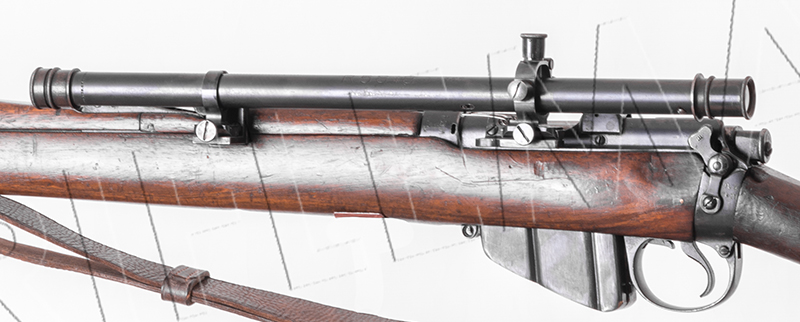
Lastly, neither a Pattern 1916 nor 1918 'scope, but a U.S. made Winchester A5 'scope
fitted to a 1916 SMLE No.1 Mk.III* on Whitehead mounts - just for further comparison.
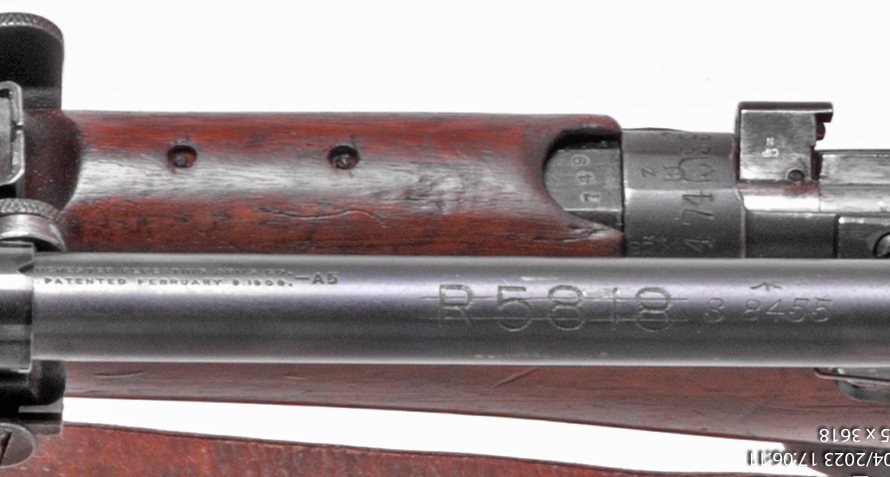
The marks on the 'scope show a barred out serial no. R5818 and a further serial no. S 8455
with the Broad Arrow acceptance mark above.
The rolled stamping of the manufacturer reads
MANUFACTURED BY THE WINCHESTER REPEATING ARMS COMPANY
NEW HAVEN, CONN. U.S.A. PATENTED FEBRUARY 9.1909.
New Haven is in the state of Connecticut.
______________
______________________
We have recently been experimenting further with rotational imagery; and the trial results are shown below.
Two rotatable and zoomable images of the rifle with its leather-bound cheek-piece in place.
The first set using flash, and the second set using floods.
Full screen viewing from expansion arrows.
Full screen viewing from expansion arrows.
Click the images below to view trial rotating MP4 video clips of the rifle.
The videos can be zoomed by clicking command or control and +
360 horizontal - fast - 1.3 minutes
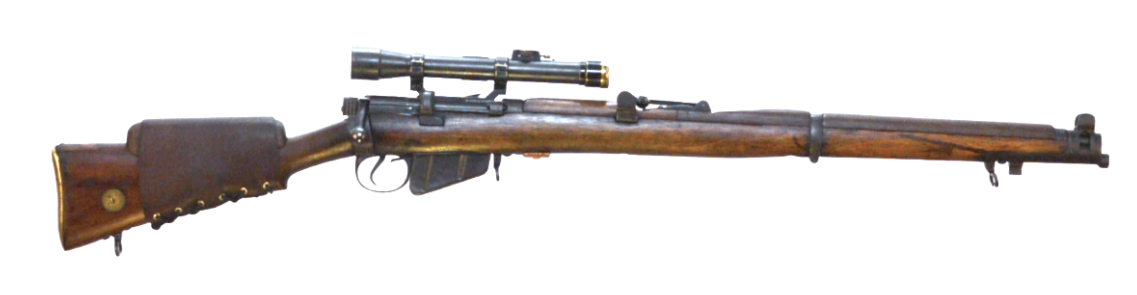
720 degree - slow - 2.4 mins