"ARMORY" MODEL .....-....."BISLEY" MODEL .....-..... "FAVOURITE" MODEL.....-..... "IDEAL 44½" MODEL
"WALNUT HILL" MODEL....-..... AN UNUSUAL CONVERSION....-..... STEVENS 1918 CATALOGUE
See also: the Stevens Model 76A semi-auto military issue rifle,
and the 1920 Lyman Gun Corporation Sights Catalogue
N.B. We have chosen not to repeat each of the rifles' weights, dimensions and options
in the text, as all these are clearly shown in the various catalogue entries on this page.
The history of Joshua Stevens and his erstwhile buy-out of Harry Pope, at the very beginning of the Twentieth Century, that enabled the latter's barrel-making expertise to be incorporated into the Stevens Arms Co., is already well covered elsewhere on the internet. Pope only stayed with the company for about five years, but the Stevens-Pope name continued without his presence there. We will therefore not expand that company history here, and will simply detail those rifles that have most enjoyed usage in British hands over the following hundred years and more.
___________
Manufactured between ca. 1908 and 1932.
(*this is not a mis-spelling - the word is spelled 'Armoury' this side of the pond).
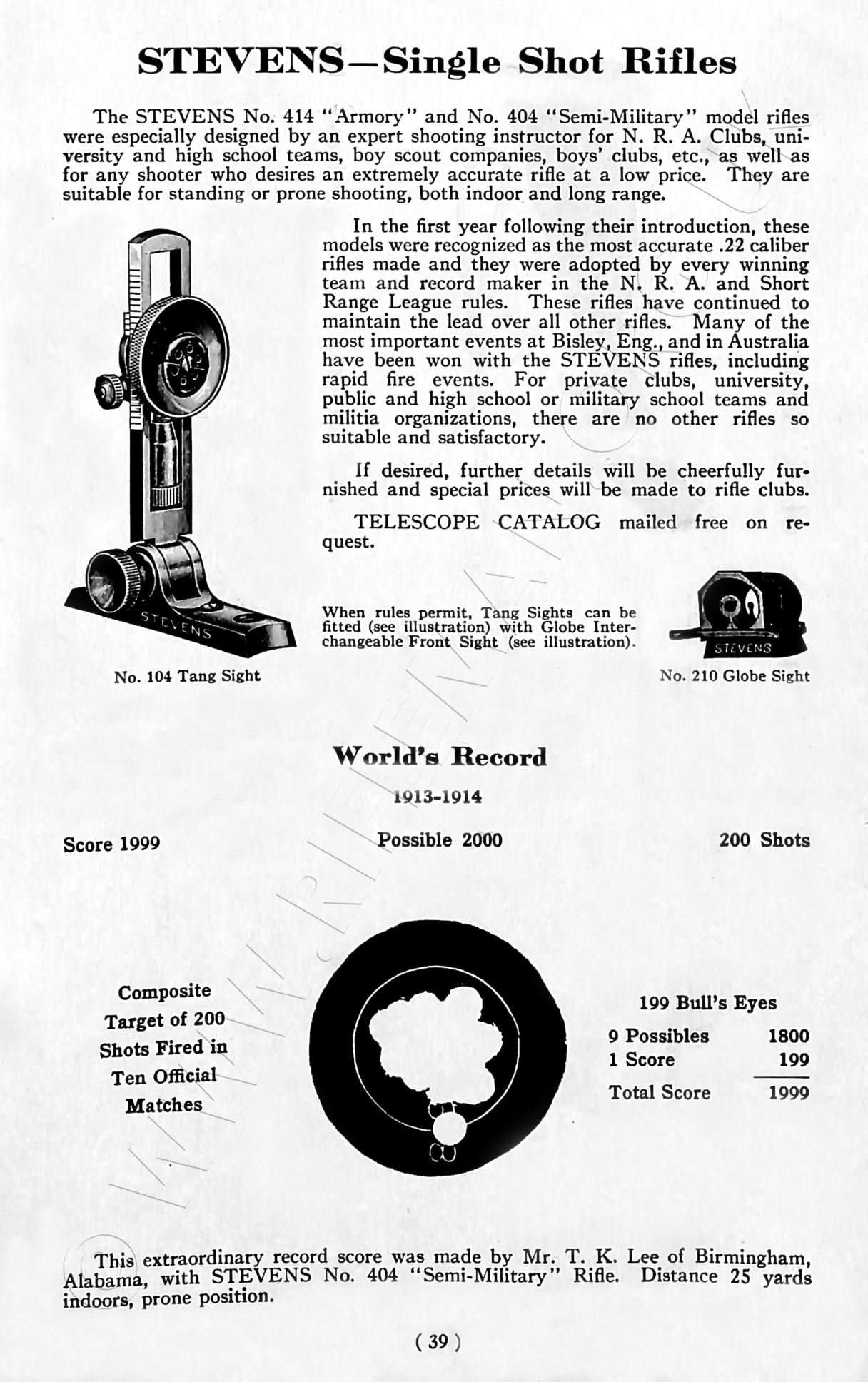
The 1918 catalogue carried a page affording the details of both the no. 414 Armory model and the 404 Semi-military model.
The text explains that the two rifles were designed "by an expert shooting instructor" for U.S. National Rifle Association clubs, university and high school teams, Boy Scout companies, boys' clubs and the like.
The company credited these rifles with significant successes because of their fine accuracy, and even mentions acheivements in competitions at the Bisley ranges - home of the British National Rifle Association.
Particularly mentioned is a World Record shot with an Armory rifle during the 1913-14 season, with a score attained of 1999 ex. a possible 2000 - just one point dropped over ten matches by one T.K. Lee of Birmingham, Alabama.
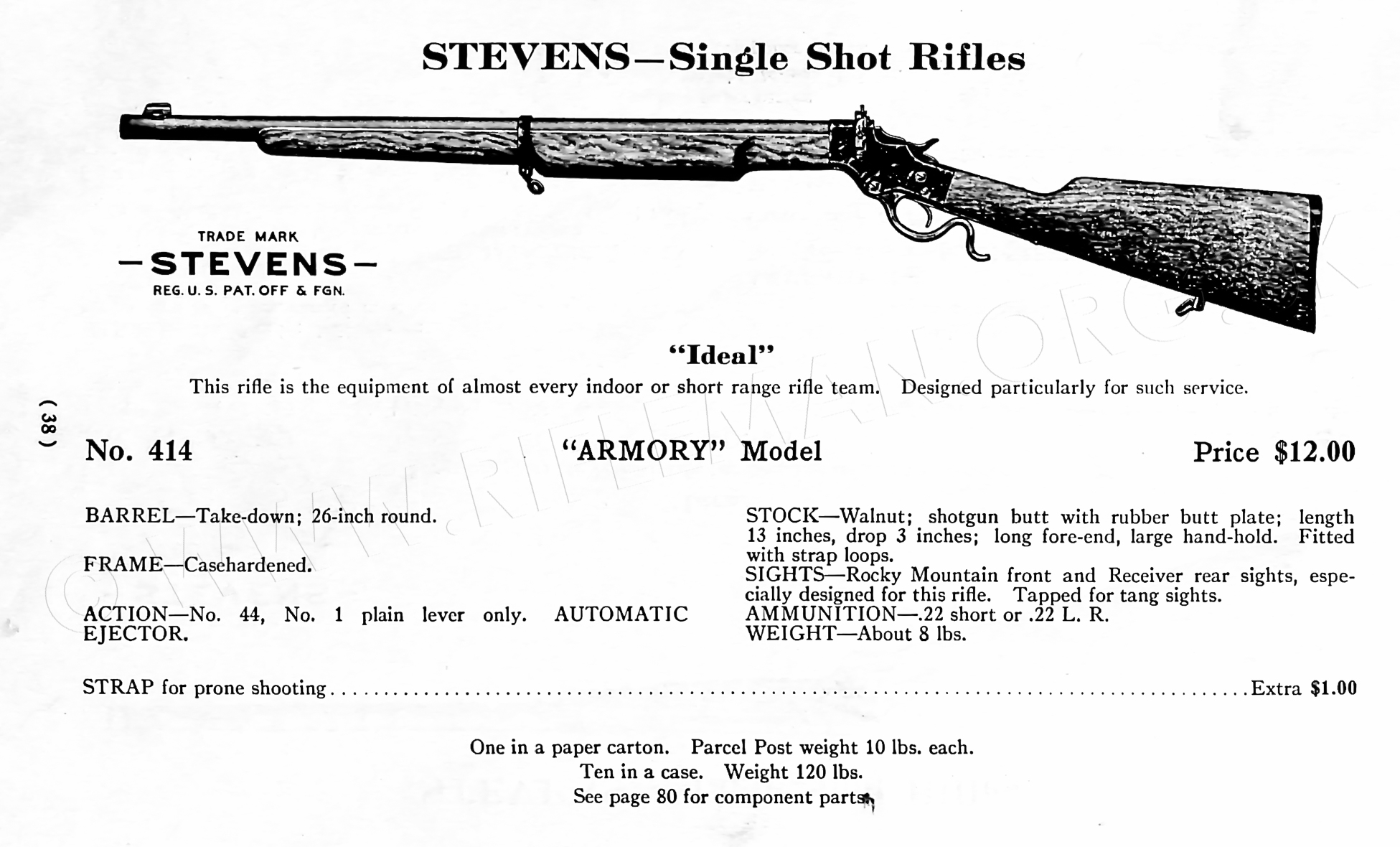
Details of the Armory model are shown here on the page for the rifle in that 1918 catalogue.
This good-looking rifle has probably been refinished, but this has been done both well and sympathetically. The case-hardening of the action body is still eveident, although slightly darkened. The rifle has been fitted with a Lyman 66MD model rear-sight for the flat-sided receiver.
Hover over or Click image to bring up hi-res file and magnifier
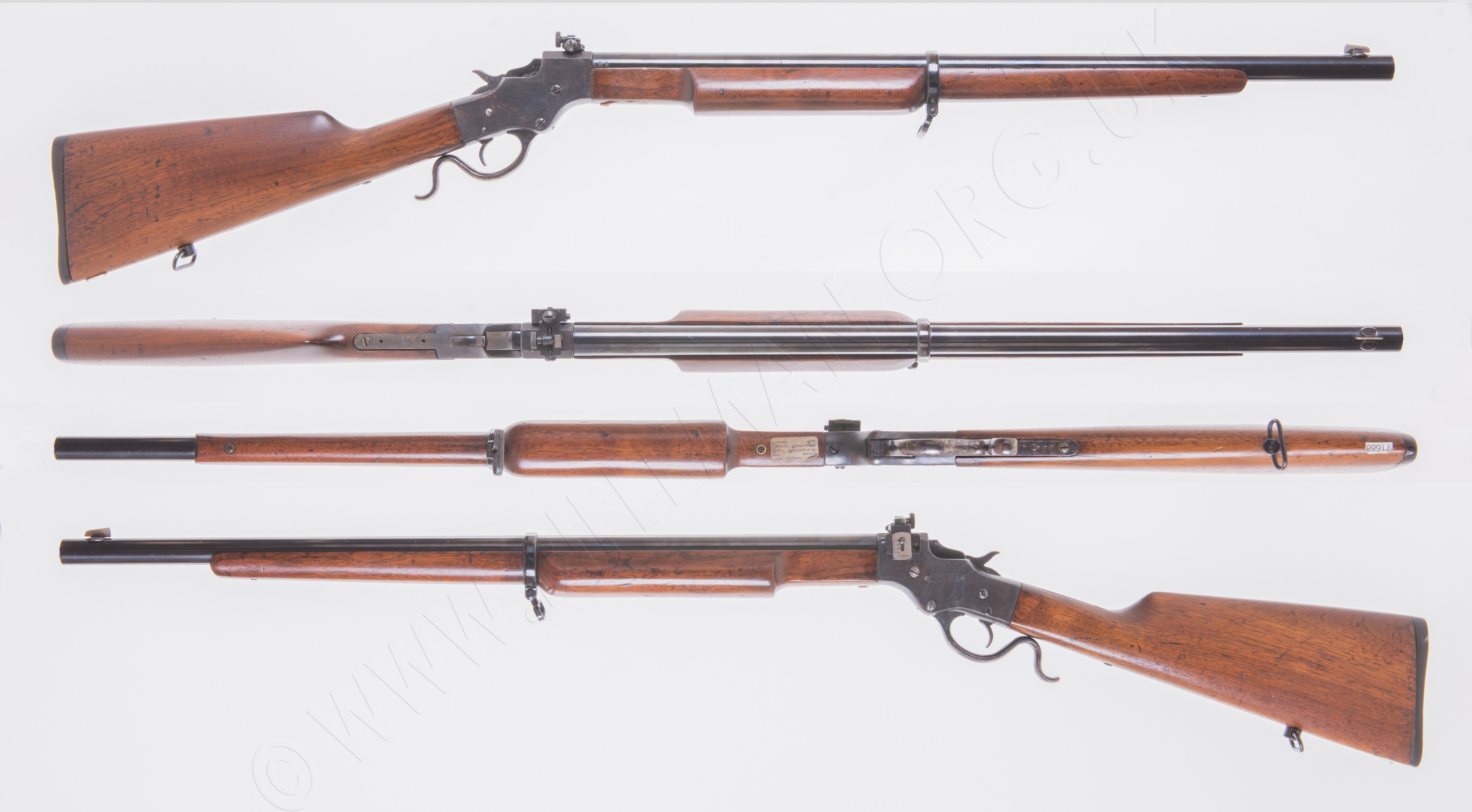
The label beneath the fore-end, ahead of the action, is a class identification one issued for the Historic Arms Meeting at Bisley early in this Millenium. It shows that the rifle is eligible for pre-1919 Military and Target competitions.
________________
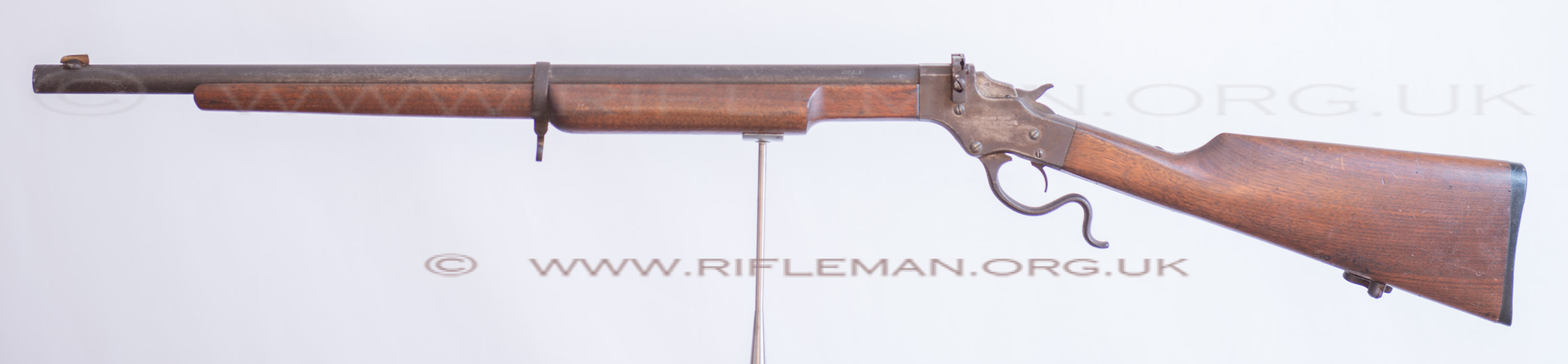
This next Armory example may not be the finest, but it is a rifle that has evidently enjoyed significant use in British hands over many years as a club rifle, and it is perfectly illustrative of the type.
The case-hardening on the forged receiver has deteriorated with handling over more than a Century, but the bore remains excellent, the stocking is in good condition, and the rifle is still remarkably accurate.
It is interesting to note that the catalogue page advises that the butt-tang is drilled and tapped ready for a Lyman type folding rear aperture target sight.

Below: the RHS of the familiar action body, viewed from behind and ahead.
The side-mounted adjustable rear-sight is a simple piece of design,
but is thoroughly practical and robust. This receiver sight is shown on the parts list for the Models 44 and 414 further down this page. The diagram parts are numbered 41 and 42, but the listing only shows a part no. 36 as a receiver sight. The 1918 catalogue page for the 414 describes the sight as a "Rocky Mountain" model especially designed for the rifle.
The hammer is shown both with action not quite closed,
and again in the cocked position for loading, with the under-lever fully down.
 .....
..... 
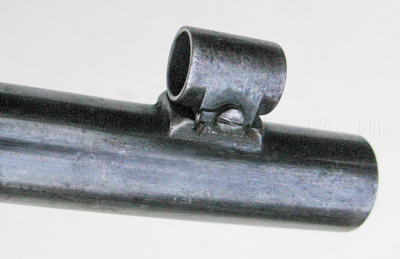
Below: there an original Rocky Mountain foresight
with brass blade in the lateral dovetailed block.

The "Armory" model 414 is also shown
on page 40 of the Stevens 1918 catalogue
_____________________
The SEMI-MILITARY MODEL
This rifle was another intending for the training rôle,
and employed the action of the No. 44½ " MODEL.
Unlike the Armory model's basic open sights, it came with a Lyman no.42 rear-sight and a tubed or 'globe' Lyman no.210 fore-sight. There was no barrel-band with a sling-swivel, but a swivel was fitted underneth the barrel just foreward of the shorter fore-end woodwork.
28" was the longest barrel available.
However, most No.42 receiver sights had a radiussed mount for bolt-action rifles, and we have yet to see a No.42 with a mount to suit a Model 44½ action.
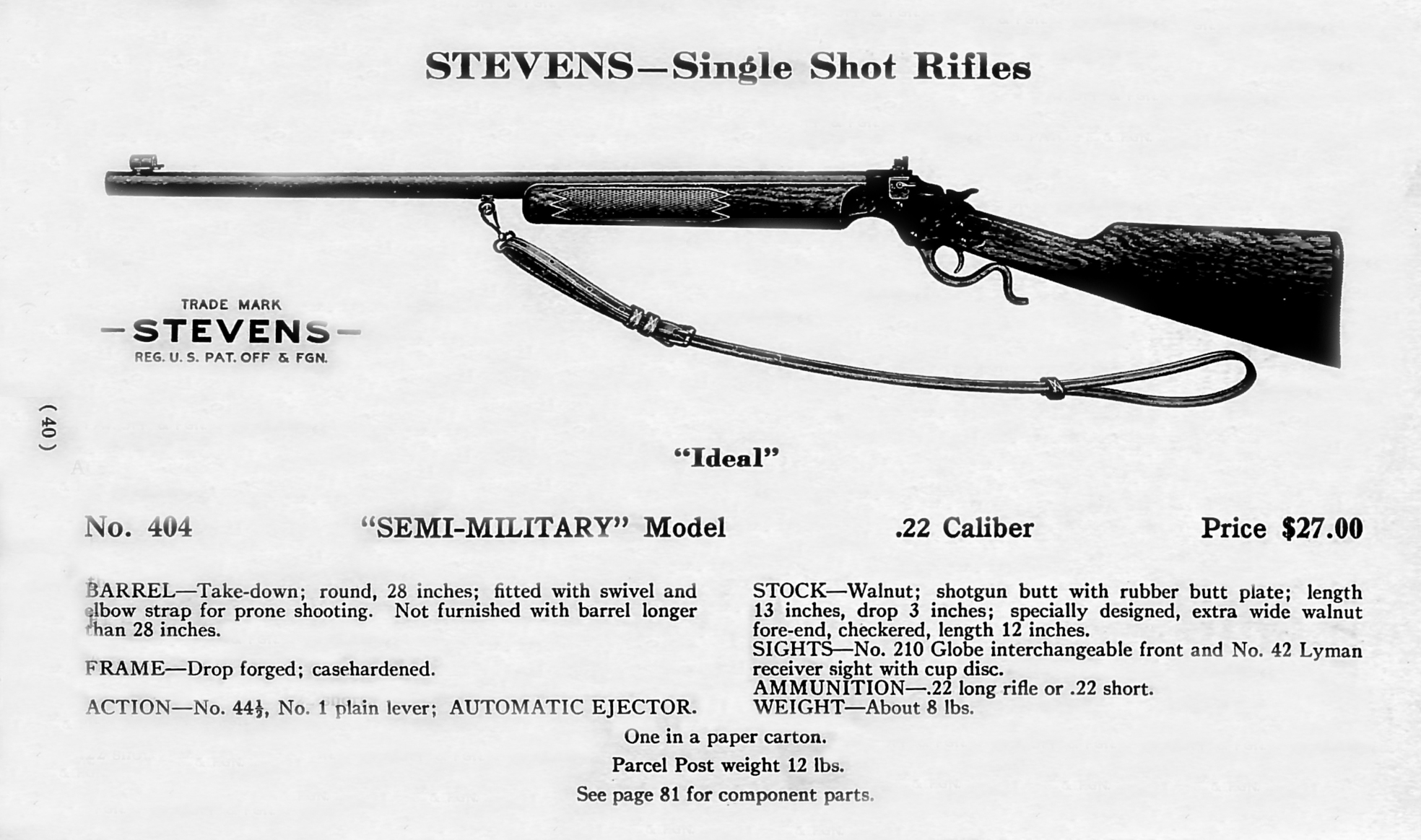
The components parts list for the Model 404 semi-military rifle
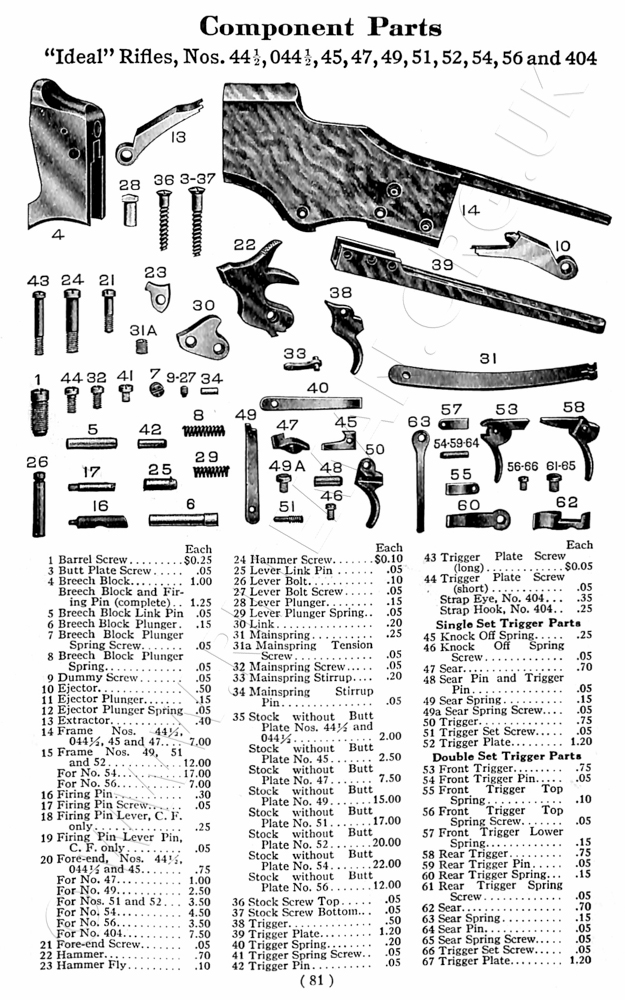
is the same as that for the Model 44½ shown after that section further down this page.
One of the rarest and most important Stevens rifle with a true British connection, was the Bisley Model.
This "de-luxe" rifle was built on the large-frame Martini action as originally utilised for the Martini-Henry rifle in .577/.450 calibre Many of these actions saw life in any number of configurations. In service rifles were converted to, Martini-Metford and Martini-Enfield rifles in .303-inch calibre, the arrival of the Long model of Lee rifle in the late 1890s, and the following Short Lee-Enfield rifle in 1903, saw large numbers of the obsolescent Martinis sold out of service. These were then sleeved to lesser calibres or even rebarrelled anew.

The significant outshooting of British Forces by South Africans in the two Boer Wars at the turn of the Nineteenth Century, with their Mauser-armed sharpshooters in clothing more suited to guerilla type warfare, led to Lord Roberts and other leaders initiating the Nationwide setting up of rifle clubs to encourage "everyman" to learn to shoot with the rifle. (See: the Society of Miniature Rifle Clubs). This was achieved rather less forcefully than had been the case with the Medieval method of requiring every male subject to be a capable archer.
Rifles for civilian use had always been relatively expensive, as was full-bore ammunition. Advantage was taken of the availability of huge numbers of obsolete Martini service rifles, and gunmakers such as WW. Greener and C.G. Bonehill converted thousands of them for small-bore target use; by dint intially of sleeving the full-bore barrels or, later in some cases, using newly manufactured solid .22 rimfire barrels.
Indeed, post the Great War (WWI 1914-18), right through to after the Second World War (1939-45), such rifles were still being converted for small-bore target use by the likes of the A.J. & A.G. Parker companies, with their CMT rifles for example; this even whilst various models of obsolescent Lee-Enfield rifles were already being similarly converted for military training and civilian target use.
All this was quite apart from the many newly made small-frame Martini rifles, in a plethora of miniature calibres, that were being manufactured and sold worldwide, often by the same companies, but particularly the Birmingham Small Arms Company, starting with their Martini Cadet rifles - the Model no.4.
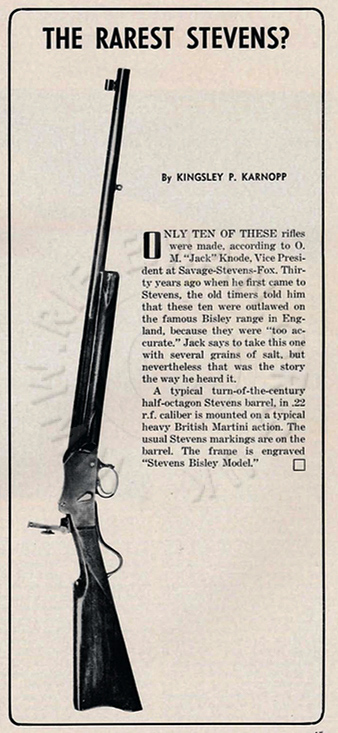
In February 1969, the American "Guns" magazine carried this diminutive quarter-page article, almost in the form of an advertising feature, written by Kingsley P. Karnoff.
He quite reasonably entitled the piece "The Rarest Stevens?"
The text read:
"Only ten of these rifles were made, according to O.M. "Jack" Knode,vice-president at Savage-Stevens-Fox. Thirty years ago (1939) when he first came to Stevens, the old timers told him that these ten rifles were outlawed on the famous Bisley range in England because they were "too accurate". Jack says to take this one with several grains of salt, but nevertheless that was the story the way he heard it.
A typical turn-of-the-century half-octagon Stevens barrel, in .22 r.f. caliber [U.S. spelling. Ed.] is mounted on a typical heavy British Martini action. The usual Stevens markings are on the barrel. The frame is engraved "Stevens Bisley Model"
The comment attributed to the Stevens' old-timers should certainly be treated with caution. Bisley rules have always been quite strict regarding the sights, configuration, dimensions and trigger weight of rifles used in particular classes, and it is more than possible that some aspect of the rifle, or even ammunition, as presented on the ranges, failed to meet the rules of the class in which it had been entered.
That any British shooting organisation would be prepared to ban a rifle for being "too accurate" is patently nonsense. Indeed, even nowadays, there would usually be a rush by competitors to purchase such a model.
The collection at the Stevens factory does hold one of these rifles, but they "cannot find" any information on the model's history.
Sadly, when a post WWII U.S. Government enquiry into suspected financial wrong-doing at the company was mooted, a fire started in a store area that destroyed all records and documentation - not just those of the Second World War - which selectivity would perhaps have increased suspicion of deliberacy; hence the lack of any production and serial number dating data whatsoever for researchers.
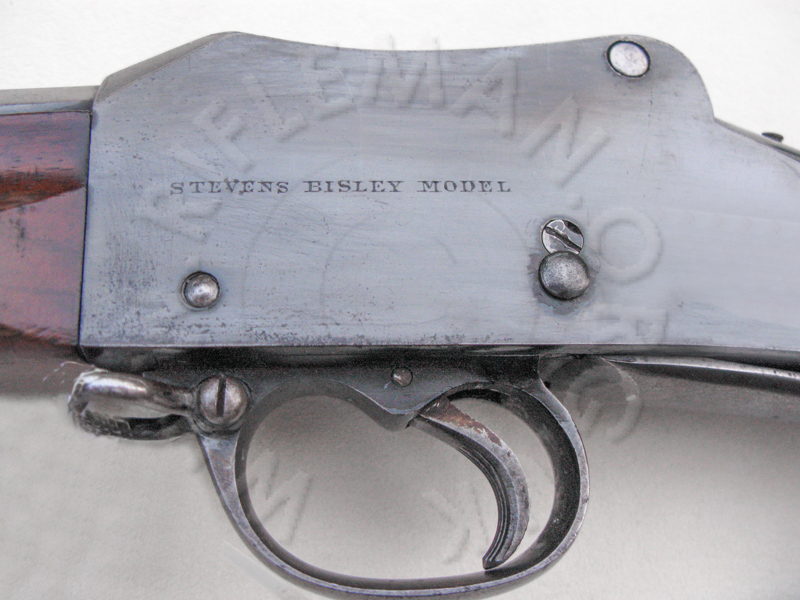
The rifle was described, in a 1910-11 J. Stevens Arms & Tool Company catalogue advertisement destined for British consumption, as "The Stevens Model #600 - The Modele DeLuxe miniature target rifle."
It is almost certain that there was British involvement in the rifle's production, and it is known that the company had been advised that there was a market here for a high quality full-frame Martini small-bore target rifle; and, of course, one that would meet then current competition rules.
Indeed, the text said that:
" This model, specially made for the the English market, has been brought out at the express wish of our many friends in the United Kingdom. It has the well-known Martini action, which is so easy to manipulate, especially when rapid firing. It is eligible for use in all competitions for Military Miniature Rifles".
Weight: with a 27" barrel was specified as 9½ lbs. The barrel being a half-octagon Stevens Match Quality product. The rifle was specifically chambered for the British "Kings Norton H.P.S." ammunition. [Highest Possible Score: Ed]. The action, probably U.K. sourced, was case-hardened with a special finish.
The stock and for-end were in "specially selected oiled walnut, well figured, neatly chequered, with horn cap to fore-end, with an engine-turned butt-plate".
The specification included a "B.S.A. aperture rear sight with adjustable eye cup, and micrometer Wind Gauge with vertical adjustment." The fore-sight was a combination ring and bead, with options of Bead and Barleycorn, or a simple knife-edge unit.
The quoted price in 1910 was five pounds and five shillings; or five guineas in contemporary parlance.
It should be mentioned that a number of these features are not evident on the example kindly loaned to us for illustration on this page, particularly in respect of the lack of chequering, and the heavily fluted fore-end.
But the rear-sight is certainly the windage and elevation adjustable Model No.8 manufactured and marketed by B.S.A., and the fore-sight is their No.19 tunnelled flip-over model. See: BSA Sights & accessories.

Below: the barrel markings familiar to all Stevens rifle pundits and owners.

James Grant, in his book "More Single-shot Rifles" ( pages 12 to 14), writes that all the old Stevens factory records were destroyed shortly after World War One when Congress threatened to investigate the company's alleged illegal profiteering on WWI contracts - so there is sadly never likely to be any confirmed detail of production dates and quantities.
The known serial numbers of extant rifles suggest that the originally reported figure of ten was considerably exceeded; but no more than the very low hundreds are likely to have been produced, and possibly as few as forty.
Interestingly, Grant writes that, when he later met Kingsley Karnoff - the author of the 1969 'Guns' magazine article - Karnoff told him that he was not even certain that the rifle discussed was an authentic example. Who knows what to think of it all?
The STEVENS "IDEAL" MODELS 44 and 44½
The Stevens Model No 44½ is occasionally found in the U.K. and was one of their extensive "Ideal" range of rifles. No more than 13,000 were manufactured between 1903 and 1916.
The claims in the last paragraph of the advertisement below, that the rifle "has never been equalled and cannot be beaten" are a touch immodest. The first claim may (questionably) have been true at the time, but the latter one was highly optimistic.

STEVENS MODELS 44 and 44½
Below: the 1918 catalogue pages for both the preceding Model no. 44 rifle, and the no. 044½ rifle.
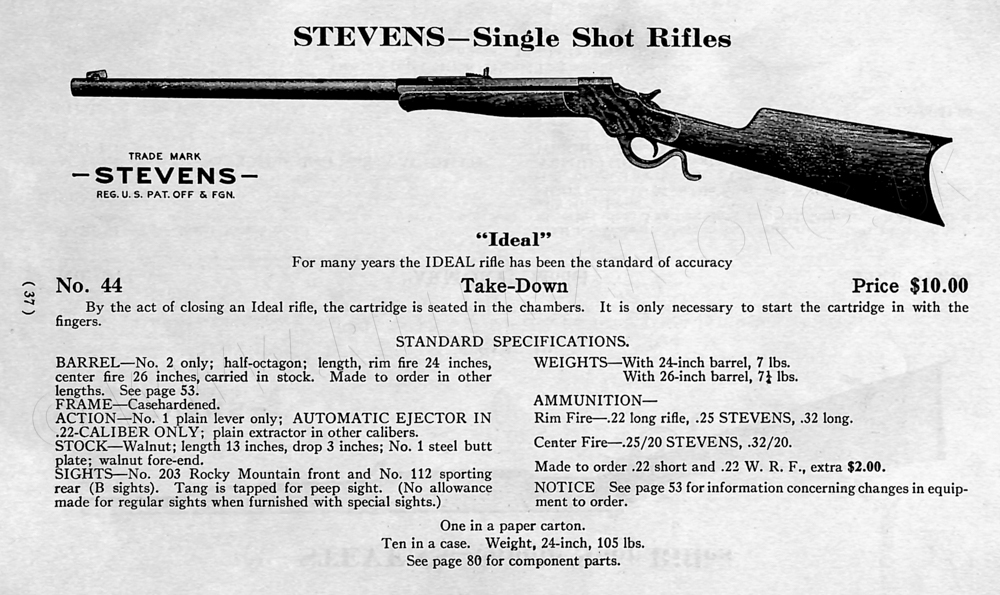
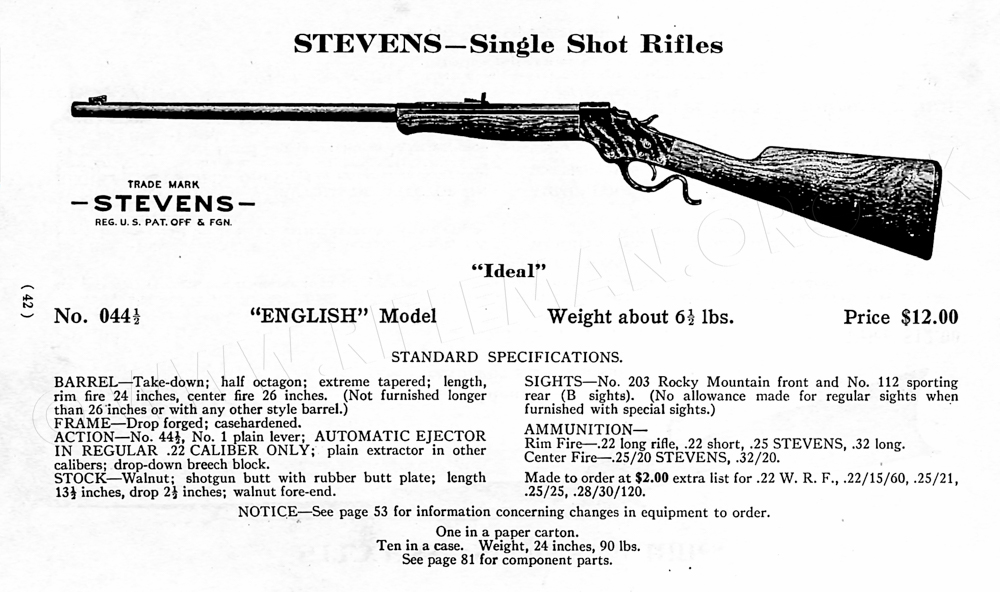
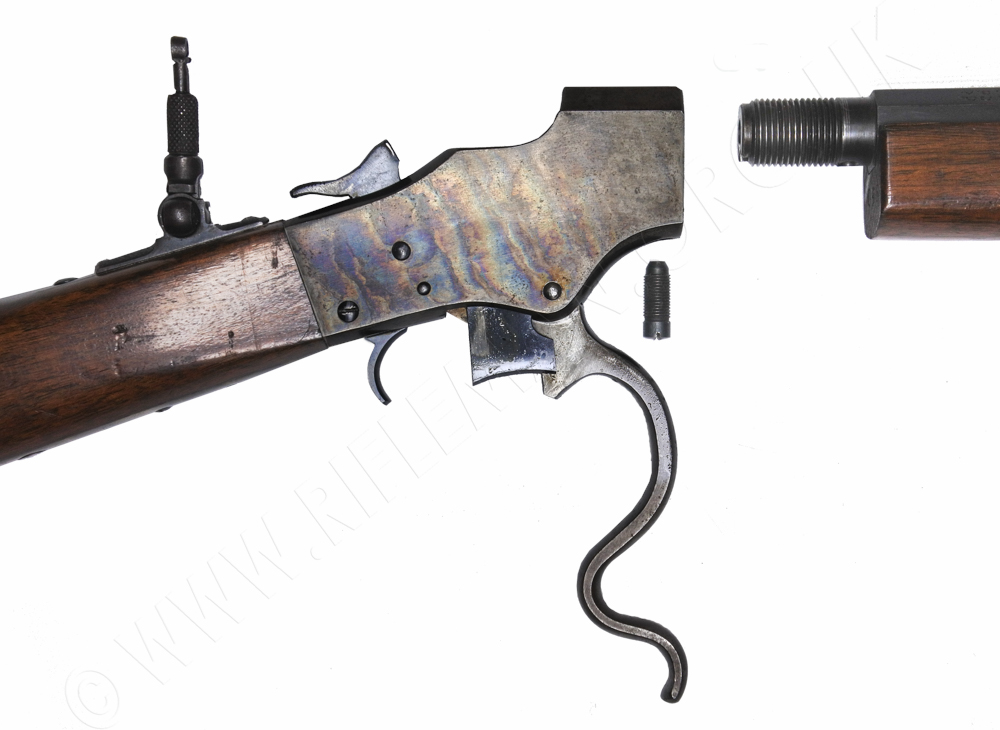
This fine rifle has been well cared for indeed, with the case-hardening of the drop-forged receiver body still almost at its best. The wood furniture is in excellent condition, and the bore is eminently shootable, with the chamber and leed showing practically no sign of wear or erosion. The folding Lyman No.1 tang-mounted rear-sight remains tight in its pivot and adjustment.
Hover over or Click image to bring up hi-res file and magnifier
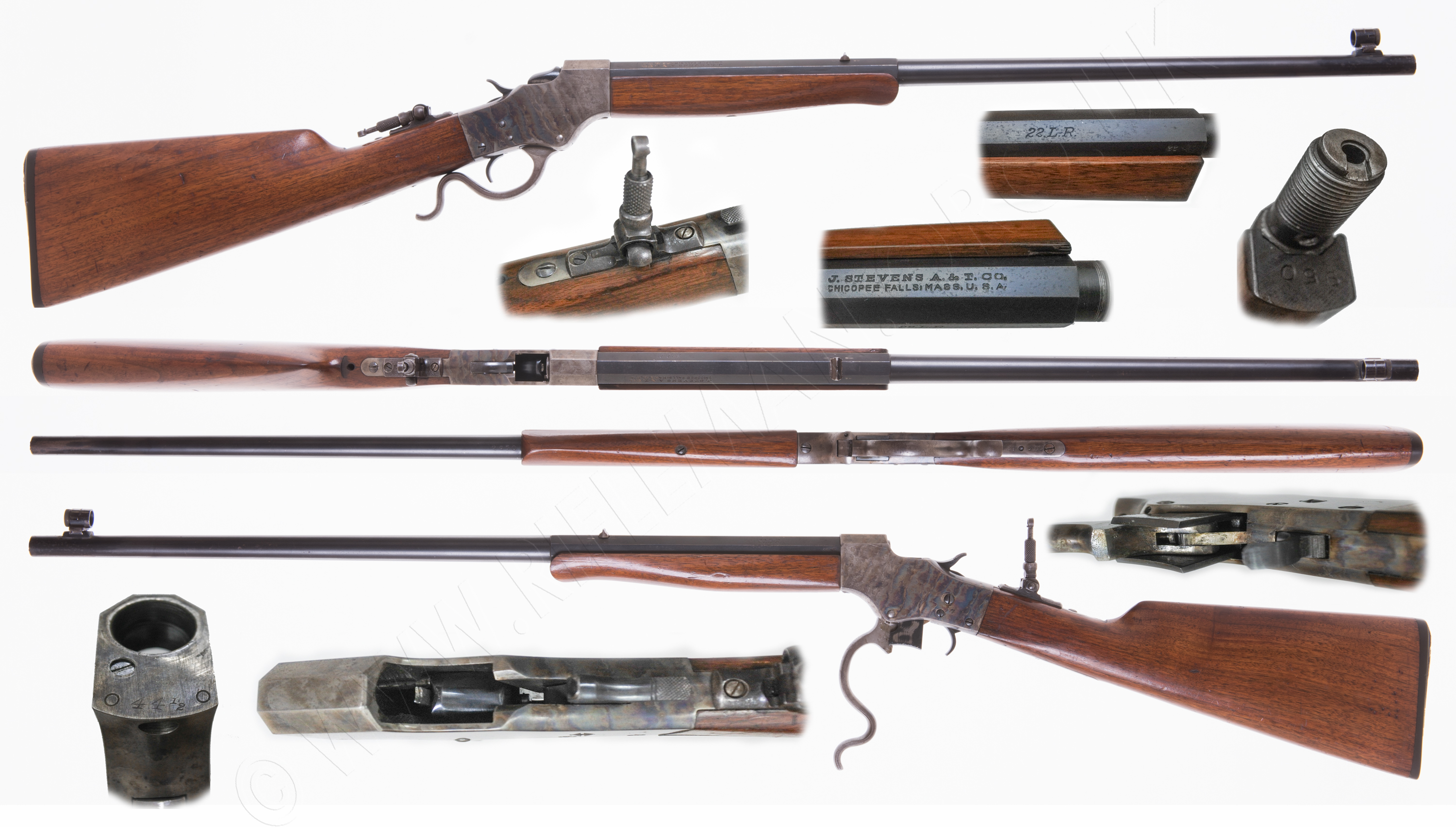
This rifle is a "take-down" model;
here shown separated with the locking screw
that screws into a detent in the base of the barrel reinforce.
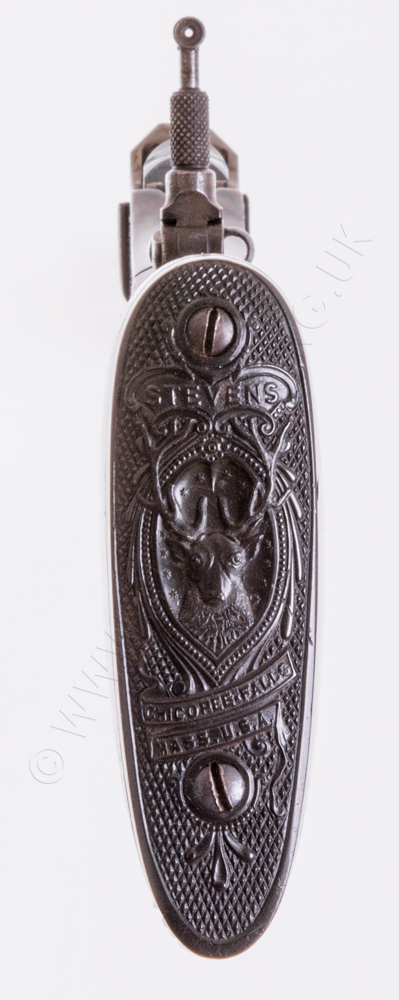
To the right is the fine and damage free Vulcanite butt-plate.
 ..........
Below: the 1918 parts lists for the 44, 414 and 44½ models.
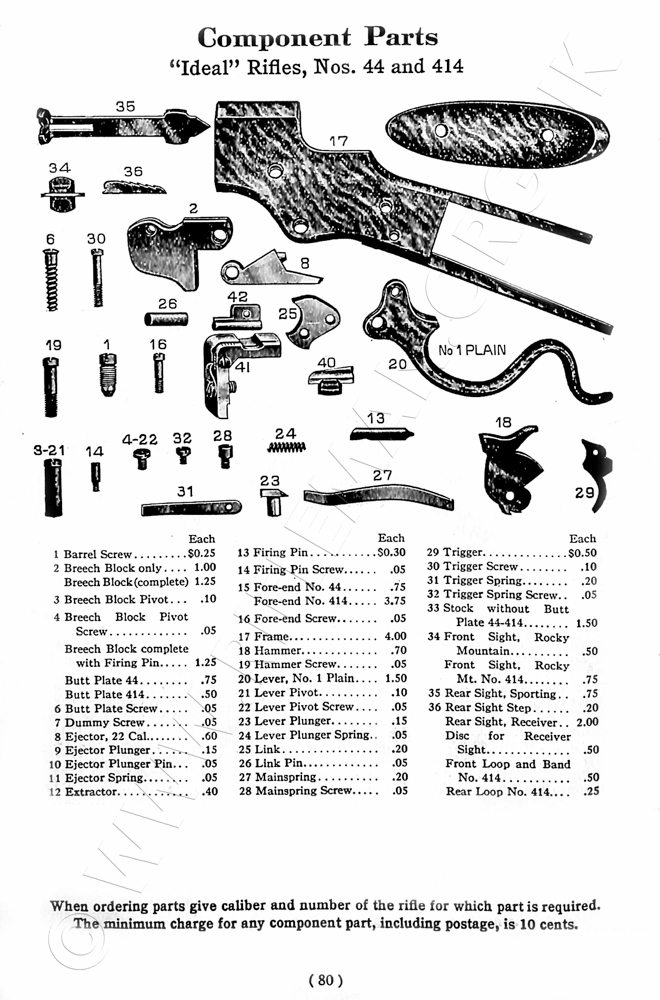
The Components List for the Model No.44½ and the No.404 Semi-military rifles.
________________
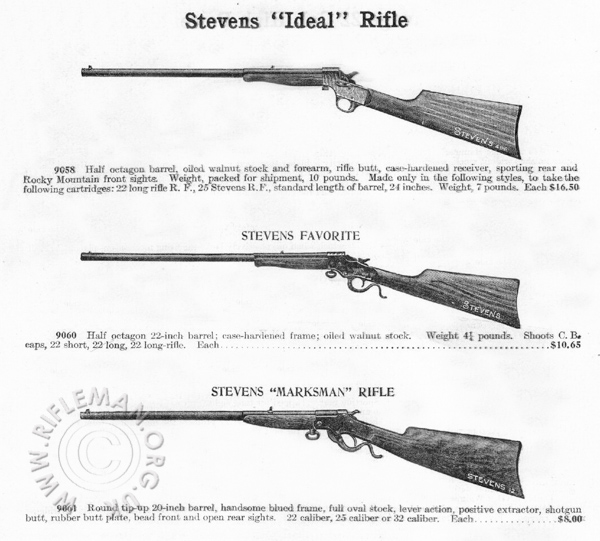
An earlier advertisement is dated 1913, and includes the ubiquitous "Ideal" model,
then at $16.50, then approximately the equivalent of about GBP 6.00,
the "Favourite" at $10.65,
and the "Marksman Rifle" at half the price of the Ideal, equating to as little as £3.00;
although importation costs to the U.K. would have made
all these rifles considerably more expensive.
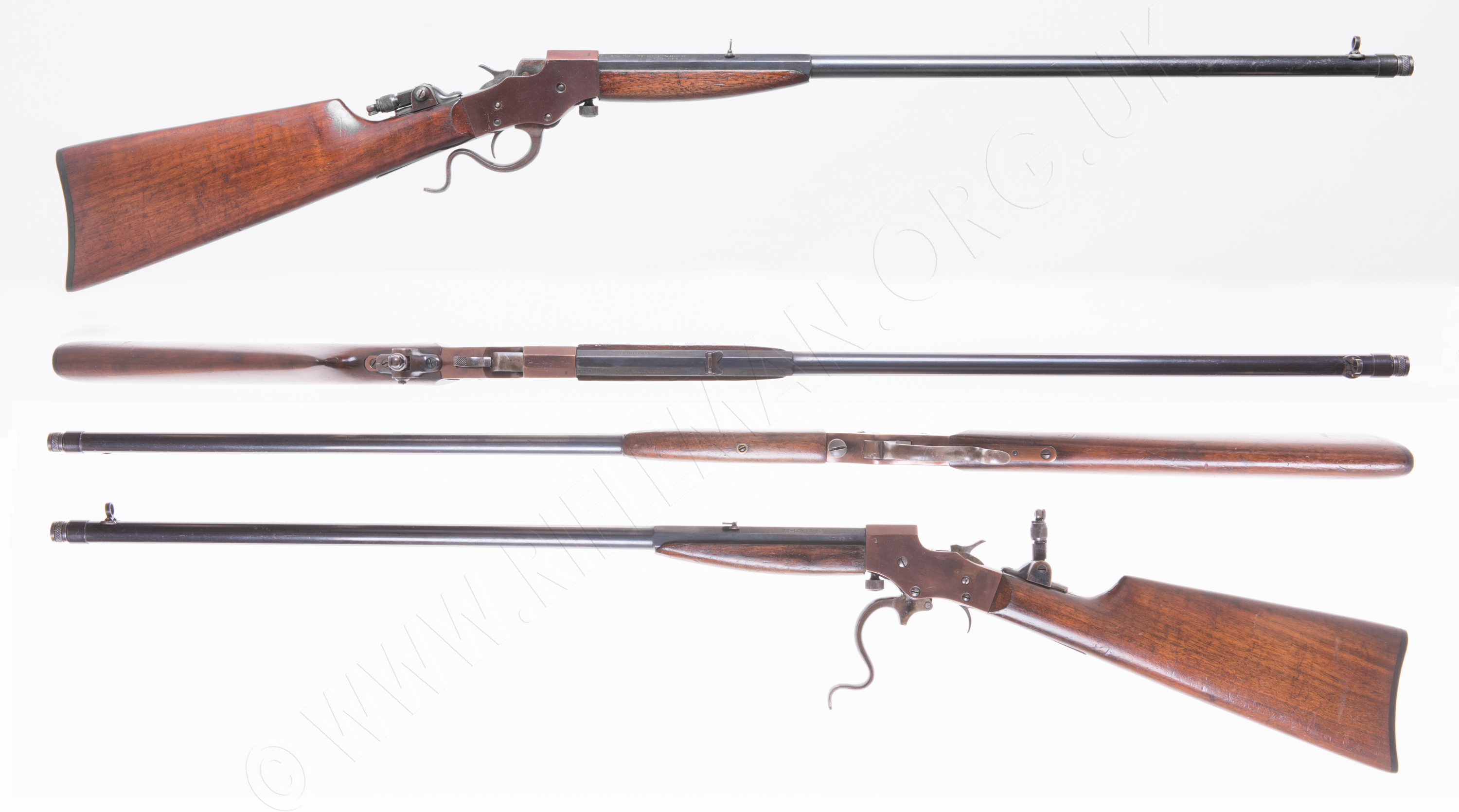
Next is the multi-facet image of a standard Favourite rifle in .22LR calibre.
Hover over or Click image to bring up hi-res file and magnifier
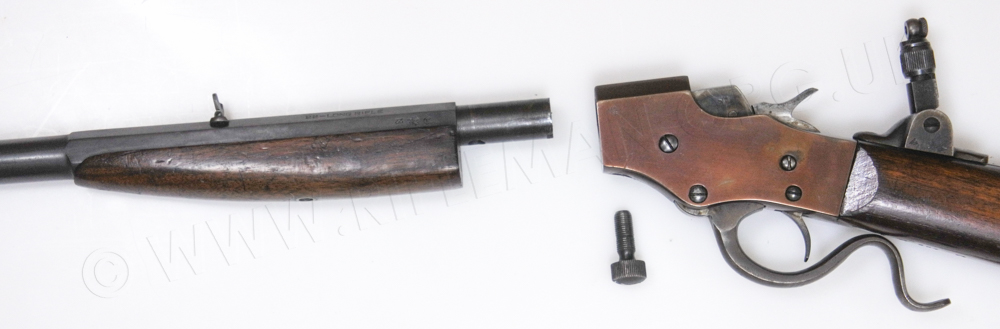
This rifle too is a take-down model, and is next shown seperated. Unlike the 44 models, which have barrels threaded into the receiver, the Favourites have a plain shank with a locating detent, and a much sturdier locking machine screw with a large knurled head.
The tang sight on this rifle is of British manufacture, by the well-known A.G. Parker Company of Birmingham.
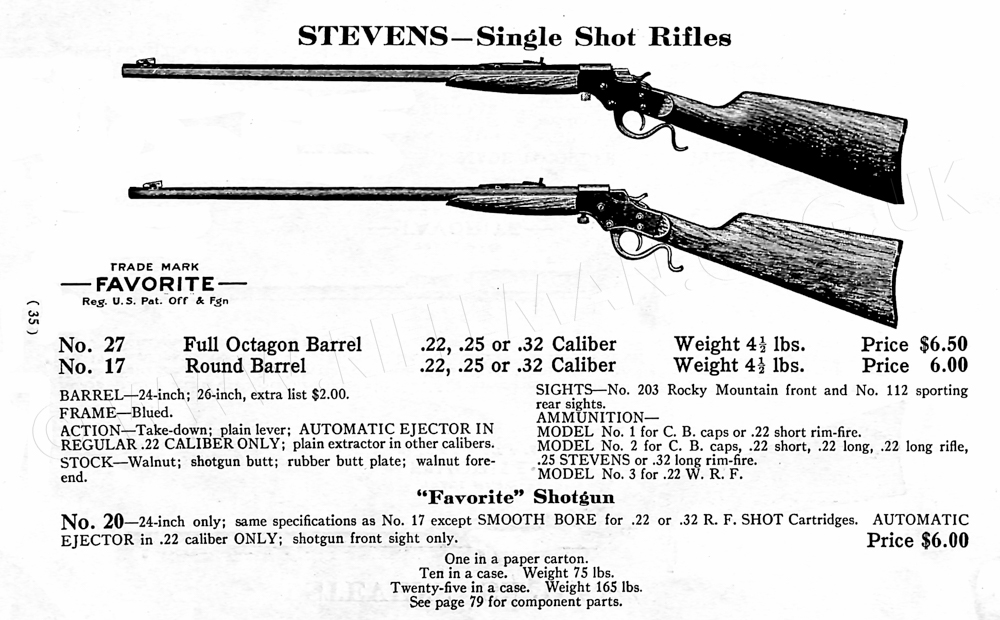
The 1918 Stevens catalogue carried two pages covering four Favourite models,
and showed the weights and dimensions, and the options available.
The model numbers were then 17, 18, 19, 20, 21, 27, 28 and 29.
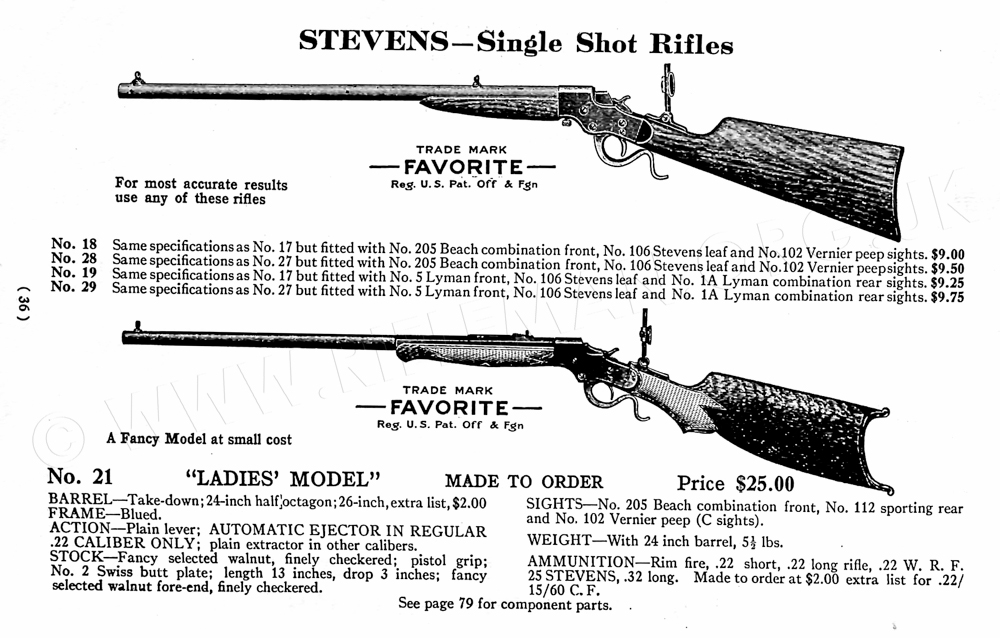
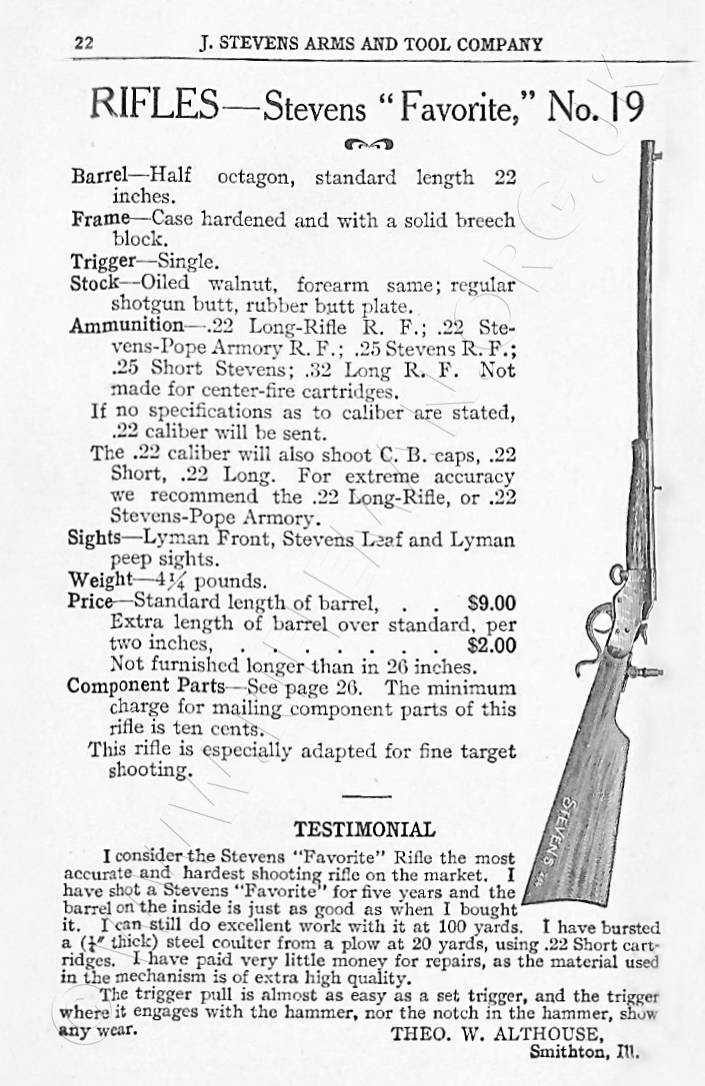
A later catalogue in the 1920s showed an uplift in prices approaching 50% - to $9.00 for the standard 22" barrel, and a further dollar per inch for the 24" barrel. The rifle was available in a number of rimfire calibres, but no centre-fire ones.
There was also a testimonial affording detail of the rifle's accuracy and longevity, with a brief mention of its armour piercing capability!
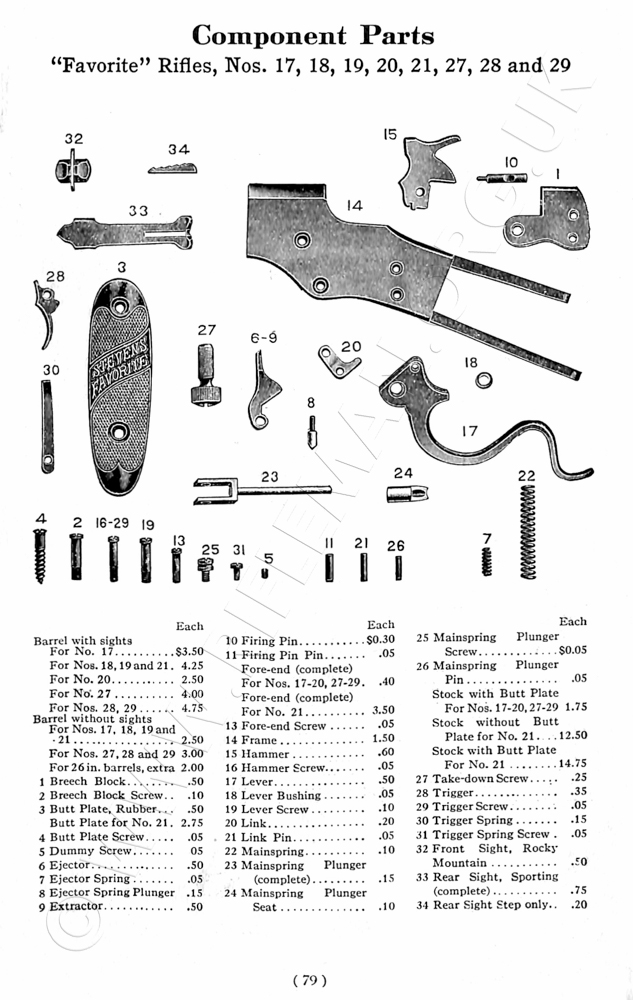
Below: the 1918 Parts List for the Favourite models.
The "Ideal" range models are also shown through pages 39-51 of the Stevens 1918 catalogue
The "Favorites" are there on the PDF page nos. 37 and 38.
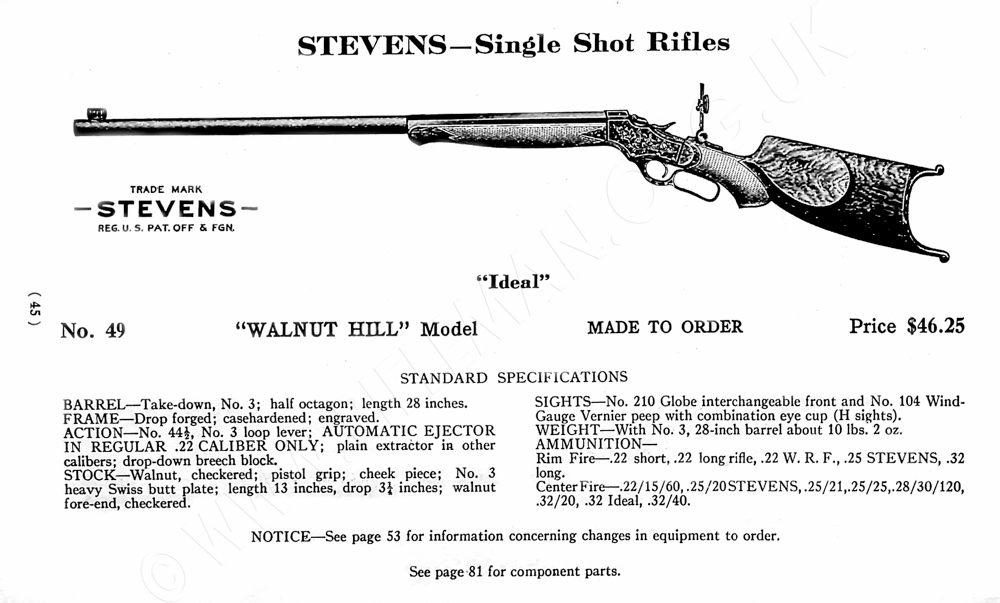
The page from the 1918 catalogue giving full details of the rifle
and the "Automatic Ejector" installed in the .22LR models.
The action is the same as that used for the 44½ rifle, but with the No.3 looped under-lever.
Here is one rifle from the U.S.A. that is rarely seen in Britain,
and which has been carefully looked after by an owner - or custodian - who must,
in his day, have been relatively wealthy.
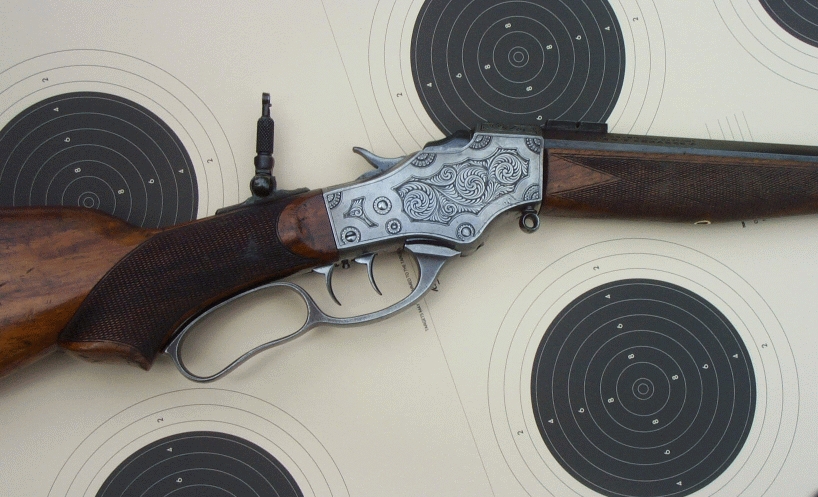
The Stevens fine "Walnut Hill" model.
Photo by the late John Hopes
The Model 49 Walnut Hill, so numbered in 1918, was built on the Model 44½ action.
These rifles were usually only built to order, and can therefore differ considerably in minor detail. The example in the photograph has fine ammonite-styled scroll engraving on the sides of the action, the loop under-lever handle, and the rarely seen double-set triggers of some schuetzen models. A sling-eye is fitted beneath the front of the action.
Most of these scheutzen rifles were produced in the period at the start of the 20th. Century when Harry Pope was with the company. A very few of these competition models were even sold with second barrels and fore-end wood. Some had the most elaborate multi-fingered under-levers to improve hold, along with the usual double-hooked deeply radiussed butt-plates.
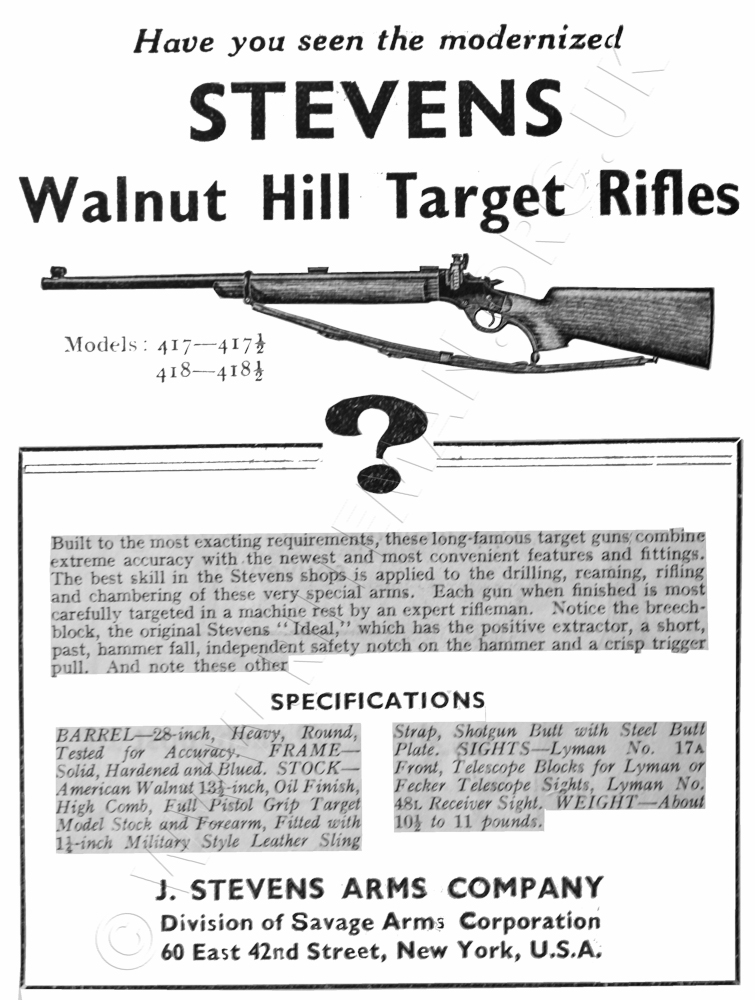
Below: another contemporary advertisement in a magazine.
Note the Model Nos. 417 and 418, with the optional added "halves",
presumably relating to the action used or other modifications such as take-downs.
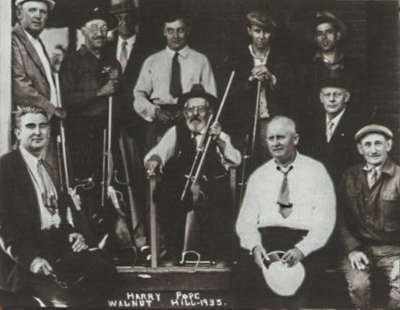
In 1935, the associated gunsmith and barrel maker Harry Pope was photographed at Walnut Hill.
He engineered his own very successful rifling systems.
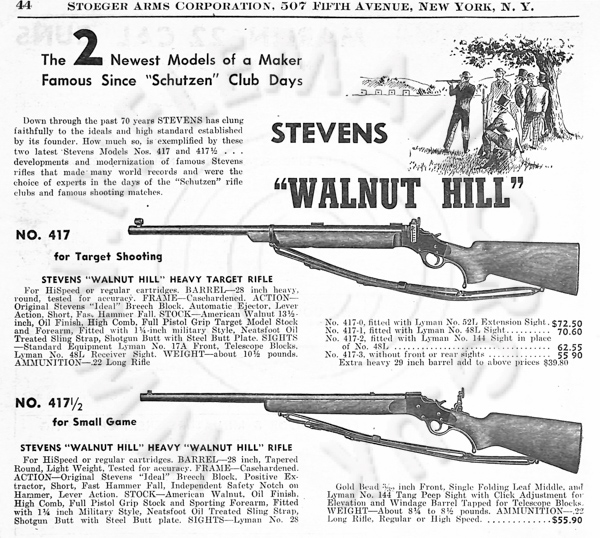
The Walnut Hill models are also shown on page 47 of the Stevens 1918 catalogue
A rare STEVENS "SHORT RIFLE"
This Stevens rifle conversion may well be unique.
Originally a Stevens Model 16 Crack-shot with the side-lever action
manufactured between 1900 and 1913.
....
It was adapted as a pistol by a member of the WWII Home Guard
Early in the Second World War, after the Dunkirk evacuation in 1940, Britain was being threatened with invasion from France and Belgium by Hitler's German forces. The populace was being asked to assist in home front defence, starting with the formation of the LVD - the Local Volunteer Defence Force.
Just short of thirty years later, the well know television series "Dad's Army" brought to our television screens the humorous side of the life and problems of that initially formed home defence force as it morphed into the Home Guard. With much British armament, particularly small-arms, left on the beaches of France during the Dunkirk evacuation, there were insufficient rifles and pistols for the regular forces, let alone for those civilians being asked to help hold back a potential invading army that would certainly include large numbers of paratroops.
The Home Guard units really did train with broomsticks for rifles, and pitchforks as weaponry. Necessity being the mother of invention, their members soon made up their own dummy rifles to add to the realism, while impatiently waiting to be armed with the real thing. In the meantime, every available sporting gun or target rifle was brought into service by the patrolmen. Such .22 calibre rimfire rifles as were often used by farmers for vermin control, or those in the hands of civilian target shooters, were regularly requisitioned for the purpose.
A typical adaptation, developed out of necessity, was the conversion of what may have been a tired or otherwise worn or damaged rifle. The Stevens Model 16 Crack-shot rifle below was then already at least twenty-seven years old; its repurposing being a reflection of the dire needs of those days. It is a significant reminder of the pressure under which Britain lay at that time.

Zooming in the above image shows the original markings
just remaining on the rather corroded barrel.Below: the action of an unadulterated rifle.
The later rolling-block Stevens Model 26 Crack-shot is shown below,
with its under-lever action, manufactured between 1912 and the start of WWII in 1939.
The associated CRACK-SHOT MODEL
This rifle had a straighter profile to the action body than the Model 16's markedly cranked design.
Both the 16 and 26 models were produced with round barrels of either 18 or 20 inches, with similar open sights.
The Crack-Shot is also shown on page 35 of the Stevens 1918 catalogue
The Home Guard units were eventually mainly issued with the First World War Pattern '14 Enfield Rifle No.3 that had been made in North America to supplement British rifle production that could not then keep up with demand. These rifles were brought out of long-term storage, refurbished and distributed as quickly as could possible.
A separate secret force was then brought into being within the Home Guard; the Auxiliary Units.
Intended as a "stay behind" group in the event that individual counties were overun by a German invasion, its members were specifically trained in subversion and guerilla tactics to harass the enemy. Observation points, bunkers and hides were built to accommodate them for only the few short weeks it was anticipated they would be able to survive. They were armed with explosives, grenades, a number of light machine guns, and moderated .22 rifles occasionally suggested to have been for the silent dispatch of German administrators and collaborators. This is further discussed on the page covering wartime imported small-bore rifles - accessible from the Winchester link below. It is, however, probably fair to say that, although moderated and 'scoped .22RF rifles were unlikely to have been issued specifically for sniping purposes, rather than for target practice and the possible necessity for the shooting of game for food in occupied countryside; had the invasion actually taken place it is not beyond reason that such weaponry could have been employed for alternative purposes.
A significant number of these small-bore weapons were used, including several U.S. models specially imported at the time, as well as those utilised in the Great War, are described on the page for Winchester Auto and Winder rifles.
Among the number of American weapons used by the Royal Flying Corps during the First World War, were the Winchester models 1903 and 1907 semi-auto rifles. A small number of U.S. military training rifles are also covered on site, as are a few relevant rifles of Savage production - the Models 19 and 1931 - the unusual employment of the Model 6A - and an obscure British link to the Model 1908; these along with detail of the full-bore 30.06 calibre U.S. version of the aforementioned Pattern '14 Enfield rifle, the Pattern '17 model.
One of the most significant weapons that was specifically designed for the clandestine despatch of enemy sentries, senior officers and guard dogs was the later produced De Lisle silenced Commando carbine, here mentioned because it was borne out of Godfrey De Lisle's personal silenced .22RF carbine that he had built for putting food on the table during the war.
Here is a model we have not yet spotted this side of the "pond",
but this 1885 advertisement for the "new" Model No.5 rifle is worthy of mention.
See also: the Winchester 1885 Browning design
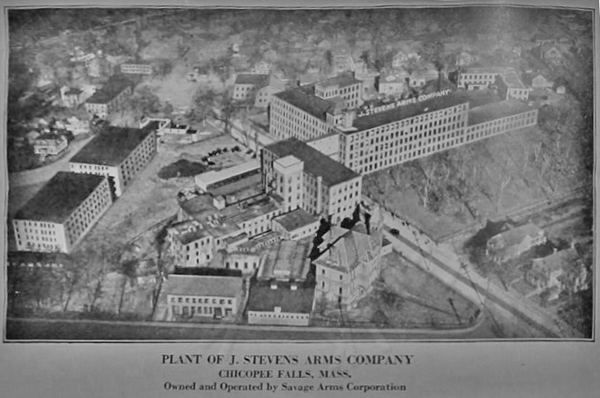
Below: The Stevens factory in 1927
at Chicopee Falls, Massachusetts, U.S.A.
Stevens rifles have enjoyed a long and valued reputation in Great Britain,
as is well illustrated by the image below.
It is taken from the January 1914 issue of the Journal of the National Rifle Association (G.B.)
Ernest Robinson was a highly successful shot, and co-author, with Lt. H. Ommundsen,
of the renowned reference tome "Rifles and Ammunition".
Robinson survived the then approaching Great War,
but Ommundsen was sadly killed in action early in the conflict.
He was earlier pictured with his Stevens rifle.